Brain cells created from patients' skin cells
February 7, 2012 in Neuroscience
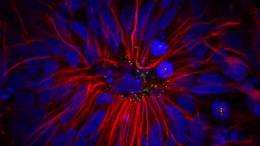
Neural stem cells. Credit: Yichen Shi (Livesey Lab) University of Cambridge
(Medical Xpress) -- Cambridge scientists have, for the first time, created cerebral cortex cells those that make up the brains grey matter from a small sample of human skin. The researchers findings, which were funded by Alzheimers Research UK and the Wellcome Trust, were published today in Nature Neuroscience.
Diseases of the cerebral cortex range from developmental conditions, such as epilepsy and autism, to neurodegenerative conditions such as Alzheimers. Todays findings will enable scientists to study how the human cerebral cortex develops, how it wires up and how that can go wrong (a common problem leading to learning disabilities).
It will also allow them to recreate brain diseases, such as Alzheimers, in the lab. This will give them previously impossible insight, allowing them to both watch the diseases develop in real time and also develop and test new drugs to stop the diseases progressing.
Dr. Rick Livesey of the Gurdon Institute and Department of Biochemistry at the University of Cambridge, principal investigator of the research, said: This approach gives us the ability to study human brain development and disease in ways that were unimaginable even five years ago.
For their research, the scientists took skin biopsies from patients and then reprogrammed the cells from the skin samples back into stem cells. These stem cells as well as human embryonic stem cells were then used to generate cerebral cortex cells.
Dr. Livesey added: We are using this system to recreate Alzheimers disease in the lab. Alzheimers disease is the commonest form of dementia in the world, and dementia currently affects over 800,000 people in the UK. Its a disease that primarily affects the type of nerve cell weve made in the lab, so weve the perfect tool to create a full, human model of the disease in the lab.
Dr. Simon Ridley, Head of Research at Alzheimers Research UK, the UKs leading dementia research charity, said: We are really pleased to have contributed funding for this work and the results are a positive step forward. Turning stem cells into networks of fully functional nerve cells in the lab holds great promise for unravelling complex brain diseases such as Alzheimers.
Dementia is the greatest medical challenge of our time we urgently need to understand more about the condition and how to stop it. We hope these findings can move us closer towards this goal.
Provided by
University of Cambridge
-
Scientists uncover free radical clue to dementia
Jul 22, 2011 |
not rated yet |
0
-
Structural brain changes in people at risk for Alzheimer’s disease
Nov 17, 2010 |
not rated yet |
0
-
Shedding light on Alzheimer's
May 25, 2011 |
not rated yet |
0
-
Scientists shed light on blood flow problems in dementia
Dec 06, 2010 |
not rated yet |
0
-
Understanding Alzheimer's: Scientists find new way to study disease
Nov 08, 2010 |
not rated yet |
0
-
Of mice and mental models: Neuroscientific implications of risk-optimized behavior in the mouse
May 25, 2012 |
not rated yet |
0
-
Limits to growth: Scientists identify key metastasis-enabling enzyme
May 22, 2012 |
5 / 5 (4) |
0
-
Seeing is as seeing does: Spatially-structured retinal input in early development of cortical maps
Apr 26, 2012 |
5 / 5 (4) |
1
-
Dreamless nights: Brain activity during nonrapid eye movement sleep
Apr 09, 2012 |
4.4 / 5 (12) |
0
-
Take your time: Neurobiology sheds light on the superiority of spaced vs. massed learning
Mar 28, 2012 |
4.5 / 5 (21) |
3
-
Potential Breakthrough in Seizure Control
18 hours ago
-
Popping/Cracked sternum.
23 hours ago
-
Which Mental Illness Encompasses This Problem?
23 hours ago
-
A question about drug tolerance
May 23, 2012
-
Poor nutrition leading to overeating?
May 23, 2012
-
Math and dyslexia?
May 21, 2012
- More from Physics Forums - Medical Sciences
More news stories
Of mice and mental models: Neuroscientific implications of risk-optimized behavior in the mouse
(Medical Xpress) -- Regardless of an organism’s biological complexity, every encephalized animal continuously makes under-informed behavioral choices that can have serious consequences. Despite its ubiquity, ...
Neuroscience
May 25, 2012 |
not rated yet |
0
|
Persistent sensory experience is good for aging brain
Despite a long-held scientific belief that much of the wiring of the brain is fixed by the time of adolescence, a new study shows that changes in sensory experience can cause massive rewiring of the brain, even as one ages. ...
Neuroscience
May 24, 2012 |
not rated yet |
0
Boundary stops molecule right where it needs to be
A molecule responsible for the proper formation of a key portion of the nervous system finds its way to the proper place not because it is actively recruited, but instead because it can't go anywhere else.
Neuroscience
May 24, 2012 |
not rated yet |
0
|
Locating ground zero: How the brain's emergency workers find the disaster area
Like emergency workers rushing to a disaster scene, cells called microglia speed to places where the brain has been injured, to contain the damage by 'eating up' any cellular debris and dead or dying neurons. ...
Neuroscience
May 24, 2012 |
5 / 5 (2) |
0
|
Genetic 'reset switch' enables signaling pathway to induce multiple developmental outcomes for olfactory neurons
Within the nervous system, a handful of signaling pathways modulate development of a cornucopia of different neuronal subtypes. Even small alterations in neuron differentiation pathways can disrupt subsequent ...
Neuroscience
May 24, 2012 |
not rated yet |
0
Keep food safety in mind this memorial day weekend
(HealthDay) -- Picnics, parades and cookouts are as much a part of Memorial Day weekend as tributes to the United States' war veterans.
Travel to high altitudes tied to Crohn's, colitis flare-ups
(HealthDay) -- People with inflammatory bowel disease, which includes Crohn's disease and colitis, may be at increased risk for flare-ups when they fly or travel to high altitudes for skiing or mountain climbing, ...
Family history of Alzheimer's affects functional connectivity
(HealthDay) -- Cognitively normal individuals with a family history of late-onset Alzheimer's disease (AD) may display lower resting state functional connectivity in the default mode network (DMN) of the brain, ...
Transvaginal mesh op restores pelvic organ prolapse at price
(HealthDay) -- Transvaginal mesh (TVM) procedures are effective for anatomical restoration of pelvic organ prolapse (POP), but patients report a worsening of sexual function following surgery, according to ...
Weight struggles? Blame new neurons in your hypothalamus
New nerve cells formed in a select part of the brain could hold considerable sway over how much you eat and consequently weigh, new animal research by Johns Hopkins scientists suggests in a study published in the May issue ...
Thioridazine kills cancer stem cells in human while avoiding toxic side-effects of conventional cancer treatments
A team of scientists at McMaster University has discovered a drug, thioridazine, successfully kills cancer stem cells in the human while avoiding the toxic side-effects of conventional cancer treatments.
Feb 07, 2012
Rank: not rated yet