Heart doctors repair coronary aneurysm without open surgery
February 16, 2012 By David Bricker in Surgery
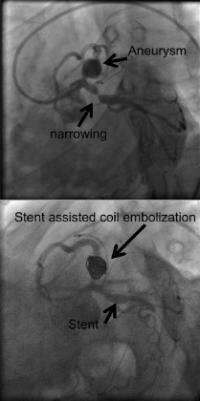
Top: Angiogram of a large aneurysm in the left anterior descending artery and narrowing in the circumflex artery. Bottom: Angiogram after successful stent assisted coil embolization of the left anterior descending artery and stent placement of the circumflex artery.
(Medical Xpress) -- Methodist DeBakey Heart & Vascular Center interventional cardiologists have, for the first time, repaired a large coronary artery aneurysm with stent-assisted coil embolization without doing open heart surgery. The successful procedure could mean a new option for patients, especially those who would be at risk undergoing an open chest operation. The work is published in the February issue of Circulation: Cardiovascular Interventions, an American Heart Association journal.
"Coronary aneurysms aren't rare," said interventional cardiologist, Htut Win, M.D., who performed the procedure in collaboration with Neal Kleiman, M.D. "They can cause limited blood flow or clots that can cause heart attacks. In rare cases, they can rupture. Traditionally, people with large coronary aneurysms have chosen to have them fixed with open surgery, which can mean one or two weeks of recovery. Our patient walked out of the hospital the next day."
In a follow-up visit about a month later, the now-38-year-old patient, a police sergeant, ran on a treadmill, unassisted and without trouble, for 12 minutes.
Coronary aneurysms are believed to occur in one to two percent of American adults. They are traditionally repaired during open surgery, which is a complex and risky operation, especially if they are situated right at the beginning of the coronary artery, Win said. Normally, surgeons open the chest and work their way to the aneurysm, sometimes having to split the lung-destined pulmonary artery or lift it up to get access, at which point the coronary artery can be repaired and bypassed.
Stent-assisted coil embolization has been used to repair aneurysms inside the brain to prevent rupture. But this is the first time this technique has been used to repair a large coronary artery -- a crucial blood vessel that keeps the heart alive -- using percutaneous means.
"The patient would have been out two to four weeks, at least," Win said. "Because of his job -- he's a Houston police officer -- we wanted to get him back on his feet as soon as possible."
Win and Kleiman, in collaboration with cardiac imaging specialists Su Min Chang, M.D., and Venkateshwar Polsani, M.D., designed the procedure specifically for the patient using 3-D CT coronary angiograms. Using the images to see beforehand where blood vessels and other structures stop and start, Win and Kleiman were able to decide how best to get to access the aneurysm. Win and his group placed a stent across the aneurysm and a microcatheter (small tube) was trapped inside the aneurysm. Then a platinum coil was delivered thru the catheter wrapping around the stent inside the aneurysm to help blood to clot, sealing off the extra space and forcing blood to flow only through the stent.
"Our hospital has this incredible diversity of diagnostic and interventional expertise, and our experts routinely work in teams to come up with new ways to help our patients," Win said. "Methodist has a strong history in heart imaging. Without the help of Dr. Chang and his team, without the eyes that allowed us to see the procedure before we actually getting in, we could not have done this with such ease and, more importantly, safety. There were no surprises."
The type of aneurysm Win repaired is called "fusiform," which means the bulging of the blood vessel is symmetrical down the line of the blood vessel, a bit like the end of a bagpipe horn. Win said repair of fusiform aneurysms is much more complex than for "saccular" aneurysms, in which the blood vessel bulges out asymmetrically to one side.
Provided by Methodist Hospital System
-
The Medical Minute: Pipes in the brain as treatment for aneurysms
Dec 09, 2011 |
not rated yet |
0
-
New treatment option for ruptured brain aneurysms
Aug 25, 2009 |
not rated yet |
0
-
Treating complex brain aneurysms without open surgery
Jan 19, 2011 |
not rated yet |
0
-
Adding a stent during minimally invasive surgery to repair aneurysms prevents recurrence
Jul 26, 2011 |
not rated yet |
0
-
New device offers revolutionary treatment for difficult-to-Treat brain aneurysms
Jun 08, 2011 |
not rated yet |
0
-
Of mice and mental models: Neuroscientific implications of risk-optimized behavior in the mouse
May 25, 2012 |
not rated yet |
0
-
Limits to growth: Scientists identify key metastasis-enabling enzyme
May 22, 2012 |
5 / 5 (4) |
0
-
Seeing is as seeing does: Spatially-structured retinal input in early development of cortical maps
Apr 26, 2012 |
5 / 5 (4) |
1
-
Dreamless nights: Brain activity during nonrapid eye movement sleep
Apr 09, 2012 |
4.4 / 5 (12) |
0
-
Take your time: Neurobiology sheds light on the superiority of spaced vs. massed learning
Mar 28, 2012 |
4.5 / 5 (21) |
3
-
magnetic field from stream of protons
4 hours ago
-
Force on a particle constrained to move on the surface of a sphere
5 hours ago
-
Force in a magnetic coupling
15 hours ago
-
Sign of scalar product in electric potential integral?
22 hours ago
-
Heat engines: how can we yield work?
22 hours ago
-
Work done by us on the spring
May 25, 2012
- More from Physics Forums - Classical Physics
More news stories
Simple motions, complex tool New robot successfully performs surgical closure in a beating heart
A new robotic device may be the solution to a longstanding surgical dilemma: how to precisely manipulate tools within the delicate tissues of a beating heart, report researchers at Boston Children’s Hospital. The team’s ...
Surgery
May 23, 2012 |
not rated yet |
0
A quick fix is possible for sacroiliac joint pain in many children and adolescents
Investigators report that a simple bedside manual therapy to correct a painful misaligned sacroiliac joint was highly successful in a group of 45 patients 10 to 20 years of age. Thirty-six patients (80 percent) obtained significant ...
Surgery
May 22, 2012 |
not rated yet |
0
Research examines effect of prednisolone in patients with Bell palsy
Treatment for Bell palsy (a condition involving the facial nerve and characterized by facial paralysis) with the corticosteroid prednisolone within 72 hours appeared to significantly reduce the number of patients with mild ...
Surgery
May 21, 2012 |
not rated yet |
0
Study finds surgical residents often fatigued
A study involving 27 orthopedic surgery residents suggests that surgical residents are often fatigued during their awake time, according to a report in the May issue of Archives of Surgery.
Surgery
May 21, 2012 |
not rated yet |
0
Moveable magnets used to forge gastric bypass in pigs
(HealthDay) -- In a scenario reminiscent of the film Fantastic Voyage, researchers have found a way to perform nearly surgery-free gastric bypass procedures in pigs using only a local anesthetic.
Surgery
May 21, 2012 |
not rated yet |
0
|
Keep food safety in mind this memorial day weekend
(HealthDay) -- Picnics, parades and cookouts are as much a part of Memorial Day weekend as tributes to the United States' war veterans.
Travel to high altitudes tied to Crohn's, colitis flare-ups
(HealthDay) -- People with inflammatory bowel disease, which includes Crohn's disease and colitis, may be at increased risk for flare-ups when they fly or travel to high altitudes for skiing or mountain climbing, ...
Family history of Alzheimer's affects functional connectivity
(HealthDay) -- Cognitively normal individuals with a family history of late-onset Alzheimer's disease (AD) may display lower resting state functional connectivity in the default mode network (DMN) of the brain, ...
Transvaginal mesh op restores pelvic organ prolapse at price
(HealthDay) -- Transvaginal mesh (TVM) procedures are effective for anatomical restoration of pelvic organ prolapse (POP), but patients report a worsening of sexual function following surgery, according to ...
Of mice and mental models: Neuroscientific implications of risk-optimized behavior in the mouse
(Medical Xpress) -- Regardless of an organism’s biological complexity, every encephalized animal continuously makes under-informed behavioral choices that can have serious consequences. Despite its ubiquity, ...
Weight struggles? Blame new neurons in your hypothalamus
New nerve cells formed in a select part of the brain could hold considerable sway over how much you eat and consequently weigh, new animal research by Johns Hopkins scientists suggests in a study published in the May issue ...