Heart hormone helps shape fat metabolism
February 6, 2012 in Medical research
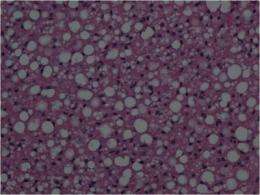
Calorie-burning brown fat (shown here) gets a boost from natriuretic peptides produced by the heart. Credit: Collins lab, Sanford-Burnham Medical Research Institute
It's well known that exercising reduces body weight because it draws on fat stores that muscle can burn as fuel. But a new study at Sanford-Burnham Medical Research Institute (Sanford-Burnham) suggests that the heart also plays a role in breaking down fat. In their study, published February 6 in the Journal of Clinical Investigation, Sheila Collins, Ph.D. and colleagues detail how hormones released by the heart stimulate fat cell metabolism. These hormones turn on a molecular mechanism similar to what's activated when the body is exposed to cold and burns fat to generate heat. This study adds another dimension to our understanding of how the body regulates fat tissue and may someday lead to new ways to manipulate the process with drugs to reduce weight in obese patients or maintain it in individuals who experience pathological weight loss during chronic heart failure.
"Exercise is always going to raise your blood pressure some, so there's the potential that these heart hormonescalled cardiac natriuretic peptidesare being released and contributing to the breakdown of fats," said Collins, professor in the Diabetes and Obesity Research Center at Sanford-Burnham's Lake Nona campus in Orlando and senior author of the study. "Over a period of time, natriuretic peptides could also be leading to an increase in the numbers of brown fat cells, which we know are very important for protection against diet-induced obesity, at least in laboratory experiments."
Brown fat cells, unlike white fat cells typically associated with body fat, not only store fat but also readily convert calories into energya process that malfunctions in obesity.
In their study, Collins and her team found that the metabolic effects caused by natriuretic peptides depend largely on the ratio of two different kinds of receptorsmessage-receiving proteinson the surface of fat cells. One, called NPRA, is a "signaling" receptor and its presence helps boost brown fat cells and burn white fat. The other, called NPRC, is a "clearance" receptor and seems to prevent natriuretic peptides from activating NPRA, resulting in a greater accumulation of white fat cells.
When exposed to cold in this study, mice had elevated amounts of natriuretic peptides in their circulatory system. They also showed increased levels of the NPRA signaling receptor, relative to the NPRC clearance receptor, on fat cells. As a result, fatty acids were mobilized and the calorie-burning brown fat machinery was turned on in these mice. Exactly what alters the levels of the different types of receptors is still unknown.
"In the next phases of our work, we hope to not only more tightly link the physiology and genetics, but also understand how these receptors are regulated," Collins said.
A progressive understanding of what regulates NPRA and NPRC receptors, and therefore how natriuretic peptides control white fat cell mass, could lead to new therapeutic targets to manage obesity and metabolic disease. For example, blocking the NRPC clearance receptor, or creating agents that favor binding NPRA, could help obese patients lose weight.
More information about how this system works could also give hope to patients suffering from cardiac cachexia, a severe body wasting that can occur in chronic heart failure. High levels of natriuretic peptides are characteristic of heart failure and are used as diagnostic markers of the severity of the disease. One hypothesis is that the high levels of circulating natriuretic peptides seen in cardiac cachexia patients may be leading to abnormally high levels of brown fat production, energy expenditure, and therefore weight loss. In these patients, suppressing the production of the peptides might slow or halt this process. The Collins lab is now gearing up to test this hypothesis in the lab.
More information: Cardiac natriuretic peptides act via p38 MAPK to induce the brown fat thermogenic program in mouse and human adipocytes, View this article at: http://www.jci.org … f1ce5a9bf63d
Journal reference:
Journal of Clinical Investigation
Provided by Sanford-Burnham Medical Research Institute
-
Orexin: A hormone that fights fat with fat
Oct 04, 2011 |
not rated yet |
0
-
Calorie-burning brown fat is a potential obesity treatment, researchers say
Jun 06, 2011 |
not rated yet |
0
-
Study identifies cells that give rise to brown fat
Dec 20, 2010 |
not rated yet |
0
-
Brown fat burns calories in adult humans
Jan 24, 2012 |
not rated yet |
0
-
Molecular switch found in mice could lead to future obesity treatments
Aug 20, 2008 |
not rated yet |
0
-
Of mice and mental models: Neuroscientific implications of risk-optimized behavior in the mouse
May 25, 2012 |
not rated yet |
0
-
Limits to growth: Scientists identify key metastasis-enabling enzyme
May 22, 2012 |
5 / 5 (4) |
0
-
Seeing is as seeing does: Spatially-structured retinal input in early development of cortical maps
Apr 26, 2012 |
5 / 5 (4) |
1
-
Dreamless nights: Brain activity during nonrapid eye movement sleep
Apr 09, 2012 |
4.4 / 5 (12) |
0
-
Take your time: Neurobiology sheds light on the superiority of spaced vs. massed learning
Mar 28, 2012 |
4.5 / 5 (21) |
3
-
Potential Breakthrough in Seizure Control
19 hours ago
-
Popping/Cracked sternum.
23 hours ago
-
Which Mental Illness Encompasses This Problem?
May 25, 2012
-
A question about drug tolerance
May 23, 2012
-
Poor nutrition leading to overeating?
May 23, 2012
-
Math and dyslexia?
May 21, 2012
- More from Physics Forums - Medical Sciences
More news stories
Implantable pain disk may help those with cancer
An estimated 3.5 million cancer patients around the globe are in severe pain from their disease, but many get no relief.
Medical research
May 25, 2012 |
5 / 5 (1) |
0
|
Energy levels link sleep control mechanisms
Sleep, or lack of it, can determine level of cognitive performance which is linked with accidents as well as increased risk of serious health problems. Links between cell energy levels, gene transcription ...
Medical research
May 25, 2012 |
not rated yet |
0
Researchers identify key brain cell in antidepressant action
(Medical Xpress) -- Antidepressant medications such as Prozac have helped improve mood and lessen anxiety in millions of people with major depression. But scientists know surprisingly little about how these drugs work.
Medical research
May 25, 2012 |
4.7 / 5 (3) |
0
|
Rockefeller scientists pioneer new method to determine mechanisms of drug action
(Medical Xpress) -- Knowing that a drug works is great. Knowing how it works is a luxury. And until now, determining a drugs mechanism of action has been a tedious and difficult process for scientists.
Medical research
May 25, 2012 |
not rated yet |
0
|
Like curry? New biological role identified for compound used in ancient medicine
Scientists have just identified a new reason why some curry dishes, made with spices humans have used for thousands of years, might be good for you.
Medical research
May 25, 2012 |
4.5 / 5 (12) |
2
|
Keep food safety in mind this memorial day weekend
(HealthDay) -- Picnics, parades and cookouts are as much a part of Memorial Day weekend as tributes to the United States' war veterans.
Travel to high altitudes tied to Crohn's, colitis flare-ups
(HealthDay) -- People with inflammatory bowel disease, which includes Crohn's disease and colitis, may be at increased risk for flare-ups when they fly or travel to high altitudes for skiing or mountain climbing, ...
Family history of Alzheimer's affects functional connectivity
(HealthDay) -- Cognitively normal individuals with a family history of late-onset Alzheimer's disease (AD) may display lower resting state functional connectivity in the default mode network (DMN) of the brain, ...
Transvaginal mesh op restores pelvic organ prolapse at price
(HealthDay) -- Transvaginal mesh (TVM) procedures are effective for anatomical restoration of pelvic organ prolapse (POP), but patients report a worsening of sexual function following surgery, according to ...
Of mice and mental models: Neuroscientific implications of risk-optimized behavior in the mouse
(Medical Xpress) -- Regardless of an organism’s biological complexity, every encephalized animal continuously makes under-informed behavioral choices that can have serious consequences. Despite its ubiquity, ...
Weight struggles? Blame new neurons in your hypothalamus
New nerve cells formed in a select part of the brain could hold considerable sway over how much you eat and consequently weigh, new animal research by Johns Hopkins scientists suggests in a study published in the May issue ...