Obesity is associated with altered brain function
February 9, 2012 in Medical research

Obesity is associated with altered brain function

Enlarge

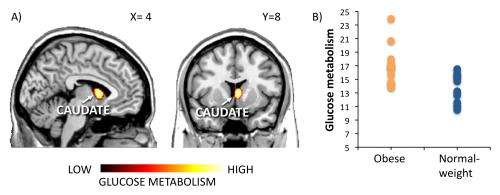
Glucose metabolism of the caudate nucleus in the midbrain (A) was significantly higher in obese versus lean individuals (B).

In most western countries the annual increase in the prevalence and the severity of obesity is currently substantial. Although obesity typically results simply from excessive energy intake, it is currently unclear why some people are prone to overeating and gaining weight.

Because the central nervous system is intimately involved in processing of hunger signals and controlling food intake, it is possible that the cause of weight gain and obesity might be in the brain.

Researchers at the University of Turku and Aalto University have now found new evidence for the role of the brain in obesity. The researchers measured the functioning involved in with multiple brain imaging methods.

The results revealed that in obese versus lean individuals, brain glucose metabolism was significantly higher in the brain's striatal regions, which are involved in processing of rewards. Moreover, obese individual's reward system responded more vigorously to food pictures, whereas responses in the frontal cortical regions involved in cognitive control were dampened.

"The results suggest that obese individuals' brains might constantly generate signals that promote eating even when the body would not require additional energy uptake," says Adjunct Professor Lauri Nummenmaa from the University of Turku.

"The results highlight the role of the brain in obesity and weight gaining. The results have major implications on the current models of obesity, but also on development of pharmacological and psychological treatments of obesity," Nummenmaa says.

The participants were morbidly obese individuals and lean, healthy controls. Their brain was measured with positron during conditions in which the body was satiated in terms of insulin signalling. to pictures of foods were measured with .

The research is funded by the Academy of Finland, Turku University Hospital, University of Turku, Åbo Akademi University and Aalto University.

The results were published on January 27th, 2012 in scientific journal PLoS ONE.

Provided by Academy of Finland

5 /5 (4 votes)  

Rank 5 /5 (4 votes)
Relevant PhysicsForums posts

More news stories

H. pylori, smoking trends, and gastric cancer in US men

Trends in Helicobacter pylori (H. pylori) and smoking explain a significant proportion of the decline of intestinal-type noncardia gastric adenocarcinoma (NCGA) incidence in US men between 1978 and 2008, and are estimated ...

Medical research created 11 hours ago | popularity not rated yet | comments 0

Common food supplement fights degenerative brain disorders

Widely available in pharmacies and health stores, phosphatidylserine is a natural food supplement produced from beef, oysters, and soy. Proven to improve cognition and slow memory loss, it's a popular treatment for older ...

Medical research created 15 hours ago | popularity 5 / 5 (3) | comments 0 | with audio podcast

Finding a family for a pair of orphan receptors in the brain

Researchers at Emory University have identified a protein that stimulates a pair of "orphan receptors" found in the brain, solving a long-standing biological puzzle and possibly leading to future treatments for neurological ...

Medical research created 16 hours ago | popularity 5 / 5 (1) | comments 0 | with audio podcast

Insight into the dazzling impact of insulin in cells

Australian scientists have charted the path of insulin action in cells in precise detail like never before. This provides a comprehensive blueprint for understanding what goes wrong in diabetes.

Medical research created 16 hours ago | popularity 4.6 / 5 (7) | comments 0 | with audio podcast

Do men's and women's hearts burn fuel differently?

Researchers at the University of Illinois at Chicago College of Medicine will study gender differences in how the heart uses and stores fat—its main energy source—and how changes in fat metabolism play ...

Medical research created 19 hours ago | popularity not rated yet | comments 0


Phthalates: Study links chemicals widely found in plastics, processed food to elevated blood pressure in children, teens

Plastic additives known as phthalates (pronounced THAL-ates) are odorless, colorless and just about everywhere: They turn up in flooring, plastic cups, beach balls, plastic wrap, intravenous tubing and—according to the ...

If you can remember it, you can remember it wrong

(Medical Xpress)—Native peoples in regions where cameras are uncommon sometimes react with caution when their picture is taken. The fear that something must have been stolen from them to create the photo ...

B vitamins could delay dementia

(Medical Xpress)—Despite spending billions of dollars on research and development, drug companies have been unable to come up with effective treatments for dementia and Alzheimer's Disease (AD). Now, A. ...

New sleeping pill poised to hit US markets

An experimental sleeping pill from US drug company Merck is effective at helping people fall and stay asleep, according to reviewers at the US Food and Drug Administration, which could soon approve the new drug.

Reducing caloric intake delays nerve cell loss

Activating an enzyme known to play a role in the anti-aging benefits of calorie restriction delays the loss of brain cells and preserves cognitive function in mice, according to a study published in the May ...

Antidepressant reduces stress-induced heart condition

A drug commonly used to treat depression and anxiety may improve a stress-related heart condition in people with stable coronary heart disease, according to researchers at Duke Medicine.