Stem cell implants boost monkeys with Parkinson's
February 22, 2012 by Harumi Ozawa in Parkinson's & Movement disorders
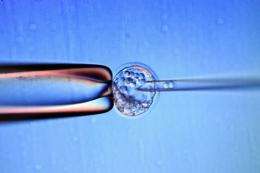
File illustration photo shows embryonic stem cells being microinjected into an embryo. Monkeys suffering from Parkinson's disease show a marked improvement when human embryonic stem cells are implanted in their brains, in what a Japanese researcher said Wednesday was a world first.
Monkeys suffering from Parkinson's disease show a marked improvement when human embryonic stem cells are implanted in their brains, in what a Japanese researcher said Wednesday was a world first.
A team of scientists transplanted the stem cells into four primates that were suffering from the debilitating disease.
The monkeys all had violent shaking in their limbs -- a classic symptom of Parkinson's disease -- and were unable to control their bodies, but began to show improvements in their motor control after about three months, Kyoto University associate professor Jun Takahashi told AFP.
About six months after the transplant, the creatures were able to walk around their cages, he said.
"Clear improvements were confirmed in their movement," he said.
Parkinson's disease is a progressive neurological illness linked to a decrease in dopamine production in the brain. There is currently no medical solution to this drop off in a key neurotransmitter.
The condition, which generally affects older people, gained wider public recognition when Hollywood actor Michael J. Fox revealed he was a sufferer.
Takahashi said at the time of the implant about 35 percent of the stem cells had already grown into dopamine neuron cells, with around 10 percent still alive after a year.
He said he wants to improve the effectiveness of the treatment by increasing the survival rate of dopamine neuron cells to 70 percent.
"The challenge before applying it to a clinical study is to raise the number of dopamine neuron cells and to prevent the development of tumours," he said.
"I would like to make this operation more effective and safe" before clinical trials, Takahashi said.
Takahashi said so far he had used embryonic stem cells, which are harvested from foetuses, but would likely switch to so-called Induced Pluripotent Stem (iPS) cells, which are created from human skin, for the clinical trial.
His team, which has also transplanted iPS cells into monkeys, are now looking to see if the primates with Parkinson's disease show similar improvements in their motor control.
Scientists say the use of human embryonic stem cells as a treatment for cancer and other diseases holds great promise, but the process has drawn fire from religious conservatives, among others.
Opponents say harvesting the cells, which have the potential to become any cell in the human body, is unethical because it involves the destruction of an embryo.
The Japanese government currently has no guidelines on the use of human stem cells in clinical research.
In October last year, the Court of Justice of the European Union banned the patenting of stem cells when their extraction causes the destruction of a human embryo, a ruling that could have repercussions on medical research.
Scientists warned that the ruling would damage stem cell research in Europe, while the Catholic church hailed it as a victory for the protection of human life.
(c) 2012 AFP
-
Neural stem cells reduce Parkinson's symptoms in monkeys
Jun 12, 2007 |
not rated yet |
0
-
Stem cells reverse disease in a model of Parkinson's disease
May 16, 2011 |
not rated yet |
0
-
Embryonic stem cells can kill cancer cells
Oct 11, 2005 |
not rated yet |
0
-
Replacing the cells lost in Parkinson disease
Dec 03, 2007 |
not rated yet |
0
-
Researchers define ideal time for stem cell collection for Parkinson's disease therapy
Nov 19, 2008 |
not rated yet |
0
-
Of mice and mental models: Neuroscientific implications of risk-optimized behavior in the mouse
May 25, 2012 |
not rated yet |
0
-
Limits to growth: Scientists identify key metastasis-enabling enzyme
May 22, 2012 |
5 / 5 (4) |
0
-
Seeing is as seeing does: Spatially-structured retinal input in early development of cortical maps
Apr 26, 2012 |
5 / 5 (4) |
1
-
Dreamless nights: Brain activity during nonrapid eye movement sleep
Apr 09, 2012 |
4.4 / 5 (12) |
0
-
Take your time: Neurobiology sheds light on the superiority of spaced vs. massed learning
Mar 28, 2012 |
4.5 / 5 (21) |
3
-
magnetic field from stream of protons
5 hours ago
-
Force on a particle constrained to move on the surface of a sphere
5 hours ago
-
Force in a magnetic coupling
15 hours ago
-
Sign of scalar product in electric potential integral?
22 hours ago
-
Heat engines: how can we yield work?
23 hours ago
-
Work done by us on the spring
May 25, 2012
- More from Physics Forums - Classical Physics
More news stories
Study supports urate protection against Parkinson's disease, hints at novel mechanism
Use of the antioxidant urate to protect against the neurodegeneration caused by Parkinson's disease appears to rely on more than urate's ability to protect against oxidative damage. In the May issue of the open-access journal ...
Parkinson's & Movement disorders
May 23, 2012 |
not rated yet |
0
|
Molecular 'on-off' switch for Parkinson's disease discovered
(Medical Xpress) -- Scientists at the Medical Research Council (MRC) Protein Phosphorylation Unit at the University of Dundee have discovered a new molecular switch that acts to protect the brain from developing Parkinson's ...
Parkinson's & Movement disorders
May 23, 2012 |
5 / 5 (8) |
0
|
Study IDs gene variants that speed progression of Parkinson's disease
UCLA researchers may have found a key to determining which Parkinson's disease patients will experience a more rapid decline in motor function, sparking hopes for the development of new therapies and helping identify those ...
Parkinson's & Movement disorders
May 15, 2012 |
not rated yet |
0
|
Colonoscopy or flexible sigmoidoscopy may be used to predict Parkinson's
Two studies by neurological researchers at Rush University Medical Center suggest that, in the future, colonic tissue obtained during either colonoscopy or flexible sigmoidoscopy may be used to predict who will develop Parkinson's ...
Parkinson's & Movement disorders
May 15, 2012 |
not rated yet |
0
Vitamin K2: New hope for Parkinson's patients?
Neuroscientist Patrik Verstreken, associated with VIB and KU Leuven, succeeded in undoing the effect of one of the genetic defects that leads to Parkinson's using vitamin K2. His discovery gives hope to Parkinson's patients. ...
Parkinson's & Movement disorders
May 11, 2012 |
not rated yet |
0
Keep food safety in mind this memorial day weekend
(HealthDay) -- Picnics, parades and cookouts are as much a part of Memorial Day weekend as tributes to the United States' war veterans.
Travel to high altitudes tied to Crohn's, colitis flare-ups
(HealthDay) -- People with inflammatory bowel disease, which includes Crohn's disease and colitis, may be at increased risk for flare-ups when they fly or travel to high altitudes for skiing or mountain climbing, ...
Family history of Alzheimer's affects functional connectivity
(HealthDay) -- Cognitively normal individuals with a family history of late-onset Alzheimer's disease (AD) may display lower resting state functional connectivity in the default mode network (DMN) of the brain, ...
Transvaginal mesh op restores pelvic organ prolapse at price
(HealthDay) -- Transvaginal mesh (TVM) procedures are effective for anatomical restoration of pelvic organ prolapse (POP), but patients report a worsening of sexual function following surgery, according to ...
Of mice and mental models: Neuroscientific implications of risk-optimized behavior in the mouse
(Medical Xpress) -- Regardless of an organism’s biological complexity, every encephalized animal continuously makes under-informed behavioral choices that can have serious consequences. Despite its ubiquity, ...
Weight struggles? Blame new neurons in your hypothalamus
New nerve cells formed in a select part of the brain could hold considerable sway over how much you eat and consequently weigh, new animal research by Johns Hopkins scientists suggests in a study published in the May issue ...