Vaccine discovered for hep C
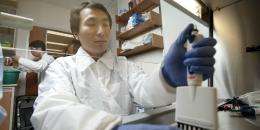
(Medical Xpress) -- A University of Alberta researcher and Canada Excellence Research Chair in Virology has made the discovery of a vaccine that will potentially help combat hepatitis C. Michael Houghton, who led the team that discovered the hepatitis C virus in 1989, announced his findings at the Canada Excellence Research Chairs Summit in Vancouver this afternoon. Currently, there are no vaccines against the disease available.
Houghton, also the Li Ka Shing Chair in Virology at the University of Alberta, says the vaccine, developed from a single strain, has shown to be effective against all known strains of the virus. It took more than 10 years to develop and started while he was working for the drug company Novartis. Following previous vaccine tests funded by the National Institutes of Health that yielded promising results, he said there remained two critical questions.
“Did the recipients actually produce antibodies that could neutralize the actual infectious virus,” he said, “and if they could, how broad was the neutralizing response?”
The challenge, Houghton said, was that hepatitis C is more virulent than HIV, thus coming up with a vaccine that would neutralize the different strains around the world was believed to be impossible. Using a vaccine developed and tested on humans in his University of Alberta lab, Houghton and his co-investigator John Law discovered that the vaccine was capable of eliciting broad cross-neutralising antibodies against all the different major strains. Houghton says that this finding bodes good news for those with hep C and those who live or travel to areas where the disease is prevalent.
“This tells us that a vaccine made from a single strain can indeed neutralize all the viruses out there,” says Houghton. “It really encourages the further development of that vaccine. This is a really a big step forward for the field of HCV vaccinology.”
With hundreds of thousands of people being infected with hepatitis C annually, and with between 20 to 30 per cent of those developing some form liver disease, this announcement brings hope. However, Houghton cautions that further testing is required, meaning that it may be five to seven years before the vaccine receives approval. And while it may make some difference in those currently suffering from hepatitis C, it is mainly a preventative measure against acquiring the disease.
The discovery of the vaccine by a University of Alberta researcher, and one of the first appointed Canada Excellence Research Chairs is proud news for both organizations.
"A breakthrough such as this one is exactly the kind of advance we believed would happen here when we created the Li Ka Shing Institute of Virology and recruited internationally renowned researchers such as Michael Houghton and his colleagues," said U of A President Indira Samarasekera.
Chad Gaffield, chair of the steering committee for Canada Excellence Research Chairs program said one of the ambitions of the program was to attract world-class talent to Canada, those whose research would be foremost in making the breakthroughs needed in the 21st century. While it may not be obvious when or where such breakthroughs will occur first, Houghton`s discovery illustrates the impact of this program on a national and international scale.
“The premise of the CERC program is that if you support top minds internationally, good things will happen,” he says. “This is a wonderful illustration of how a key problem in the world today becomes much more understandable and solutions are much closer thanks to the work of Michael Houghton.”
The breakthrough underscores the benefit of the U of A’s Li Ka Shing Institute of Virology.
"This demonstrates that the Li Ka Shing Institute is internationally competitive in important areas of virology research,” said Lorne Tyrrell, director of the institute and a leading virologist in his own right. “We are working on topics that are important to patients, and we want to translate discoveries from the lab to patient care. That has been our philosophy since day one. We have a long way to go, but this is a great step.”
The Canada Excellence Research Chairs Program supports Canadian universities in their efforts to build on Canada's growing reputation as a global leader in research and innovation. The program awards world-renowned researchers and their teams up to $10 million over seven years to establish ambitious research programs at Canadian universities. The University of Alberta is home to three of 18 CERCs in Canada. These chairs are in virology, arctic resources, and oilsands molecular engineering.


.jpg)


