Brain wiring a no-brainer? Scans reveal astonishingly simple 3D grid structure
March 29, 2012 in Neuroscience
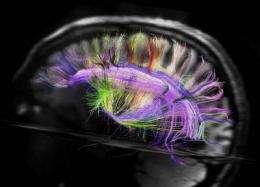
Curvature in this DSI image of a whole human brain turns out to be folding of 2-D sheets of parallel neuronal fibers that cross paths at right angles. This picture came from the new Connectom scanner. Credit: Van Wedeen, M.D., Martinos Center and Dept. of Radiology, Massachusetts General Hospital and Harvard University Medical School
The brain appears to be wired more like the checkerboard streets of New York City than the curvy lanes of Columbia, Md., suggests a new brain imaging study. The most detailed images, to date, reveal a pervasive 3D grid structure with no diagonals, say scientists funded by the National Institutes of Health.
"Far from being just a tangle of wires, the brain's connections turn out to be more like ribbon cables -- folding 2D sheets of parallel neuronal fibers that cross paths at right angles, like the warp and weft of a fabric," explained Van Wedeen, M.D., of Massachusetts General Hospital (MGH), A.A. Martinos Center for Biomedical Imaging and the Harvard Medical School. "This grid structure is continuous and consistent at all scales and across humans and other primate species."
Wedeen and colleagues report new evidence of the brain's elegant simplicity March 30, 2012 in the journal Science. The study was funded, in part, by the NIH's National Institute of Mental Health (NIMH), the Human Connectome Project of the NIH Blueprint for Neuroscience Research, and other NIH components.
"Getting a high resolution wiring diagram of our brains is a landmark in human neuroanatomy," said NIMH Director Thomas R. Insel, M.D. "This new technology may reveal individual differences in brain connections that could aid diagnosis and treatment of brain disorders."
Knowledge gained from the study helped shape design specifications for the most powerful brain scanner of its kind, which was installed at MGH's Martinos Center last fall. The new Connectom diffusion magnetic resonance imaging (MRI) scanner can visualize the networks of crisscrossing fibers by which different parts of the brain communicate with each other in 10-fold higher detail than conventional scanners, said Wedeen.
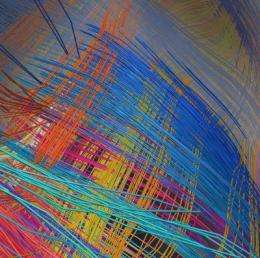
This detail from a DSI scan shows a fabric-like 3-D grid structure of connections in monkey brain. Credit: Van Wedeen, M.D., Martinos Center and Dept. of Radiology, Massachusetts General Hospital and Harvard University Medical School
"This one-of-a-kind instrument is bringing into sharper focus an astonishingly simple architecture that makes sense in light of how the brain grows," he explained. "The wiring of the mature brain appears to mirror three primal pathways established in embryonic development."As the brain gets wired up in early development, its connections form along perpendicular pathways, running horizontally, vertically and transversely. This grid structure appears to guide connectivity like lane markers on a highway, which would limit options for growing nerve fibers to change direction during development. If they can turn in just four directions: left, right, up or down, this may enforce a more efficient, orderly way for the fibers to find their proper connections and for the structure to adapt through evolution, suggest the researchers.
Obtaining detailed images of these pathways in human brain has long eluded researchers, in part, because the human cortex, or outer mantle, develops many folds, nooks and crannies that obscure the structure of its connections. Although studies using chemical tracers in neural tracts of animal brains yielded hints of a grid structure, such invasive techniques could not be used in humans.
Wedeen's team is part of a Human Connectome Project Harvard/MGH-UCLA consortium that is optimizing MRI technology to more accurately to image the pathways. In diffusion imaging, the scanner detects movement of water inside the fibers to reveal their locations. A high resolution technique called diffusion spectrum imaging (DSI) makes it possible to see the different orientations of multiple fibers that cross at a single location the key to seeing the grid structure.
In the current study, researchers performed DSI scans on postmortem brains of four types of monkeys rhesus, owl, marmoset and galago and in living humans. They saw the same 2D sheet structure containing parallel fibers crossing paths everywhere in all of the brains even in local path neighborhoods. The grid structure of cortex pathways was continuous with those of lower brain structures, including memory and emotion centers. The more complex human and rhesus brains showed more differentiation between pathways than simpler species.
Among immediate implications, the findings suggest a simplifying framework for understanding the brain's structure, pathways and connectivity.
The technology used in the current study was able to see only about 25 percent of the grid structure in human brain. It was only apparent in large central circuitry, not in outlying areas where the folding obscures it. But lessons learned were incorporated into the design of the newly installed Connectom scanner, which can see 75 percent of it, according to Wedeen.
Much as a telescope with a larger mirror or lens provides a clearer image, the new scanner markedly boosts resolving power by magnifying magnetic fields with magnetically stronger copper coils, called gradients. Gradients make it possible to vary the magnetic field and get a precise fix on locations in the brain. The Connectom scanner's gradients are seven times stronger than those of conventional scanners. Scans that would have previously taken hours and, thus would have been impractical with living human subjects can now be performed in minutes.
"Before, we had just driving directions. Now, we have a map showing how all the highways and byways are interconnected," said Wedeen. "Brain wiring is not like the wiring in your basement, where it just needs to connect the right endpoints. Rather, the grid is the language of the brain and wiring and re-wiring work by modifying it."
More information: Wedeen VJ, Rosene DL, Ruopeng W, Guangping D, Mortazavi F, Hagmann P, Kass JH, Tseng W-YI. The Geometric Structure of the Brain Fiber Pathways: A Continuous Orthogonal Grid. March 30, 2012 Science.
Journal reference:
Science
Provided by National Institutes of Health
-
New map IDs the core of the human brain
Jul 01, 2008 |
not rated yet |
0
-
Effects of obesity on the brain: first evidence of sex-related differences
Apr 19, 2011 |
not rated yet |
0
-
Friendly to a fault, yet tense: Personality traits traced in brain
Mar 20, 2012 |
not rated yet |
0
-
Researchers map, measure brain's neural connections
Jun 01, 2011 |
not rated yet |
0
-
Scientists have new help finding their way around brain's nooks and crannies
Aug 09, 2011 |
not rated yet |
0
-
Motion perception revisited: High Phi effect challenges established motion perception assumptions
Apr 23, 2013 |
3 / 5 (2) |
2
-
Anything you can do I can do better: Neuromolecular foundations of the superiority illusion (Update)
Apr 02, 2013 |
4.5 / 5 (11) |
5
-
The visual system as economist: Neural resource allocation in visual adaptation
Mar 30, 2013 |
5 / 5 (2) |
9
-
Separate lives: Neuronal and organismal lifespans decoupled
Mar 27, 2013 |
4.9 / 5 (8) |
0
-
Sizing things up: The evolutionary neurobiology of scale invariance
Feb 28, 2013 |
4.8 / 5 (10) |
14
-
Why is zone 1 in liver more prone to ischemic injury?
May 23, 2013
-
How can there be villous adenoma in colon, if there are no villi there
May 22, 2013
-
How can there be a term called "intestinal metaplasia" of stomach
May 21, 2013
-
Pressure-volume curve: Elastic Recoil Pressure don't make sense
May 18, 2013
-
If you became brain-dead, would you want them to pull the plug?
May 17, 2013
-
MRI bill question
May 15, 2013
- More from Physics Forums - Medical Sciences
More news stories
New neuron formation could increase capacity for new learning, at the expense of old memories
New research presented today shows that formation of new neurons in the hippocampus - a brain region known for its importance in learning and remembering - could cause forgetting of old memories by causing a reorganization ...
Neuroscience
11 hours ago |
3.7 / 5 (3) |
0
Help at hand for people with schizophrenia
How can healthy people who hear voices help schizophrenics? Finding the answer for this is at the centre of research conducted at the University of Bergen.
Neuroscience
11 hours ago |
4 / 5 (2) |
2
Japanese research organizations contribute to Human Brain Project
One of the major frontiers of modern science is a comprehensive understanding of the human brain and its functions to guide the development of new technologies in information and communication. In a major announcement for ...
Neuroscience
12 hours ago |
3 / 5 (2) |
0
Controlling mood through the motions of mitochondria
(Medical Xpress)—Regulating the distribution of power in neurons is done by a system that makes the national electric grid look simple by comparison. Each neuron has several thousand mitochondria confined ...
Neuroscience
May 23, 2013 |
4.9 / 5 (9) |
0
|
Brain uses internal 'average voice' prototype to identify who is talking
(Medical Xpress)—The human brain is able to identify individuals' voices by comparing them against an internal 'average voice' prototype, according to neuroscientists.
Neuroscience
May 23, 2013 |
3 / 5 (2) |
3
|
Researchers identify first drug targets in childhood genetic tumor disorder
Two mutations central to the development of infantile myofibromatosis (IM)—a disorder characterized by multiple tumors involving the skin, bone, and soft tissue—may provide new therapeutic targets, according to researchers ...
Engineered cytomegalovirus protects monkeys from HIV equivalent
(Medical Xpress)—A new study by researchers in the US has shown that an ancient virus can be modified to help in the fight against the simian immunodeficiency virus SIV, which is the equivalent in monkeys ...
Hormone levels may provide key to understanding psychological disorders in women
Women at a particular stage in their monthly menstrual cycle may be more vulnerable to some of the psychological side-effects associated with stressful experiences, according to a study from UCL.
Going live: Immune cell activation in multiple sclerosis
Biological processes are generally based on events at the molecular and cellular level. To understand what happens in the course of infections, diseases or normal bodily functions, scientists would need to ...
Driving and hands-free talking lead to spike in errors, study shows
Talking on a hands-free device while behind the wheel can lead to a sharp increase in errors that could imperil other drivers on the road, according to new research from the University of Alberta.
Pollen count apps for smartphones are nothing to sneeze at
Kate O'Reilly's spring allergy survival kit includes the usual stuff - nasal sprays, allergy pills and a box of tissues. This season, she's added a new weapon to her line of defense: an app on her smartphone.

Mar 29, 2012
Rank: 5 / 5 (1)
Mar 29, 2012
Rank: 5 / 5 (1)
Take a look.
http://www.scienc...ture.jpg
Mar 29, 2012
Rank: 1 / 5 (1)
Congratulations to all.
All forms of synesthesia (over 50 known to date) will provide breathtaking insight to network pathways of adaptability and simplify understanding sourced from all the physical sources of stimuli we experience from our existence.
Kudos Mr. Frontier. Complexity with the simplest of means.
Typical Nature.
Mar 30, 2012
Rank: 1 / 5 (1)
Employing triangular numbers highlights how individual paradox units cooperate in a harmonic way, as birds form a functional flock gestalt.
Mar 30, 2012
Rank: 5 / 5 (1)
Kudos to the scientists
...and Mr.Frontier
Mar 30, 2012
Rank: 1 / 5 (1)
Mar 30, 2012
Rank: 1 / 5 (1)
Apr 02, 2012
Rank: 5 / 5 (1)
Kinda like 3d chess or coordinates in space...
I guess I mean - are neurons ONLY on the surface of the brain?
Apr 03, 2012
Rank: not rated yet
Apr 03, 2012
Rank: not rated yet
The grey matter at the surface of the cortex has a very high proportion of neurons which lack the oligodendrocites. The lack of olig.. cells allows greater density and interconnections of neurons but slower impulse transmission speeds.
Apr 04, 2012
Rank: 1 / 5 (1)
From
http://universe-l...ilation/
Lifes evolution, mass formats self-replication:
RNA nucleotides Genes (organisms) to RNA and DNA genomes (organisms) to mono-cellular to multicellular organisms.
Individual mono-cells to cooperative mono-cells communities, cultures.
Mono-cells cultures to neural systems, then to nerved multicellular organisms.
Dov Henis
(comments from 22nd century)
Apr 04, 2012
Rank: not rated yet
Read the paper from Eric Andrulis about how life builds "gyres"... and it does it very specific ways...