Chronic stress spawns protein aggregates linked to Alzheimer's
March 26, 2012 in Alzheimer's disease & dementia

Chronic stress spawns protein aggregates linked to Alzheimer's

Enlarge

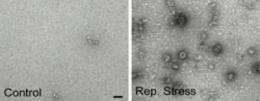
Exposing mice to 14 days of repeated stress resulted in an accumulation of insoluble phosphorylated tau protein aggregates in brain cells, visualized in this electron micrograph. Credit: Image courtesy of Robert Rissman, UC San Diego

Repeated stress triggers the production and accumulation of insoluble tau protein aggregates inside the brain cells of mice, say researchers at the University of California, San Diego School of Medicine in a new study published in the March 26 Online Early Edition of the Proceedings of the National Academy of Sciences.

The aggregates are similar to neurofibrillary tangles or NFTs, modified protein structures that are one of the physiological hallmarks of Alzheimer's disease. Lead author Robert A. Rissman, PhD, assistant professor of neurosciences, said the findings may at least partly explain why clinical studies have found a strong link between people prone to stress and development of sporadic Alzheimer's disease (AD), which accounts for up to 95 percent of all AD cases in humans.

"In the mouse models, we found that repeated episodes of , which has been demonstrated to be comparable to what humans might experience in ordinary life, resulted in the phosphorylation and altered solubility of tau proteins in neurons," Rissman said. "These events are critical in the development of NFT pathology in Alzheimer's disease."

The effect was most notable in the hippocampus, said Rissman, a region of the brain linked to the formation, organization and storage of memories. In AD patients, the hippocampus is typically the first region of the brain affected by tau pathology and the hardest-hit, with substantial cell death and shrinkage.

Not all forms of stress are equally threatening. In earlier research, Rissman and colleagues reported that – a single, passing episode – does not result in lasting, debilitating long lasting changes in accumulation of phosphorylated tau. Acute stress-induced modifications in the cell are transient, he said, and on the whole, probably beneficial.

"Acute stress may be useful for brain plasticity and helping to facilitate learning. Chronic stress and continuous activation of stress pathways may lead to pathological changes in stress circuitry. It may be too much of a good thing." As people age, perhaps their neuronal circuits do too, he said, becoming less robust and perhaps less capable of completely rebounding from the effects of stress.

"Age is the primary, known risk factor for Alzheimer's disease. It may be that as we age, our neurons just aren't as plastic as they once were and some succumb."

The researchers observed that stress cues impacted two key corticotropin-releasing factor receptors, suggesting a target for potential therapies. Rissman noted drugs already exist and are in human trials (for other conditions) that modulate the activity of these receptors.

"You can't eliminate stress. We all need to be able to respond at some level to stressful stimuli. The idea is to use an antagonist molecule to reduce the effects of stress upon neurons. The stress system can still respond, but the response in the brain and hippocampus would be toned down so that it doesn't result in harmful, permanent damage."

Journal reference: Proceedings of the National Academy of Sciences search and more info website

Provided by University of California - San Diego search and more info website

4 /5 (1 vote)  

Rank 4 /5 (1 vote)
Relevant PhysicsForums posts

More news stories

Study identifies new approach to improving treatment for MS and other conditions

(Medical Xpress)—Working with lab mice models of multiple sclerosis (MS), UC Davis scientists have detected a novel molecular target for the design of drugs that could be safer and more effective than current FDA-approved ...

Alzheimer's disease & dementia created 14 hours ago | popularity 5 / 5 (2) | comments 0 | with audio podcast

Nonmelanoma skin cancer tied to lower Alzheimer's risk

(HealthDay)—Older individuals with nonmelanoma skin cancer (NMSC) seem to have a significantly reduced risk of developing Alzheimer's disease (AD), according to a study published online May 15 in Neurology.

Alzheimer's disease & dementia created May 16, 2013 | popularity 5 / 5 (1) | comments 0

Skin cancer may be linked to lower risk of Alzheimer's disease

People who have skin cancer may be less likely to develop Alzheimer's disease, according to new research published in the May 15, 2013, online issue of Neurology®, the medical journal of the American Academy of Neurology. The li ...

Alzheimer's disease & dementia created May 15, 2013 | popularity 5 / 5 (1) | comments 0 | with audio podcast

Alzheimer's markers predict start of mental decline

(Medical Xpress)—Scientists at Washington University School of Medicine in St. Louis have helped identify many of the biomarkers for Alzheimer's disease that could potentially predict which patients will develop the disorder ...

Alzheimer's disease & dementia created May 14, 2013 | popularity 3 / 5 (1) | comments 0 | with audio podcast

Scientists develop drug that slows Alzheimer's in mice

A drug developed by scientists at the Salk Institute for Biological Studies, known as J147, reverses memory deficits and slows Alzheimer's disease in aged mice following short-term treatment. The findings, ...

Alzheimer's disease & dementia created May 13, 2013 | popularity 4.2 / 5 (5) | comments 0 | with audio podcast


AIDS science at 30: 'Cure' now part of lexicon

Big names in medicine are set to give an upbeat assessment of the war on AIDS on Tuesday, 30 years after French researchers identified the virus that causes the disease.

For combat veterans suffering from post-traumatic stress disorder, 'fear circuitry' in the brain never rests

Chronic trauma can inflict lasting damage to brain regions associated with fear and anxiety. Previous imaging studies of people with post-traumatic stress disorder, or PTSD, have shown that these brain regions can over-or ...

Melon focus headband turns to Kickstarter for rollout plans

(Medical Xpress)—What if the quality of your work depends more on your focus on the piano keys or canvas or laptop than your musical or painting or computing skills? If target users can be convinced, they ...

Temporal processing in the olfactory system

The neural machinery underlying our olfactory sense continues to be an enigma for neuroscience. A recent review in Neuron seeks to expand traditional ideas about how neurons in the olfactory bulb might encode information about ...

Now we know why old scizophrenia medicine works on antibiotics-resistant bacteria

In 2008 researchers from the University of Southern Denmark showed that the drug thioridazine, which has previously been used to treat schizophrenia, is also a powerful weapon against antibiotic-resistant bacteria such as ...

Individuals who drink heavily and smoke may show 'early aging' of the brain

Treatment for alcohol use disorders works best if the patient actively understands and incorporates the interventions provided in the clinic. Multiple factors can influence both the type and degree of neurocognitive abnormalities ...