Study suggest that conscious perception has little to do with the primary visual cortex
From a purely intuitive point of view, it is easy to believe that our ability to actively pay attention to a target is inextricably connected with our capacity to consciously perceive it. However, this proposition remains the subject of extensive debate in the research community, and surprising new findings from a team of scientists in Japan and Europe promise to fuel the debate.
Resolving how these aspects of perception are managed requires a detailed understanding of how the visual centers in our brain process information. A region known as V1 has been investigated as it represents the first portion of the visual cortex to receive and process signals transmitted from the retina.
Many researchers favor a model in which functions pertaining consciousness are widely spread among the whole visual system, including V1. The classical model, which assumes that the neural mechanism of consciousness is integrated into a narrow subset of brain structures, referred to as a homunculus, or ‘little human’, is almost defunct. However, a modern version of this model is under debate. It proposes that the neural mechanism of consciousness is a privileged set of cortical areas, a subpopulation of neurons, or certain neural dynamics (e.g. oscillations); while there are also visual systems that have nothing to do with conscious vision, explains Masataka Watanabe a researcher investigating brain function at the University of Tokyo, Japan.
Watanabe cites studies proposing that visual attention as processed within V1 may be only minimally impacted by conscious perception; but, the experimental data have been contradictory. For example, studies using a technique called functional magnetic resonance imaging (fMRI) to map brain activity have indicated that V1 contributes to both attention and awareness in humans. However, invasive electrophysiological studies in non-human primates yielded different results. “You would find only 10 to 15% of neurons in V1 that are barely modulated by awareness, and 85% or so that are not modulated at all,” says Watanabe. To resolve this ambiguity, he, Kang Cheng from the RIKEN Brain Science Institute, Wako, and their colleagues designed an experiment that examined both processes independently. Surprisingly, their results may lend support the modern homunculus model.
Blind-siding awareness
The difficulty in separately testing awareness and attention in an experimental setting is a likely cause for these contradictory results. “I believe previous studies were most likely ‘contaminated by attention’,” says Watanabe.
Watanabe, Cheng and their colleagues used a technique known as continuous flash suppression (CFS) to address the issue of awareness. The concept is based on ‘binocular rivalry’: when each eye is presented with a distinct image, perception rapidly shifts between the two images rather than melding them together. However, by making one of these stimuli extremely ‘busy’ and dynamic, it becomes possible to entirely suppress conscious perception of the other, thereby selectively eliminating awareness.
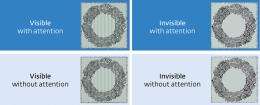
In their study, the researchers used a patterned ring as the visual target. They displayed this to subjects along with an equally sized ring consisting of multiple patches of dynamically shifting patterns. When both target and ring were projected in an alternating pattern to the same eye, the subjects could consciously perceive both the ring and the target at its center. When the two were transmitted to different eyes, however, the dynamic ring suppressed perception of the target.
For both visible and invisible target conditions, the subjects participated in two kinds of trials. In one, they were asked to pay attention to and report the visibility of the target. In the other, they were asked to shift attention away from the target region so they could follow a rapidly changing series of letters appearing within the surrounding ring pattern. Using fMRI, the researchers could specifically track changes in neuronal activity in each subject’s V1 that were induced by different combinations of attention and visual awareness under all four conditions.
Attentive, but unaware
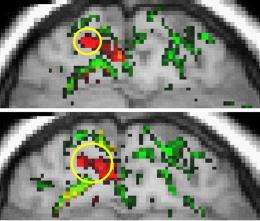
The results proved striking: for all seven subjects, the shift of attention toward or away from the target had a dramatic effect on brain activity in the region of V1 corresponding to the visual target. However, the ability to consciously perceive the target proved surprisingly unimportant, and shifts in target awareness had no clear or consistent effect on the activity of this subset of neurons. “I was quite surprised that there was zero modulation of awareness in V1,” says Watanabe. “Even in monkey studies where the [animals] showed only 10% of their neurons being modulated, [those researchers] were nevertheless observing modulation.” By comparison, no such awareness effect was observed in the human subjects.
Watanabe and colleagues’ findings indicate that awareness is not a major factor in the earliest stages of visual perception, even though it is clearly a core component of the overall process. Further investigation will be required to determine how consciousness becomes integrated with other visual data. “Scientists are pretty sure that the terminal areas of the visual system, such as the regions that process shape and color or motion, are likely to be heavily modulated by awareness,” says Watanabe. “But where exactly this modulation starts is still an open question.”
Future studies from this research team will seek out the brain structures involved in awareness processing. For now, these data offer surprising support for a still-contested model of visual perception and consciousness. “To tell the truth, three years ago I would not have believed this result,” says Watanabe. “I don’t think the ‘Battle of V1’ is fully settled, but these data could imply that the modern homunculus model may be true.”
More information: Read more in Science.


