Poor colonoscopy prep hides pre-cancerous polyps
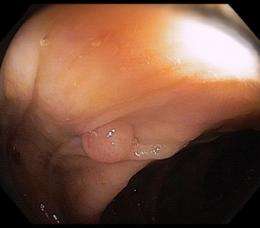
(Medical Xpress) -- What happens on the day before a colonoscopy may be just as important as the colon-screening test itself.
Gastroenterologists at Washington University School of Medicine in St. Louis have found that when patients don’t adequately prep for the test by cleansing their colons, doctors often can’t see potentially dangerous pre-cancerous lesions.
Reporting in the journal Gastrointestinal Endoscopy, the researchers say that doctors often missed at least one pre-cancerous growth in about one-third of patients who did not properly prepare for their colonoscopy. Those polyps and other markers of cancer risk were only discovered months later when patients had their next colonoscopy.
Although several studies have found that up to a quarter of colonoscopy patients don’t prepare adequately for the test, the new study is the first to point out the potential consequences of poor bowel preparation in outpatients at average risk.
“Because so many of the patients had a follow-up screening less than a year after the initial test, we strongly suspect that most of the pre-cancerous growths found during the second colonoscopy already were present at the time of the initial test,” says first author Reena Chokshi, MD, a gastroenterology fellow at Washington University.
The researchers say their findings suggest that if a physician is having difficulty seeing the colon due to inadequate bowel prep, the colonoscopy should be stopped and rescheduled.
“We often can detect preparation problems during the first few minutes of the procedure,” Chokshi says. “And based on this study, we would say that rather than subjecting a patient to the potential risks of a full colonoscopy when we may not be able to detect polyps, or other pre-cancerous growths called adenomas, it may be better to bring that patient back as soon as possible for a repeat procedure with better bowel preparation.”
On the day before a colonoscopy exam, people are asked to stop eating solid food and to consume only clear liquids. Later in the day and the next morning, patients drink bowel-cleansing mixtures to empty the colon prior to the examination.
The test itself usually takes less than an hour, and patients are sedated during that time. Using a tiny camera, doctors are able to look at the walls of the colon in an attempt to detect polyps and other pre-cancerous growths. Once detected, those growths can be removed during the course of the colonoscopy. Patients often must miss two days of work: the day of preparation and the day of the test. Recently, the outpatient endoscopy center at Washington University and Barnes-Jewish Hospital in St. Louis has begun screening patients on Saturday mornings to reduce the number of vacation days some patients have to use.
“Many patients say that the bowel preparation before the colonoscopy is the worst part of having the test, but it’s also very important because in order to see polyps or cancers, we really have to be able to clearly see the entire wall of the colon,” says senior author Jean S. Wang, MD, PhD, assistant professor of medicine in the Division of Gastroenterology. “Inadequate preparation makes that very difficult for a physician.”
The researchers retrospectively studied patients who had an average risk of colon cancer and got screening colonoscopies in the outpatient endoscopy center. Individuals with a history of inflammatory bowel disease, a family history of colorectal cancer or a medical history of colon polyps were not included in the study.
In the five-year span between 2004-09, 373 patients at the center were identified as having inadequate bowel preparation. Of the 133 patients who later had a second colonoscopy during the study period, 33.8 percent had at least one pre-cancerous adenoma detected in that repeat screening. And almost one in five of that group were considered to be at high risk for colon cancer because they either had more than three adenomas detected, or the test discovered at least one large lesion.
In fact, the researchers found that 18 percent of the patients who had a second colonoscopy would have been given different recommendations if their polyps and adenomas had been detected during the initial screening, such as more frequent colonoscopies to monitor the development of growths in the colon.
“It generally takes several years for an adenoma to become cancerous,” Chokshi says. “But it’s hard to know where in that sequence a particular adenoma is when we detect it. So it certainly is possible that any lesion we miss during a colonoscopy could develop into a malignancy before a person’s next colonoscopy, especially if it doesn’t happen until 10 years later.”
More information: Chokshi RV, Hovis CD, Hollander T, Early DS Wang JS. Prevalence of missed adenomas in patients with inadequate bowel preparation on screening colonoscopy. Gastrointestinal Endoscopy, vol. 75, 2012 [Epub. ahead of print]. 10.1016/j.gie.2012.01.005


