Rats match humans in decision-making that involves combining different sensory cues: study
March 13, 2012 in Neuroscience

rat

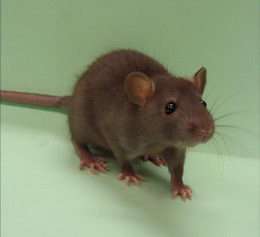
The next time you set a trap for that rat running around in your basement, here's something to consider: you are going up against an opponent whose ability to assess the situation and make decisions is statistically just as good as yours.

A Cold Spring Harbor Laboratory (CSHL) study that compared the ability of humans and rodents to make perceptual decisions based on combining different modes of sensory stimuli—visual and auditory cues, for instance—has found that just like humans, rodents also combine multisensory and exploit it in a "statistically optimal" way -- or the most efficient and unbiased way possible.

"Statistically optimal combination of multiple has been well documented in humans, but many have been skeptical about this behavior occurring in other species," explains Assistant Professor Anne Churchland, Ph.D., a neuroscientist who led the new study. "Our work is the first demonstration of its occurrence in rodents." The study appears in the March 14 issue of the .

This discovery is exciting, according to Churchland, because it suggests that the same evolutionarily conserved neural circuits underlie this behavior in both humans and rodents. "By observing this behavior in rodents, we have a chance to explore its neural basis – something that is not feasible to do in people," Churchland says.

Such investigations, she hopes, will explain why patients with autism spectrum disorders (ASDs) integrate sensory information in an atypical and less-than-optimal way, relative to healthy people. "We can use our rat model to 'look under the hood' to understand how the brain is combining multisensory information and be in a better position to develop treatments for these disorders in people."

Churchland and her team tested multisensory integration in humans and rats by designing a task that gauged how the subjects made decisions when presented with visual and auditory stimuli -- separately and in tandem. "We threw in a couple of additional features that made the task challenging enough to simulate a real-life situation," Churchland adds.

Her team also designed the task keeping in mind the caveat that our brains process visual information much slower than auditory information. "Our task included stimuli that were much more dynamic and temporal (time-varying) compared to other studies that have tested multisensory integration, which we regard an important advance in the field," explains Churchland.

Her team now reports that both humans and rats made more accurate decisions when presented with combined multisensory information and that this was close to being statistically optimal – a mathematical prediction of how well each subject could possibly perform in the task.

The researchers have also found evidence that offers fresh insight into how the brain deals with the challenge of having a visual processing system that's slower that the auditory processing system. "Even though visual and auditory stimuli don't come in exactly at the same time, we think that the brain keeps events in sequence by processing each sensory cue in parallel, fusing the two signals at a later stage and then making a judgment about the fused signal," elaborates Churchland.

Her team next plans to investigate how the two streams of information are being combined and how the brain combines sensory experience with memory. "Now that we have a good animal model in which to investigate these questions, the world—or the brain—is our oyster," she says.

More information: "Multisensory decision-making in rats and humans," appears in the Journal of Neuroscience on March 14. The full citation is: David Raposo, John P. Sheppard, Paul R. Schrater, and Anne K. Churchland.

Journal reference: Journal of Neuroscience search and more info website

Provided by Cold Spring Harbor Laboratory search and more info website

not rated yet  

Filter


Move the slider to adjust rank threshold, so that you can hide some of the comments.


Display comments: newest first

Modernmystic
Mar 13, 2012

Rank: not rated yet
So long and thanks for all the fish...
JVK
Mar 14, 2012

Rank: not rated yet
Aren't rodents primarily olfactory creatures? Could we be missing something important about olfaction in autism spectrum disorders by comparing rats to humans using visual and auditory stimuli? What if olfactory/pheromonal input is responsible for pruning of the excess connectivity that fits with the extra sensitivity to sensory input that develops in some ASDs? It's during the first two years of life, right? And at the same time as social bonding is occurring via the epigenetic influence of nutrient chemicals and social odors? Is it the extra connections and extreme sensitivity that causes the withdrawal. Do neuroscientists understand pattern recognition across evolution, or simply recognize what they can see and hear with regard to developmental disorders involving neurogenesis?
Isaacsname
Mar 14, 2012

Rank: not rated yet
Ya, situational awareness. Squirrels would really blow your mind if you are impressed by rats.
Rank not rated yet
Relevant PhysicsForums posts

More news stories

For combat veterans suffering from post-traumatic stress disorder, 'fear circuitry' in the brain never rests

Chronic trauma can inflict lasting damage to brain regions associated with fear and anxiety. Previous imaging studies of people with post-traumatic stress disorder, or PTSD, have shown that these brain regions can over-or ...

Neuroscience created 19 hours ago | popularity 5 / 5 (1) | comments 0 | with audio podcast

Temporal processing in the olfactory system

The neural machinery underlying our olfactory sense continues to be an enigma for neuroscience. A recent review in Neuron seeks to expand traditional ideas about how neurons in the olfactory bulb might encode information about ...

Neuroscience created May 17, 2013 | popularity not rated yet | comments 0 | with audio podcast report

Melon focus headband turns to Kickstarter for rollout plans

(Medical Xpress)—What if the quality of your work depends more on your focus on the piano keys or canvas or laptop than your musical or painting or computing skills? If target users can be convinced, they ...

Neuroscience created May 17, 2013 | popularity 3.7 / 5 (3) | comments 0 | with audio podcast weblog

Deep brain stimulation: A fix when the drugs don't work

Neurological disorders can have a devastating impact on the lives of sufferers and their families.

Neuroscience created May 17, 2013 | popularity 5 / 5 (1) | comments 0 | with audio podcast

Brain makes call on which ear is used for cell phone

If you're a left-brain thinker, chances are you use your right hand to hold your cell phone up to your right ear, according to a newly published study from Henry Ford Hospital in Detroit.

Neuroscience created May 16, 2013 | popularity 2 / 5 (2) | comments 0 | with audio podcast


New research identifies risks, interventions for children's GI health

An increasing number of U.S. children are experiencing gastrointestinal issues that require interventions to resolve, according to research presented at Digestive Disease Week (DDW).

US psychiatry gets makeover in new manual

The latest makeover to a massive psychiatric tome honored by some, reviled by others and even called the "Bible" of mental disorders is being released Saturday with a host of new changes.

New case of SARS-like virus in Saudi: ministry

A new case of the deadly coronavirus has been detected in Saudi Arabia where 15 people have already died after contracting it, the health ministry announced on Saturday on its Internet website.

AIDS science at 30: 'Cure' now part of lexicon

Big names in medicine are set to give an upbeat assessment of the war on AIDS on Tuesday, 30 years after French researchers identified the virus that causes the disease.

New colonoscope provides ground-breaking view of colon

A ground-breaking advance in colonoscopy technology signals the future of colorectal care, according to research presented today at Digestive Disease Week(DDW). Additional research focuses on optimizing the minimal withdrawal ...

Flesh-eating disease victim gets prosthetic hands

(AP)—A woman who lost both hands, her left leg and right foot after contracting a flesh-eating disease has been fitted with prosthetic hands.