Researchers validate the potential of a protein for the treatment of type 2 diabetes
March 23, 2012 in Diabetes

Researchers validate the potential of a protein for the treatment of type 2 diabetes

Enlarge

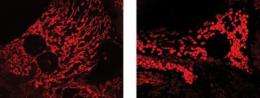
This shows hepatic cells isolated from healthy mice and mice deficient in Mitofusin 2 (right). Morphology of mitochondria (red), more rounded, is altered in the image on the right Credit: Antonio Zorzano laboratory (IRB Barcelona)

Researchers at the Institute for Research in Biomedicine (IRB Barcelona, Spain)) have discovered that deficiency of a single protein, Mitofusin 2, in muscle and hepatic cells of mice is sufficient to cause tissues to become insensitive to insulin, thus producing an increase in blood glucose concentrations. These are the two most common conditions prior to development of diabetes type 2. Published in this week's issue of Proceedings of the National Academy of Sciences (PNAS), the study validates Mitofusin 2 as a possible target for the treatment of diabetes type 2.

"Resistance to insulin plays a key role in the development of diabetes mellitus, dyslipidemia (alteration of lipid concentrations) and obesity. Mitofusin 2 may provide a specific target for the development of drugs that could hold back a disease that affects millions of people worldwide", explains the head of the study, Antonio Zorzano, full professor of the University of Barcelona, coordinator of the Molecular Medicine Programme at IRB Barcelona, and head of the Heterogenic and Polygenic Diseases lab at the same centre.

The estimates that there will be 350 million people suffering from diabetes in 2020. Diabetes type 2 accounts for 90% of diabetes cases and is due to a great extent to , poor nutrition and sedentary lifestyle. According to the Spanish Society of Diabetes, in Spain 6.5% of the current population between 30 and 65 years has this disease and about 11.6 % of Spaniards are at risk of developing it.

Previous studies performed at IRB Barcelona demonstrate that both obese and subjects have low levels of muscle Mitofusin 2. This protein controls the in the liver and muscles. The scientists have observed that deficiency of this protein causes alterations in mitochondria and the endoplasmic reticulum, two crucial organelles for correct cell functioning. "We have shown that the accumulation of dysfunctions in these two structures alters cell behavior and favors the appearance of pre-diabetes symptoms", say the main authors of the article, David Sebastián and María Isabel Hernández-Álvarez, post-doctoral fellows in Zorzano's team.

More information: PNAS (2012): Doi:10.1073/pnas.1108220109

Journal reference: Proceedings of the National Academy of Sciences search and more info website

Provided by IRB Barcelona

not rated yet  

Rank not rated yet
Relevant PhysicsForums posts

More news stories

Exercise prevents fructose-induced hypertriglyceridemia

(HealthDay)—Moderate aerobic exercise prevents fructose-induced hypertriglyceridemia in healthy males, according to a study published online May 14 in Diabetes.

Diabetes created 19 hours ago | popularity 5 / 5 (1) | comments 0 | with audio podcast

DNA variant affects diabetes risk and treatment response

A DNA variant near a digestive enzyme does not only affect risk of developing diabetes but also affects the response to treatment, an international consortium of researchers including the University of Dundee has found.

Diabetes created May 17, 2013 | popularity not rated yet | comments 0 | with audio podcast

The artificial pancreas that keeps tabs on sugar

(Medical Xpress)—Development of a sophisticated artificial pancreas holds potential to transform the lives of patients with Type 1 diabetes.

Diabetes created May 16, 2013 | popularity 5 / 5 (1) | comments 0 | with audio podcast

Study findings significant for treating infections in Type 1 diabetes

A small University at Buffalo study has found for the first time that in Type 1 diabetics, insulin injections exert a strong anti-inflammatory effect at the cellular and molecular level, while even small amounts of glucose ...

Diabetes created May 16, 2013 | popularity not rated yet | comments 0

Hospital hypoglycemia rates up in black men with diabetes

(HealthDay)—Home diabetes regimens partially explain the increased risk of having a hypoglycemia event during hospitalization among older African-American men with diabetes, according to a study published ...

Diabetes created May 14, 2013 | popularity not rated yet | comments 0


AIDS science at 30: 'Cure' now part of lexicon

Big names in medicine are set to give an upbeat assessment of the war on AIDS on Tuesday, 30 years after French researchers identified the virus that causes the disease.

For combat veterans suffering from post-traumatic stress disorder, 'fear circuitry' in the brain never rests

Chronic trauma can inflict lasting damage to brain regions associated with fear and anxiety. Previous imaging studies of people with post-traumatic stress disorder, or PTSD, have shown that these brain regions can over-or ...

Melon focus headband turns to Kickstarter for rollout plans

(Medical Xpress)—What if the quality of your work depends more on your focus on the piano keys or canvas or laptop than your musical or painting or computing skills? If target users can be convinced, they ...

Temporal processing in the olfactory system

The neural machinery underlying our olfactory sense continues to be an enigma for neuroscience. A recent review in Neuron seeks to expand traditional ideas about how neurons in the olfactory bulb might encode information about ...

23 dead in initiation rites in South Africa

(AP)—Twenty-three youths have died in the past nine days at initiation ceremonies that include circumcisions and survival tests, South African police said Friday.

Now we know why old scizophrenia medicine works on antibiotics-resistant bacteria

In 2008 researchers from the University of Southern Denmark showed that the drug thioridazine, which has previously been used to treat schizophrenia, is also a powerful weapon against antibiotic-resistant bacteria such as ...