Alzheimer's precursor protein controls its own fate, study finds
April 10, 2012 in Alzheimer's disease & dementia
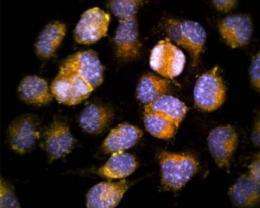
This is a microscopic image showing co-localization of a fragment of the amyloid precursor protein, known as sAPP-α, with BACE1, an enzyme involved in the development of characteristic Alzheimer's amyloid deposits. This merging suggests sAPP-α may serve as a mechanism to inhibit BACE1 activity and thus lower production of toxic amyloid beta associated with Alzheimer's disease. Credit: © University of South Florida
A research team led by the University of South Florida Department of Psychiatry & Behavioral Neurosciences has found that a fragment of the amyloid precursor protein (APP) -- known as sAPP-α and associated with Alzheimer's disease -- appears to regulate its own production. The finding may lead to ways to prevent or treat Alzheimer's disease by controlling the regulation of APP.
Their study is published online today in Nature Communications.
"The purpose of this study was to help better understand why, in most cases of Alzheimer's disease, the processing of APP becomes deregulated, which leads to the formation of protein deposits and neuron loss," said study senior author Dr. Jun Tan, professor of psychiatry and the Robert A. Silver Chair, Rashid Laboratory for Developmental Neurobiology at the USF Silver Child Development Center. "The many risk factors for Alzheimer's disease can change the way APP is processed, and these changes appear to promote plaque formation and neuron loss."
An estimated 30 million people worldwide and 5 million in the U.S. have Alzheimer's. With the aging of the "Baby Boom" generation, the prevalence of the debilitating disease is expected to increase dramatically in the U.S. in the coming years. Currently, there are no disease-modifying treatments to prevent, reverse or halt the progression of Alzheimer's disease, only medications that may improve symptoms for a short time.
"For the first time, we have direct evidence that a secreted portion of APP itself, so called 'sAPP-α,' acts as an essential stop-gap mechanism," said the study's lead author Dr. Demian Obregon, a resident specializing in research in the Department of Psychiatry & Behavioral Neurosciences at USF Health. "Risk factors associated with Alzheimer's disease lead to a decline in sAPP-α levels, which results in excessive activity of a key enzyme in Aβ formation,"
In initial studies using cells, and in follow-up studies using mice genetically engineered to mimic Alzheimer's disease, the investigators found that the neutralization of sAPP-α leads to enhanced Aβ formation. This activity depended on sAPP-α's ability to associate with the APP-converting enzyme, BACE1. When this interaction was blocked, Aβ formation was restored.
The authors suggest that through monitoring and correcting low sAPP-α levels, or through enhancing its association with BACE, Alzheimer's disease may be prevented or treated.
Provided by University of South Florida
-
Autism may be linked to abnormal immune system characteristics and novel protein fragment
Jan 03, 2012 |
not rated yet |
0
-
New biomarker may help with early diagnosis of Alzheimer's disease
Jun 22, 2011 |
not rated yet |
0
-
New key factor identified in the development of Alzheimer's disease
Jan 04, 2010 |
not rated yet |
0
-
Characterizing a toxic offender
Dec 09, 2011 |
not rated yet |
0
-
Mechanisms that prevent Alzheimer's Disease: Enzymatic activity plays key role
Feb 23, 2009 |
not rated yet |
0
-
Motion perception revisited: High Phi effect challenges established motion perception assumptions
Apr 23, 2013 |
3 / 5 (2) |
2
-
Anything you can do I can do better: Neuromolecular foundations of the superiority illusion (Update)
Apr 02, 2013 |
4.5 / 5 (11) |
5
-
The visual system as economist: Neural resource allocation in visual adaptation
Mar 30, 2013 |
5 / 5 (2) |
9
-
Separate lives: Neuronal and organismal lifespans decoupled
Mar 27, 2013 |
4.9 / 5 (8) |
0
-
Sizing things up: The evolutionary neurobiology of scale invariance
Feb 28, 2013 |
4.8 / 5 (10) |
14
-
How many joules expended for a push up?
1 hour ago
-
force to keep the folding doors
1 hour ago
-
Confusion regarding direction of kinetic friction on inclined plane.
2 hours ago
-
Mage hand
8 hours ago
-
Sphygmomonometers energy...storage?
10 hours ago
-
How does momentum, inertia and drag affect the motion of an object?
13 hours ago
- More from Physics Forums - Classical Physics
More news stories
Study identifies new approach to improving treatment for MS and other conditions
(Medical Xpress)—Working with lab mice models of multiple sclerosis (MS), UC Davis scientists have detected a novel molecular target for the design of drugs that could be safer and more effective than current FDA-approved ...
Alzheimer's disease & dementia
19 hours ago |
5 / 5 (2) |
0
|
Nonmelanoma skin cancer tied to lower Alzheimer's risk
(HealthDay)—Older individuals with nonmelanoma skin cancer (NMSC) seem to have a significantly reduced risk of developing Alzheimer's disease (AD), according to a study published online May 15 in Neurology.
Alzheimer's disease & dementia
May 16, 2013 |
5 / 5 (1) |
0
Skin cancer may be linked to lower risk of Alzheimer's disease
People who have skin cancer may be less likely to develop Alzheimer's disease, according to new research published in the May 15, 2013, online issue of Neurology®, the medical journal of the American Academy of Neurology. The li ...
Alzheimer's disease & dementia
May 15, 2013 |
5 / 5 (1) |
0
|
Alzheimer's markers predict start of mental decline
(Medical Xpress)—Scientists at Washington University School of Medicine in St. Louis have helped identify many of the biomarkers for Alzheimer's disease that could potentially predict which patients will develop the disorder ...
Alzheimer's disease & dementia
May 14, 2013 |
3 / 5 (1) |
0
|
Scientists develop drug that slows Alzheimer's in mice
A drug developed by scientists at the Salk Institute for Biological Studies, known as J147, reverses memory deficits and slows Alzheimer's disease in aged mice following short-term treatment. The findings, ...
Alzheimer's disease & dementia
May 13, 2013 |
4.2 / 5 (5) |
0
|
New research identifies risks, interventions for children's GI health
An increasing number of U.S. children are experiencing gastrointestinal issues that require interventions to resolve, according to research presented at Digestive Disease Week (DDW).
New colonoscope provides ground-breaking view of colon
A ground-breaking advance in colonoscopy technology signals the future of colorectal care, according to research presented today at Digestive Disease Week(DDW). Additional research focuses on optimizing the minimal withdrawal ...
AIDS science at 30: 'Cure' now part of lexicon
Big names in medicine are set to give an upbeat assessment of the war on AIDS on Tuesday, 30 years after French researchers identified the virus that causes the disease.
For combat veterans suffering from post-traumatic stress disorder, 'fear circuitry' in the brain never rests
Chronic trauma can inflict lasting damage to brain regions associated with fear and anxiety. Previous imaging studies of people with post-traumatic stress disorder, or PTSD, have shown that these brain regions can over-or ...
Melon focus headband turns to Kickstarter for rollout plans
(Medical Xpress)—What if the quality of your work depends more on your focus on the piano keys or canvas or laptop than your musical or painting or computing skills? If target users can be convinced, they ...
Temporal processing in the olfactory system
The neural machinery underlying our olfactory sense continues to be an enigma for neuroscience. A recent review in Neuron seeks to expand traditional ideas about how neurons in the olfactory bulb might encode information about ...