Fatty acids fight cancer spread
April 10, 2012 in Cancer

Fatty acids fight cancer spread

Enlarge

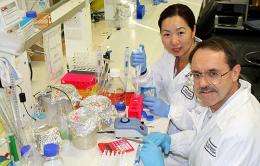
Professor Michael Murray and Dr Sarah Cui were part of the team who made the discovery.

Tiny agents found in omega-3 could potentially be used to block the path of primary cancer tumours, preventing the advance to secondary stage cancers according to pharmacy researchers at the University of Sydney.

Investigators in the Pharmacogenomics and Drug Development Group of the Faculty of Pharmacy are using to gauge the blocking capacity of the omega-3 agents called epoxides on cancer cell movement.

Dr. Michael Murray, Professor of Pharmogenetics at the University, says a major life-threatening consequence of malignant is metastasis where the disease has spread to distant sites (or tissues) and at present there are no treatments.

He led his team to the discovery of the anti-metastatic actions of epoxides which are produced within the body from omega-3 polyunsaturated fatty acids. The groundbreaking work has led Murray and his Drug Development Group deeper into the molecular structure of the omega-3 agents.

Professor Murray says: "These agents are a bit like frontline soldiers blocking the assault of an invading army and now we want to advance our research which was published late last year and apply it to .

"We know that epidemiological studies have reported that dietary intake of omega-3 including eicosapentaenoic and docosahexaenoic acids, decrease the risk of certain cancers. And many of us are including sources of omega-3 such as tuna and salmon in our diet as a precaution.

"The major objective of our new project is to speed the development of anti-metastatic agents based on omega-3 epoxides and trial their effectiveness in vivo on breast cancer tissue.

"Longer term we are aiming to develop a completely new class of anti-metastatic drugs designed to inhibit the spread of primary cancers," Murray says.

Although not all experts agree, women who eat foods rich in omega-3 fatty acids over many years may be less likely to develop breast cancer. More research is needed to understand the effect that omega-3 fatty acids may have on the prevention of breast cancer says Murray.

Research has also shown that omega-3 fatty acids reduce inflammation and may help lower risk of chronic diseases such as heart disease and arthritis.

Provided by University of Sydney

not rated yet  

Rank not rated yet
Relevant PhysicsForums posts

More news stories

New fluorescent tools for cancer diagnosis

In recent years, microRNAs (miRNAs) and other non-coding RNAs are small molecules that help control the expression of specific proteins. In recent years they have emerged as disease biomarkers. miRNA profiles have been used ...

Cancer created 22 hours ago | popularity not rated yet | comments 0

Modulating the immune system to combat metastatic cancer

Cancer cells spread and grow by avoiding detection and destruction by the immune system. Stimulation of the immune system can help to eliminate cancer cells; however, there are many factors that cause the immune system to ...

Cancer created 22 hours ago | popularity 5 / 5 (1) | comments 0

Scientists put bowel cancer under the microscope

Researchers from London's Kingston University have begun a two-year study which could help prolong the lives of people with colorectal tumours.

Cancer created May 24, 2013 | popularity 5 / 5 (1) | comments 0

Researcher identifies breast cancer fighting hormone

Transformative research from Western University has identified new hormones in the body which may suppress breast cancer and stimulate the regression of breast tumors.

Cancer created May 24, 2013 | popularity 5 / 5 (2) | comments 0

Ground breaking cancer research finds immune system link

(Medical Xpress)—Curtin University researchers have found evidence that targeting specific cells in the body can reverse the effects of cancer on the immune system.

Cancer created May 24, 2013 | popularity 5 / 5 (4) | comments 0


First drug to improve heart failure mortality in over a decade

Coenzyme Q10 decreases all cause mortality by half, according to the results of a multicentre randomised double blind trial presented today at Heart Failure 2013 congress. It is the first drug to improve heart failure mortality ...

Hormone levels may provide key to understanding psychological disorders in women

Women at a particular stage in their monthly menstrual cycle may be more vulnerable to some of the psychological side-effects associated with stressful experiences, according to a study from UCL.

Heart failure accelerates male 'menopause'

Heart failure accelerates the aging process and brings on early andropausal syndrome (AS), according to research presented today at the Heart Failure Congress 2013. AS, also referred to as male 'menopause', was four times ...

Researchers identify first drug targets in childhood genetic tumor disorder

Two mutations central to the development of infantile myofibromatosis (IM)—a disorder characterized by multiple tumors involving the skin, bone, and soft tissue—may provide new therapeutic targets, according to researchers ...

Going live: Immune cell activation in multiple sclerosis

Biological processes are generally based on events at the molecular and cellular level. To understand what happens in the course of infections, diseases or normal bodily functions, scientists would need to ...

Feds fight morning-after pill age ruling in NY

(AP)—Department of Justice lawyers have again asked a federal appeals court in New York to delay lifting age restrictions and prescription requirements on an emergency contraceptive popularly known as the morning-after ...