Human skin model shows signaling pathway effects from low dose exposure
April 25, 2012 in Genetics

Human skin model shows signaling pathway effects from low dose exposure

Enlarge

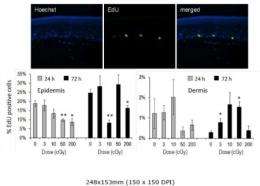
Upper panel: Stained tissue section for EdU incorporation with Alexa 488-fluorescent coupled antibody (green) indicating cells that synthesize DNA and DNA in blue, 20x. EdU is a nucleoside analog of thymidine and is incorporated into DNA during synthesis and repair. Lower panel: Percentage of EdU-positive nuclei per tissue section for epidermal keratinocytes and dermal fibroblasts 24 and 72 hrs post exposure to 3, 10, 50 and 200 cGy. Mean values with standard error of the mean for three (0, 3, 50 cGy) or six (10, 200 cGy) biological replicates each. * p values < 0.05, ** p values < 0.005

(Medical Xpress) -- In studies on a human skin tissue model, researchers at Pacific Northwest National Laboratory used a systems biology approach to show that an ionizing radiation dose mimicking that received during a CT scan is sufficient to alter genes in two cell layers. The epidermis is the outer skin layer, and the dermis is beneath it. The researchers found 1452 genes altered in the dermis and 428 genes altered in the epidermis. Genes altered in the two layers showed little overlap, but the affected signaling pathways were similar.

These results were found to be in good agreement with human in vivo data, which suggests that the 3D human model, though greatly simplified, provides a faithful representation of intact tissue.  It further highlights the need for cell type-dependent analysis, because the involved cell layers showed differences in their response at the gene, protein, and cellular levels.

Medical exposures are the primary source of non-background radiation exposure in the U.S., and more than 70 million CT scans are performed annually. These scans result in organ doses between 5-100 milliSievert (equals 5-100 centiGrays, or cGy). A second source of radiation exposures is doses in the normal tissue during radiotherapy treatments.

Current risk estimates for developing radiation-induced cancer and other health problems are extrapolated from high dose exposure data, and large uncertainty exists in defining the dose-response relationship in the low-dose region. The exposure scenario in this study (10 cGy) mimics the dose limit for a full body spiral CT and the skin dose in radiotherapy procedures.

The scientists performed a microarray study on a 3D reconstituted tissue model. They used quantitative reverse transcription polymerase chain reaction (qRT-PCR) to validate the microarray data.

They then analyzed the proliferation profile and the expression of proliferating cell nuclear antigen (PCNA) in both layers and found that 50 or 200 cGy of exposure decreased the percentage of proliferating cells in the epidermis, while 3 or 10 cGy were insufficient to induce the same effect. Later, samples exposed to 50 cGy returned to control levels; however, the 10- and 200-cGy exposures still showed decreased proliferation compared to the control. No significant changes could be detected in the dermis because of the low numbers of proliferating cells.

PCNA expression increased significantly in 10 and 200 cGy exposed samples before returning to control level. No statistical significant change in apoptosis was detected, which suggests PCNA involvement in DNA repair and synthesis instead of apoptosis.

The scientists want to study radiation quality effects on the differentiation profile of the cells in the epidermis. Differentiating cells are no longer active but provide important structural proteins, and in their terminal differentiated state, they form the skin barrier. A breakdown of the skin barrier function can lead to fluid loss and invasion of pathogenic germs. They intend to investigate if radiation-induced alterations in proliferation affect the differentiation process and lead to skin barrier damage.

More information: von Neubeck C, et al. 2012. "Cell type-dependent gene transcription profile in a three-dimensional human skin tissue model exposed to low doses of ionizing radiation: Implications for medical exposures." Environmental and Molecular Mutagenesis 53(4):247-259. DOI: 10.1002/em.21682

Provided by Pacific Northwest National Laboratory search and more info website

not rated yet  

Rank not rated yet
Relevant PhysicsForums posts

More news stories

Researchers complete largest genetic sequencing study of human disease

Researchers from Queen Mary, University of London have led the largest sequencing study of human disease to date, investigating the genetic basis of six autoimmune diseases.

Genetics created 17 hours ago | popularity 4.7 / 5 (3) | comments 0 | with audio podcast

Researchers develop model for better testing, targeting of malignant peripheral nerve sheath tumors

University of Minnesota Medical School researchers from the Masonic Cancer Center, University of Minnesota, in partnership with the University's Brain Tumor Program, have developed a new mouse model of malignant peripheral ...

Genetics created May 20, 2013 | popularity 5 / 5 (1) | comments 0 | with audio podcast

Researchers identify new circadian clock component

Northwestern University scientists have shown a gene involved in neurodegenerative disease also plays a critical role in the proper function of the circadian clock.

Genetics created May 16, 2013 | popularity 3 / 5 (1) | comments 1 | with audio podcast

Returning genetic incidental findings without patient consent violates basic rights, experts say

Informed consent is the backbone of patient care. Genetic testing has long required patient consent and patients have had a "right not to know" the results. However, as 21st century medicine now begins to use the tools of ...

Genetics created May 16, 2013 | popularity 5 / 5 (1) | comments 3 | with audio podcast

Ethicists provide framework supporting new recommendations on reporting incidental findings in gene sequencing

In a paper published in Science Express, a group of experts led by bioethicists in the Center for Medical Ethics and Health Policy at Baylor College of Medicine provide a framework for the new American College of Medical Geneti ...

Genetics created May 16, 2013 | popularity not rated yet | comments 0


Slowing the aging process—only with antibiotics

Swiss scientists reveal the mechanism responsible for aging hidden deep within mitochondria—and dramatically slow it down in worms by administering antibiotics to the young.

Rate of bicycle-related fatalities significantly lower in states with helmet laws

Existing research shows that bicyclists who wear helmets have an 88 percent lower risk of brain injury, but researchers at Boston Children's Hospital found that simply having bicycle helmet laws in place showed a 20 percent ...

Brain can be trained in compassion, study shows

Until now, little was scientifically known about the human potential to cultivate compassion—the emotional state of caring for people who are suffering in a way that motivates altruistic behavior.

Having both migraines, depression may mean smaller brain

(HealthDay)—Migraines and depression can each cause a great deal of suffering, but new research indicates the combination of the two may be linked to something else entirely—a smaller brain.

Novel approach for influenza vaccination shows promise in early animal testing

A new approach for immunizing against influenza elicited a more potent immune response and broader protection than the currently licensed seasonal influenza vaccines when tested in mice and ferrets. The vaccine ...

Enzyme-activating antibodies revealed as marker for most severe form of rheumatoid arthritis

In a series of lab experiments designed to unravel the workings of a key enzyme widely considered a possible trigger of rheumatoid arthritis, researchers at Johns Hopkins have found that in the most severe ...