Longer breastfeeding along with antiretroviral drugs could lower HIV transmission to babies
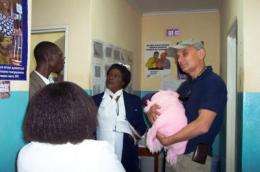
Shown here are Charles Chasela, PhD, nurse Bertha Chisale, Charles van der Horst, MD (holding a BAN study baby) and the baby's mother. This photo was taken at Kawale Clinic in Lilongwe, Malawi. Credit: Photo by Lisa Chensvold/UNC Institute for Global Health & Infectious Diseases
In early results of a large-scale randomized study published in 2010 and led by researchers from the University of North Carolina at Chapel Hill, giving daily antiretroviral drugs (ART) to HIV-infected moms or their breastfeeding babies for 28 weeks proved safe and effective for preventing mother-to-child HIV transmission through breast milk.
Now it appears that early weaning stopping breastfeeding before six months is of little, if any, protective value against HIV transmission nor is it safe for infant survival.
The findings came from the Breastfeeding, Antiretrovirals, and Nutrition (BAN) trial that was conducted in Lilongwe, Malawi, between April 21, 2004 and January 28, 2010. The study involved more than 2,300 HIV-infected breastfeeding mothers and their newborn babies. BAN investigators were from the U.S. Centers for Disease Control and Prevention (CDC), UNC-Chapel Hill, and UNC Project-Malawi in Lilongwe, Malawi.
In 2010, BAN investigators reported early results demonstrating a 74 project reduction in HIV transmission to the breastfeeding babies if they were taking a single daily dose of the antiviral medication nevirapine for 28 weeks. In light of this and other emerging evidence, the World Health Organization in 2010 recommended that antiretroviral drugs be given to either HIV-infected mothers or infants throughout breastfeeding.
A report of the latest and long-term (48 week) BAN outcomes appears in the online edition of The Lancet on April 26, 2012. Here, the researchers focused specifically on the safety and effects of weaning and stopping of maternal or infant ART at 28 weeks after birth. The study's first author is Denise J. Jamieson, MD, MPH from the CDC. Senior author and principal investigator of BAN is Charles van der Horst, MD, a professor in the UNC School of Medicine, Division of infectious diseases.
Jamieson and her BAN colleagues found the overall risk of HIV transmission was significantly greater at 48 weeks (7 percent) in the control group of infants (breastfeeding only) than in the maternal ART group (4 percent) and the infant ART group (4 percent). However, about a third of the infants became HIV infected after most mothers said they had stopped nursing their babies at 28 weeks after giving birth.
"Our 48-week follow-up of women in Malawi has shown that either infant or maternal prophylaxis [with ART] effectively reduces postnatal HIV transmission and that this protective effect persists until after breastfeeding cessation," states Dr. Jamieson. "However, transmission does occur after mothers report that they have weaned their infants."
The report also noted that infant illnesses (diarrhea, malaria and TB), growth problems, and deaths significantly increased after early weaning. "Breastfeeding is essential for babies in Malawi. There should be no early weaning and anti-HIV medications given to the mother or infant should be continued throughout the breastfeeding period," Dr. van der Horst said.
More information: www.thelancet.com/… 1-3/abstract
Provided by
University of North Carolina School of Medicine
-
ART therapy for babies, mothers safely reduces HIV transmission
Jul 22, 2009 |
not rated yet |
0
-
Prevention of mother-child transmission programs work but infants need checking for drug resistance
Mar 29, 2011 |
not rated yet |
0
-
Zambian study finds longer breastfeeding best for HIV-infected mothers
Jan 14, 2010 |
not rated yet |
0
-
Extended infant antiretroviral prophylaxis reduces HIV risk during breastfeeding
Jun 05, 2008 |
not rated yet |
0
-
Maternal HIV-1 treatment protects against transmission to newborns
Oct 16, 2009 |
not rated yet |
0
-
Motion perception revisited: High Phi effect challenges established motion perception assumptions
Apr 23, 2013 |
3 / 5 (2) |
2
-
Anything you can do I can do better: Neuromolecular foundations of the superiority illusion (Update)
Apr 02, 2013 |
4.5 / 5 (11) |
5
-
The visual system as economist: Neural resource allocation in visual adaptation
Mar 30, 2013 |
5 / 5 (2) |
9
-
Separate lives: Neuronal and organismal lifespans decoupled
Mar 27, 2013 |
4.9 / 5 (8) |
0
-
Sizing things up: The evolutionary neurobiology of scale invariance
Feb 28, 2013 |
4.8 / 5 (10) |
14
-
Classical and Quantum Mechanics via Lie algebras
Apr 15, 2011
- More from Physics Forums - Independent Research
More news stories
Engineered cytomegalovirus protects monkeys from HIV equivalent
(Medical Xpress)—A new study by researchers in the US has shown that an ancient virus can be modified to help in the fight against the simian immunodeficiency virus SIV, which is the equivalent in monkeys ...
HIV & AIDS
26 minutes ago |
not rated yet |
0
|
New microsphere-based methods for detecting HIV antibodies
Detection of HIV antibodies is used to diagnose HIV infection and monitor trials of experimental HIV/AIDS vaccines. New, more sensitive detection systems being developed use microspheres to capture HIV antibodies ...
HIV & AIDS
16 hours ago |
5 / 5 (1) |
0
Fecal microbiota tx feasible for recurrent C. difficile in HIV
(HealthDay)—For HIV-infected individuals with recurrent Clostridium difficile infection, fecal microbiota therapy is feasible, according to a letter published in the May 21 issue of the Annals of Intern ...
HIV & AIDS
May 22, 2013 |
not rated yet |
0
Canada lifts ban on gay men donating blood
Canadian health authorities lifted Wednesday what was effectively a ban on gay men giving blood, announcing new rules making men who have not had sex with men in the past five years eligible.
HIV & AIDS
May 22, 2013 |
not rated yet |
1
AIDS scientists optimistic of AIDS cure, for some
Top AIDS scientists were optimistic Wednesday of finding a cure for the disease that has claimed 30 million lives—but said it might not work for all people.
HIV & AIDS
May 22, 2013 |
not rated yet |
0
Help at hand for people with schizophrenia
How can healthy people who hear voices help schizophrenics? Finding the answer for this is at the centre of research conducted at the University of Bergen.
Scientists put bowel cancer under the microscope
Researchers from London's Kingston University have begun a two-year study which could help prolong the lives of people with colorectal tumours.
Are there atheists in foxholes? Study says they're the minority
Ernie Pyle – an iconic war correspondent in World War II – reportedly said "There are no atheists in foxholes." A new joint study between two brothers at Cornell and Virginia Wesleyan found that only ...
Breathing exercises help veterans find peace after war, scholar says
(Medical Xpress)—Research by Stanford scholar Emma Seppala at the Center for Compassion and Altruism Research and Education found that post-traumatic stress disorder decreased in veterans who participated ...
Do doctors understand the individualisation of treatments?
The individualisation of drug treatments to support patients to self-manage their conditions is a concept that sits at the heart of policy, but a recent study in BMJ Open shows that there is no concrete defini ...
Reducing experimental inflammatory arthritis
(Medical Xpress)—UCD researchers led by Conway Fellow, Professor David Brayden in UCD School of Veterinary Medicine have successfully reduced inflammation in the swollen arthritic knees of a murine model using a novel nanoparticle.