Rhythm of heart revealed by 3D X-ray
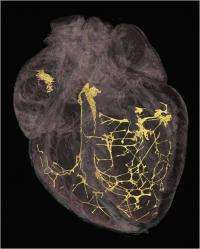
A 3D image of the heart, showing the fibres that control heart rhythm
(Medical Xpress) -- Scientists at the University have developed a new X-ray technique to identify tissue fibres in the heart that ensure the muscle beats in a regular rhythm.
The new 3D images could further understanding of how the bodys heartbeat can be disturbed, which may help medics develop ways to reduce the risk of fibrillation a condition in which heart muscle contracts chaotically and fails to pump blood rhythmically around the body.
The heart needs to pump blood in a regular rhythm to maintain a steady circulation of blood to all parts of the body. It does this through the coordinated action of the muscle tissue, that pumps the blood, and the conducting tissue, which is necessary to distribute an electrical wave to trigger every heartbeat. Until now scientists have been unable to produce high resolution 3D images of the conducting tissue to fully identify the network that controls heart rhythm.
The team at Liverpool used a micro CT scanner to image hearts that had been treated with iodine to highlight the different parts of the tissue. They found that the solution was absorbed less significantly by the conducting parts of the heart compared to the muscular parts of the organ, allowing scientists to clearly identify the areas that produce electrical activity on the resulting 3D image.
Dr Jarvis: "Images will help us understand normal and abnormal heart rhythms"
Dr Jonathan Jarvis, from the Universitys Institute of Ageing and Chronic Disease, said: These new anatomically-detailed images could improve the accuracy of future computer models of the heart and help us understand how normal and abnormal heart rhythms are generated. 3D imaging will give us a more thorough knowledge of the cardiac conduction system, and the way it changes in heart disease.Computer models based on these high-fidelity images will help us to understand why the heart rhythm is vulnerable to changes in heart size, blood supply, or scarring after a heart attack. One of the major concerns for surgeons in repairing malformed hearts, for example, is to avoid damage to the tissue that distributes electrical waves. If they had access to 3D images of the conducting tissues in malformed hearts, however, it could be possible to understand where the conducting tissue is likely to be before they operate.
The research, in collaboration with Alder Hey Childrens Hospital and the University of Manchester, is published in PLoS ONE.
Provided by
University of Liverpool
-
Enzyme prevents fatal heart condition associated with athletes
May 25, 2011 |
not rated yet |
0
-
Cardiac imaging breakthrough developed at the University of Western Ontario
Sep 16, 2010 |
not rated yet |
0
-
Keeping the rhythm of life in sync
May 28, 2008 |
not rated yet |
0
-
Researchers examine developing hearts in chickens to find solutions for human heart abnormalities (Video)
Jan 21, 2009 |
not rated yet |
0
-
Tiny heart pump helps heart attack, heart failure patients
Mar 25, 2011 |
not rated yet |
0
-
Motion perception revisited: High Phi effect challenges established motion perception assumptions
Apr 23, 2013 |
3 / 5 (2) |
2
-
Anything you can do I can do better: Neuromolecular foundations of the superiority illusion (Update)
Apr 02, 2013 |
4.5 / 5 (11) |
5
-
The visual system as economist: Neural resource allocation in visual adaptation
Mar 30, 2013 |
5 / 5 (2) |
9
-
Separate lives: Neuronal and organismal lifespans decoupled
Mar 27, 2013 |
4.9 / 5 (8) |
0
-
Sizing things up: The evolutionary neurobiology of scale invariance
Feb 28, 2013 |
4.8 / 5 (10) |
14
-
Question in reflection and transmission at oblique incidence.
3 hours ago
-
Is this plasma (picture in thread)
4 hours ago
-
Basic physics understanding. Could someone explain?
6 hours ago
-
Change in flux of a transformer
6 hours ago
-
Electric field between parallel plate capacitor
7 hours ago
-
Why angle of projectile has 2 solutions?
8 hours ago
- More from Physics Forums - Classical Physics
More news stories
Registry confirms TAVI efficacy and safety in Asian patients
Transcatheter aortic valve implantation (TAVI) is effective and safe in Asian patients, according to early experience based on first results from a multicentre Asian registry reported at EuroPCR 2013.
Cardiology
10 hours ago |
not rated yet |
0
Diagnostic coronary angiography: Functional flow reserve changes decisions in 25 percent of cases
Routinely measuring fractional flow reserve (FFR) using pressure wire assessment during coronary angiography for diagnosis of chest pain leads to significant changes in the management of one in four patients, according to ...
Cardiology
12 hours ago |
not rated yet |
0
Feasibility trial reports deployment of new device for TAVI in aortic insufficiency
A new investigational device - the Helio System (TF-FA) - being developed for use with the Sapien XT Transcatheter Heart Valve was successfully deployed in all four patients in a small, first-in-human feasibility study of ...
Cardiology
13 hours ago |
not rated yet |
0
Cardiac study used as source for new guidelines on treating people undergoing coronary artery bypass surgery
Cardiac research from the University of Alberta had serious impact as a source for the American College of Cardiology and the American Heart Association's new guidelines on how to treat patients undergoing coronary artery ...
Cardiology
13 hours ago |
not rated yet |
0
Dual-source cardiac CT IDs CAD in hard-to-image patients
(HealthDay)—In patients who have previously been considered difficult to image, dual-source cardiac (DSC) computed tomography (CT) can identify clinically significant coronary artery disease, according ...
Cardiology
May 23, 2013 |
not rated yet |
0
Researchers identify first drug targets in childhood genetic tumor disorder
Two mutations central to the development of infantile myofibromatosis (IM)—a disorder characterized by multiple tumors involving the skin, bone, and soft tissue—may provide new therapeutic targets, according to researchers ...
Engineered cytomegalovirus protects monkeys from HIV equivalent
(Medical Xpress)—A new study by researchers in the US has shown that an ancient virus can be modified to help in the fight against the simian immunodeficiency virus SIV, which is the equivalent in monkeys ...
Hormone levels may provide key to understanding psychological disorders in women
Women at a particular stage in their monthly menstrual cycle may be more vulnerable to some of the psychological side-effects associated with stressful experiences, according to a study from UCL.
Going live: Immune cell activation in multiple sclerosis
Biological processes are generally based on events at the molecular and cellular level. To understand what happens in the course of infections, diseases or normal bodily functions, scientists would need to ...
Driving and hands-free talking lead to spike in errors, study shows
Talking on a hands-free device while behind the wheel can lead to a sharp increase in errors that could imperil other drivers on the road, according to new research from the University of Alberta.
Comorbidities common with alopecia areata
(HealthDay)—Comorbid conditions often accompany alopecia areata, according to a study published online May 22 in JAMA Dermatology.
