Social stress affects immune system gene expression in monkeys
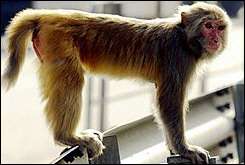
The ranking of a monkey within her social environment and the stress accompanying that status dramatically alters the expression of nearly 1,000 genes, a new scientific study reports. The research is the first to demonstrate a link between social status and genetic regulation in primates on a genome-wide scale, revealing a strong, plastic link between social environment and biology.
In a comparison of high-ranking rhesus macaque females with their low-ranking companions, researchers discovered significant differences in the expression of genes involved in the immune response and other functions. When a female's rank improved, her gene expression also changed within a few weeks, suggesting that social forces can rapidly influence genetic regulation.
"We were able to use gene expression to classify individuals based on their rank," said Yoav Gilad, PhD, associate professor of human genetics at the University of Chicago Biological Sciences and senior author of the study in the Proceedings of the National Academy of Sciences. "Demonstrating these very plastic and temporal changes was novel and quite interesting."
The research, led by University of Chicago postdoctoral researcher Jenny Tung, was conducted with rhesus macaques housed in groups of five at the Yerkes National Primate Research Center in Atlanta. As in the wild, each group self-organizes into a dominance hierarchy, defined by which individual yields first during competition over food, water and grooming partners. In captivity, dominance is determined by the order of introduction into the group, giving researchers an opportunity to study how changes in rank lead to biological effect.
"In the wild, females would not ordinarily leave the social group they were born into," said Tung, PhD, now an assistant professor of evolutionary anthropology at Duke University. "They inherit their social rank from their mothers. But in this unnatural situation, order of introduction determines rank – the newcomer is generally lower status."
Previous research on rhesus macaques discovered that social rank influenced components of the stress response, brain, and immune system. With gene chip technology for measuring the expression of over 6,000 different genes, Tung, Gilad and colleagues at Yerkes, Emory University, and Johns Hopkins looked for the first time in primates at the effects of social rank on genetic function.
Comparing 49 different female monkeys of different rank revealed significant changes in the expression of 987 genes, including 112 genes associated with immune system function. The result fits with data in monkeys where low rank and chronic stress lead to compromised immune function, and, more loosely, with human studies linking low socioeconomic status and high social stress to elevated disease risk.
The overall genetic "signature" of expression changes was robust enough that researchers could predict an individual monkey's social rank with high accuracy from their gene expression profile alone. That predictive power also enabled an unanticipated second test of whether gene expression would reflect unplanned changes in dominance rank.
"It was a fortunate event in the experiment," Gilad said. "When a couple of animals were removed from cages for various reasons and new ones were introduced to the groups, it turned out to improve the rank of a few monkeys. We could take advantage of this switch and see if our classifier still works."
By analyzing blood samples from these monkeys before and after their move, the researchers were able to use gene expression signatures to correctly predict the change in rank for six of seven monkeys. The result demonstrates that socially-induced gene expression changes are not stable, but can change rapidly in response to changes in social environment.
"There's a spooky side to this kind of research, in that an individual's social rank is partially determining health status," Tung said. "But there's also a hopeful side. For the seven females that changed ranks, their gene status changed with them. They're not stuck in place, and I think that says something more broadly about the capacity for change."
The researchers also investigated the mechanisms by which social status could influence gene expression. Dominance rank affected signaling of the glucocorticoid "stress hormone" system and the cell composition of blood samples, both of which contributed to changes in gene expression.
Experiments also demonstrated for the first time that social rank influenced the DNA methylation status of many genes, an epigenetic mechanism of transiently turning genes on and off. Genes that changed expression with rank status were more likely to be methylated than unaffected genes, suggesting that this mechanism also plays a role in the social influence on genetic regulation.
"That's a novel mechanism that people haven't considered in primates," Gilad said. "I know that some have been resistant to the possibility of methylation changes on this timescale, but this is a demonstration that this mechanism also matters."
The authors caution that the experiments used monkeys in captivity, and stressed that the relationship between stress and gene regulation in the wild might not look the same. The influence of social factors on human genetics also remains to be tested, and measuring status while controlling for confounding factors in people would be a difficult endeavor, Gilad said. But if social stress does in fact influence human health, the current research provides some optimism.
"An encouraging message to humans is the fact that the effects are plastic, reversible and change on a really large scale when rank changes," Gilad said. "Whatever it is that causes stress through social environment, you might be able to fix."
More information: "Social environment is associated with gene regulatory variation in the rhesus macaque immune system." J. Tung, L. Barreiro, Z. Johnson. et. al. April 9, 2012. PNAS Early Edition. pp. 1-6. DOI: 10.1073/pnas.1202734109


