Breaking down how we breathe
May 16, 2012 By Cindy Weiss in Sleep apnea

Breaking down how we breathe

Enlarge

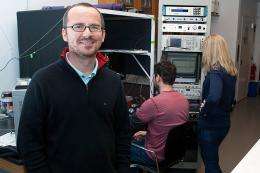
Daniel Mulkey. assistant professor of physiology and neurobiology, in his lab with graduate students Ian C. Wenker and Joanna Hawryluk. Credit: Daniel Buttrey/UConn

(Medical Xpress) -- If you’re an average person (not from Lake Wobegon) you breathe in about 900 times an hour.  You probably don’t think about it much, but Daniel Mulkey does. He studies what happens at the molecular level when you breathe and how your body gets the message that it’s time to take a breath.

We know that if you hold your breath, the build-up of carbon dioxide (CO2) causes the brain to get a message, “Hey – we need to breathe,” he explains.  In a tiny area of the brain, a subset of neurons that are highly sensitive to CO2 project a message to the respiratory centers to get breathing underway.

But what causes the rapid electrical activity of the neurons that tells the respiratory cells to go to work?

Mulkey is looking at how ion channels – pores in the cell membrane that allow the movement of ions (such as sodium or potassium) – influence the behavior of neurons when you breathe. Ion channels act as gateways into or out of cells for the ions that determine their electrical activity.

Using just a thin slice of an animal brain, his research group isolates and studies the cells that they think are important for the regulation of breathing. Identifying these cells and the ion channels that regulate their function might eventually help in the development of drugs for people who suffer from respiratory failure in conditions such as epilepsy, SIDS, or sleep apnea.

Mulkey, an assistant professor of physiology and neurobiology who came to UConn five years ago, recently won a research promise award from the American Association of University Professors (AAUP) at UConn. He also was named a UConn Teacher for a New Era Fellow.

When he was a postdoctoral researcher at the University of Virginia in 2004, Mulkey was the lead author on a paper that identified the cells in a very small area of the brainstem – the retrotrapezoid nucleus – that are critical in respiration.

He and two former fellow postdocs at Virginia, Thiago Moreira and Ana Takakura, who are now at the University of São Paulo in Brazil, are among the handful of scientists doing in vivo respiratory studies on brain cells. Moreira’s group studies breathing behavior in live rats. He can check how the animals’ breathing behavior changes, depending on the activity of ion channels that Mulkey has identified.  Mulkey’s group works on brain slices, using electrophysiology techniques to see how ion channels are regulated by CO2 or neurotransmitters that are known to influence breathing.

Although his group works at the molecular level, “It’s really satisfying to go back to the whole animal and see how these cells work,” Mulkey says. The two groups, in Storrs and in Brazil, will exchange graduate students so that each group learns the techniques of the other.

The studies in Brazil are done on both active and sedated animals. Most respiratory problems occur when you fall asleep, Mulkey notes. When you are awake, you have cues that tell you to breathe. But when you are asleep, depends entirely on the activity of the CO2-sensitive cells that drive respiration.

People who suffer from congenital central hypoventilation syndrome, also known as Ondine’s curse, have a mutation specific to these cells. When they fall asleep, these people have no drive to breathe.

By learning more about the cells and the ion channels that influence their behavior, Mulkey’s basic research could guide the development of drugs to provide a solution.

“If you know the players involved, you have a target,” he says.

His research is supported by a grant from the Heart, Lung, and Blood Institute of the National Institutes of Health and by the Cure Epilepsy Foundation. One of his graduate students, Ian C. Wenker, has his own pre-doctoral research grant from the American Heart Association.

More information: The Journal of Physiology

Provided by University of Connecticut search and more info website

not rated yet  

Rank not rated yet
Tags

Relevant PhysicsForums posts

More news stories

Obstructive sleep apnea associated with less visceral fat accumulation in women than men

A new study from researchers in Japan indicates that obstructive sleep apnea (OSA) is independently associated with visceral (abdominal) fat accumulation only in men, perhaps explaining gender differences in the impact of ...

Sleep apnea created May 22, 2013 | popularity not rated yet | comments 0

Better behavior after tonsil/adenoid surgery for kids with sleep breathing trouble?

Children with obstructive sleep apnea who had a common surgery to remove their tonsils and adenoids showed notable improvements in behavior, quality of life and other symptoms compared to those treated with "watchful waiting" ...

Sleep apnea created May 21, 2013 | popularity 5 / 5 (1) | comments 0

Stress test may help predict increased mortality risk in sleep apnea patients

Many studies have shown that men and women who suffer from obstructive sleep apnea (OSA) - a disorder that causes breathing to halt intermittently during sleep – have a higher mortality rate than those who do not have the ...

Sleep apnea created May 20, 2013 | popularity not rated yet | comments 0

Treatment of sleep apnea improves glucose levels in prediabetes

Optimal treatment of sleep apnea in patients with prediabetes improves blood sugar (glucose) levels and thus can reduce cardiometabolic risk, according to a study to be presented at the ATS 2013 International Conference in ...

Sleep apnea created May 20, 2013 | popularity not rated yet | comments 0 | with audio podcast

Researchers identify a potential new risk for sleep apnea: Asthma

Researchers at the University of Wisconsin have identified a potential new risk factor for obstructive sleep apnea: asthma. Using data from the National Institutes of Health (Heart, Lung, and Blood Institute)-funded Wisconsin ...

Sleep apnea created May 19, 2013 | popularity 5 / 5 (1) | comments 0 | with audio podcast


First drug to improve heart failure mortality in over a decade

Coenzyme Q10 decreases all cause mortality by half, according to the results of a multicentre randomised double blind trial presented today at Heart Failure 2013 congress. It is the first drug to improve heart failure mortality ...

Seniors more likely to crash when driving with pet, study finds

(HealthDay)—Animals make great companions for senior citizens, but elderly people who always drive with a pet in the car are far more likely to crash than those who never drive with a pet, researchers have ...

Heart failure accelerates male 'menopause'

Heart failure accelerates the aging process and brings on early andropausal syndrome (AS), according to research presented today at the Heart Failure Congress 2013. AS, also referred to as male 'menopause', was four times ...

Death highest in heart failure patients admitted in January, on Friday, and overnight

Mortality and length of stay are highest in heart failure patients admitted in January, on Friday, and overnight, according to research presented today at the Heart Failure Congress 2013. The analysis of nearly 1 million ...

Feds fight morning-after pill age ruling in NY

(AP)—Department of Justice lawyers have again asked a federal appeals court in New York to delay lifting age restrictions and prescription requirements on an emergency contraceptive popularly known as the morning-after ...

New immune system discovered

(Medical Xpress)—A research team, led by Jeremy Barr, a biology post-doctoral fellow, unveils a new immune system that protects humans and animals from infection.