Cyber exercise partners help you go the distance: Motivation gains can double
May 24, 2012 in Health

Cyber exercise partners help you go the distance

Enlarge

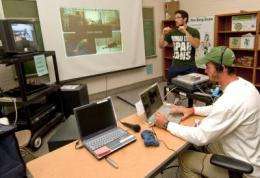
MSU's Brandon Irwin (sitting) conducts virtual workout technology in 2009 with a test subject in the Health Games Lab. Irwin led a recent study that found virtual exercise partners increase motivation to work out. Credit: Photo by Derrick Turner

A new study testing the benefits of a virtual exercise partner shows the presence of a moderately more capable cycling partner can significantly boost the motivation – by as much as 100 percent – to stick to an exercise program.

The research out of Michigan State University's Department of Kinesiology shows women taking part in cycling exercises exercised twice as long when working with a virtual , results the authors said can be used to help people meet recommendations.

The work by Brandon Irwin and colleagues is published online in the journal Annals of Behavioral Medicine.

"Being able to more than double one's performance is a substantial gain for those trying to increase their physical activity," Irwin said. "These results are encouraging and suggest the gains we observed over six hour-long sessions could be sustained on a longer-term program of ."

For many people, lack of is a barrier to achieving both the recommended amount and intensity of exercise. Using the principles of group exercise, which is known to increase people's motivation to stick to an exercise program, the researchers investigated whether a "virtually present" partner would influence participants' motivation to exercise longer.

A total of 58 women recruited from MSU physical activity courses took part in the experiment and exercised on a stationary bike. They were split into three groups: The first group exercised on their own alongside a virtual person, the second group exercised alongside a virtual person but also worked as a team and the third group cycled alone.

At the start, the women in groups one and two were assigned a "virtually present partner" for the ride and were told their partner would be riding at the same time they were, on a similar bike in another lab. The women "met" their partners via a pre-recorded video-chat and were told their partner's performance was moderately better than their own.

During the exercise sessions, participants tracked their partner's progress by watching what looked like a live feed but was in fact a recording. All students rode a video-game exercise bike for as long as they felt comfortable. They then were asked to rate their intention to exercise again, how well they felt they had done and how tired they felt.

Overall, exercising with a virtually present partner improved performance on the cycling task, and the women cycled longer when working alongside a more capable partner than when exercising alone.

Across sessions, those women who exercised as part of a team cycled, on average, two minutes longer than those who exercised independently with a partner – 22 versus 20 minutes – and twice as long as those who exercised without a partner – 22 versus 11 minutes.

In terms of motivation, there was a marked decline in intent to exercise among those who cycled on their own. In contrast, those who cycled with a virtual partner reported no decline in motivation to exercise.

Journal reference: Annals of Behavioral Medicine search and more info website

Provided by Michigan State University search and more info website

not rated yet  

Rank not rated yet
Relevant PhysicsForums posts

More news stories

Bed sharing with parents increases risk of cot death fivefold

Bed sharing with parents is linked to a fivefold increased risk of sudden infant death syndrome (SIDS), even when the parents are non-smokers and the mother has not been drinking alcohol and does not use illegal drugs, according ...

Health created 8 hours ago | popularity 1.3 / 5 (3) | comments 0

Sports seem OK for many with heart-zapping device

Doctors tell people with a heart-zapping device in their chests to give up intense sports like basketball and soccer in favor of golf or bowling. But lots of patients ignore that advice—and now new research is challenging ...

Health created 8 hours ago | popularity not rated yet | comments 0

Gym class reduces probability of obesity, study finds for first time

Little is known about the effect of physical education (PE) on child weight, but a new study from Cornell University finds that increasing the amount of time that elementary schoolchildren spent in gym class reduces the probability ...

Health created 10 hours ago | popularity not rated yet | comments 0

Prenatal exposure to traffic is associated with respiratory infection in young children

Living near a major roadway during the prenatal period is associated with an increased risk of respiratory infection developing in children by the age of 3, according to a new study from researchers in Boston.

Health created 12 hours ago | popularity not rated yet | comments 0

Combined wood and tobacco smoke exposure increases risk and symptoms of COPD

People who are consistently exposed to both wood smoke and tobacco smoke are at a greater risk for developing chronic obstructive pulmonary disease (COPD) and for experiencing more frequent and severe symptoms of the disease, ...

Health created 12 hours ago | popularity not rated yet | comments 0


Early-life traffic-related air pollution exposure linked to hyperactivity

Early-life exposure to traffic-related air pollution was significantly associated with higher hyperactivity scores at age 7, according to new research from the University of Cincinnati (UC) and Cincinnati Children's Hospital ...

New immune system discovered

(Medical Xpress)—A research team, led by Jeremy Barr, a biology post-doctoral fellow, unveils a new immune system that protects humans and animals from infection.

The compound in the Mediterranean diet that makes cancer cells 'mortal'

New research suggests that a compound abundant in the Mediterranean diet takes away cancer cells' "superpower" to escape death. By altering a very specific step in gene regulation, this compound essentially re-educates cancer ...

Resistance to last-line antibiotic makes bacteria resistant to immune system

Bacteria resistant to the antibiotic colistin are also commonly resistant to antimicrobial substances made by the human body, according to a study in mBio, the online open-access journal of the American Society for Microb ...

Scientists identify molecular trigger for Alzheimer's disease

Researchers have pinpointed a catalytic trigger for the onset of Alzheimer's disease – when the fundamental structure of a protein molecule changes to cause a chain reaction that leads to the death of neurons ...

Do salamanders hold the solution to regeneration?

Salamanders' immune systems are key to their remarkable ability to regrow limbs, and could also underpin their ability to regenerate spinal cords, brain tissue and even parts of their hearts, scientists have ...