Discovery of a new family of key mitochondrial proteins for the function and viability of the brain
May 9, 2012 in Medical research
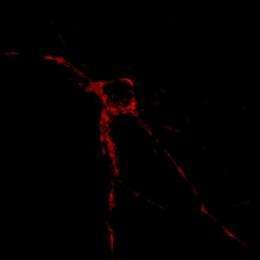
In the image, red indicates the localization of mitochondria in a neuron. The new proteins described help to regulate their positions in the cell. Credit: IRB Barcelona. Eduardo Soriano's laboratory
A team headed by Eduardo Soriano at the Institute for Research in Biomedicine (IRB Barcelona) has published a study in Nature Communications describing a new family of six genes whose function regulates the movement and position of mitochondria in neurons. Many neurological conditions, including Parkinson's and various types of Charcot-Marie-Tooth disease, are caused by alterations of genes that control mitochondrial transport, a process that provides the energy required for cell function.
"We have identified a set of new genes that are highly expressed in the nervous system and have a specific function in a biological process that is crucial for the activity and viability of the nervous system", explains Eduardo Soriano, head of the Neurobiology and Cell Regeneration group at IRB Barcelona and full professor at the University of Barcelona (UB).
By means of comparative genomic analyses, the scientists have discovered that these genes are found only in more evolved mammals, the so-called Eutharia, these characterized by internal fertilization and development. "This finding indicates the relevance of mitochondrial biology. When the brain evolved in size, function and structure, the mitochondrial transport process also became more complex and probably required additional regulatory mechanisms", says Soriano. "Likewise, given the origin of the gene cluster, in the transition between primitive mammals, such as marsupials (kangaroos) and the remaining placental mammals, it is tempting to propose that the cluster is linked to the increased complexity of the cerebral cortex in the lineage that leads to humans", adds the full UB professor Jordi Garcia-Fernàndez, collaborator in the study.
Correct brain function is highly energy-demanding. However, this energy must be finely distributed throughout neurons cells that have ramifications that can reach up to tens of centimetres in length, from the brain to the limbs. This cluster of genes forms part of the "wheel" machinery of mitochondria and regulates the localization of each cell on the basis of its energy requirements. "These genes would be like an extra control in cellular mitochondrial trafficking and they interact with the major proteins associated with the regulation of mitochondrial transport", explains Soriano.
Another striking characteristic of these new proteins is that they are found both in mitochondria, the function of which has already been described, and in the cell nucleus, where their function is unknown. "They may also be involved in the regulation of gene expression, a possibility that we are now studying". In addition to their potential involvement in brain pathologies, the researchers believe that these proteins may be related to metabolic diseases and cancer.
More information: The Eutherian Armcx genes regulate mitochondrial trafficking in neurons and interact with Miro and Trak2. G López-Doménech, R Serrat, S Mirra, S D'Aniello, I Somorjai, A Abad, N Vitureira, E García-Arumí, MT Alonso, M Rodriguez-Prados, F Burgaya, A L. Andreu, J García-Sancho, R Trullas, J Garcia-Fernàndez and Eduardo Soriano. Nature Communications (2012): DOI number: 10.1038/ncomms1829
Journal reference:
Nature Communications
Provided by
Institute for Research in Biomedicine (IRB Barcelona)
-
New mitochondrial control mechanism discovered
May 04, 2011 |
not rated yet |
0
-
The accumulation of sugar in neurons may explain the origin of several neurodegenerative diseases
Oct 21, 2007 |
not rated yet |
0
-
Genetic map reveals clues to degenerative diseases
Aug 24, 2011 |
not rated yet |
0
-
Why do neurons die in Parkinson's disease?
Nov 10, 2011 |
not rated yet |
0
-
An early step in Parkinson's disease: Problems with mitochondria
Feb 14, 2011 |
not rated yet |
0
-
Motion perception revisited: High Phi effect challenges established motion perception assumptions
Apr 23, 2013 |
3 / 5 (2) |
2
-
Anything you can do I can do better: Neuromolecular foundations of the superiority illusion (Update)
Apr 02, 2013 |
4.5 / 5 (11) |
5
-
The visual system as economist: Neural resource allocation in visual adaptation
Mar 30, 2013 |
5 / 5 (2) |
9
-
Separate lives: Neuronal and organismal lifespans decoupled
Mar 27, 2013 |
4.9 / 5 (8) |
0
-
Sizing things up: The evolutionary neurobiology of scale invariance
Feb 28, 2013 |
4.8 / 5 (10) |
14
-
Why is zone 1 in liver more prone to ischemic injury?
May 23, 2013
-
How can there be villous adenoma in colon, if there are no villi there
May 22, 2013
-
How can there be a term called "intestinal metaplasia" of stomach
May 21, 2013
-
Pressure-volume curve: Elastic Recoil Pressure don't make sense
May 18, 2013
-
If you became brain-dead, would you want them to pull the plug?
May 17, 2013
-
MRI bill question
May 15, 2013
- More from Physics Forums - Medical Sciences
More news stories
Study reveals new mechanism for estrogen suppression of liver lipid synthesis
By discovering the new mechanism by which estrogen suppresses lipid synthesis in the liver, UC Irvine endocrinologists have revealed a potential new approach toward treating certain liver diseases.
Medical research
13 hours ago |
not rated yet |
0
|
MRI-based measurement helps predict vascular disease in the brain
Aortic arch pulse wave velocity, a measure of arterial stiffness, is a strong independent predictor of disease of the vessels that supply blood to the brain, according to a new study published in the June issue the journal ...
Medical research
14 hours ago |
not rated yet |
0
Antibiotics: A new understanding of sulfonamide nervous system side effects
Since the discovery of Prontosil in 1932, sulfonamide antibiotics have been used to combat a wide spectrum of bacterial infections, from acne to chlamydia and pneumonia. However, their side effects can include serious neurological ...
Medical research
15 hours ago |
not rated yet |
0
|
Scientists discover molecule triggers sensation of itch
Scientists at the National Institutes of Health report they have discovered in mouse studies that a small molecule released in the spinal cord triggers a process that is later experienced in the brain as ...
Medical research
15 hours ago |
5 / 5 (2) |
0
|
Discarded immune cells induce the relocation of stem cells
Spanish researchers have discovered that the daily clearance of neutrophils from the body stimulates the release of hematopoietic stem cells from the bone marrow into the bloodstream, according to a report published today ...
Medical research
17 hours ago |
5 / 5 (2) |
0
Hormone replacement therapy—clarity at last
The British Menopause Society and Women's Health Concern have today released updated guidelines on Hormone Replacement Therapy (HRT) to provide clarity around the role of HRT, the benefits and the risks. The new guidelines ...
Controlling mood through the motions of mitochondria
(Medical Xpress)—Regulating the distribution of power in neurons is done by a system that makes the national electric grid look simple by comparison. Each neuron has several thousand mitochondria confined ...
Motion quotient: IQ predicted by ability to filter motion (w/ video)
A brief visual task can predict IQ, according to a new study. This surprisingly simple exercise measures the brain's unconscious ability to filter out visual movement. The study shows that individuals whose ...
Multiple research teams unable to confirm high-profile Alzheimer's study
Teams of highly respected Alzheimer's researchers failed to replicate what appeared to be breakthrough results for the treatment of this brain disease when they were published last year in the journal Science.
Researchers find common childhood asthma unconnected to allergens or inflammation
Little is known about why asthma develops, how it constricts the airway or why response to treatments varies between patients. Now, a team of researchers at Weill Cornell Medical College, Columbia University Medical Center ...
Diabetes' genetic underpinnings can vary based on ethnic background, studies say
Ethnic background plays a surprisingly large role in how diabetes develops on a cellular level, according to two new studies led by researchers at the Stanford University School of Medicine.