Locating ground zero: How the brain's emergency workers find the disaster area
May 24, 2012 in Neuroscience

Locating ground zero

Enlarge

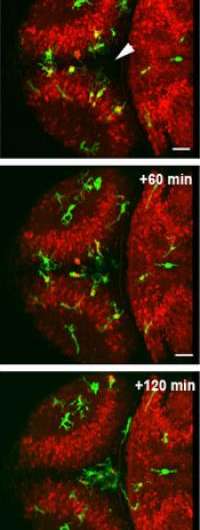
Microglia (green) move to the site of injury (arrow) to clear up debris. Credit: Copyright EMBL/Peri

Like emergency workers rushing to a disaster scene, cells called microglia speed to places where the brain has been injured, to contain the damage by 'eating up' any cellular debris and dead or dying neurons. Scientists at the European Molecular Biology Laboratory (EMBL) in Heidelberg, Germany, have now discovered exactly how microglia detect the site of injury, thanks to a relay of molecular signals. Their work, published today in Developmental Cell, paves the way for new medical approaches to conditions where microglia's ability to locate hazardous cells and material within the brain is compromised.

"Considering that they help keep our brain healthy, we know surprisingly little about microglia," says Francesca Peri, who led the work. "Now, for the first time, we've identified the mechanism that allows microglia to detect , and how that emergency call is transmitted from neuron to neuron."
Locating ground zero
Enlarge

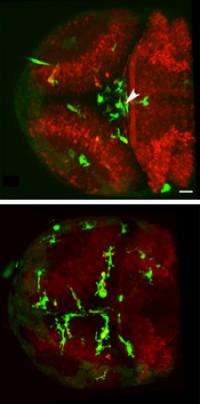
When microglia (green) cannot detect ATP (bottom), they don’t move to the injury site as they usually would (top). Credit: Copyright EMBL/Peri

When an emergency occurs, cries can alert bystanders, who will dial the emergency number. A call will go out over the radio, and , police or fire engines in the area will respond as needed. In the brain, Peri and colleagues found, injured neurons send out their own distress cry: they release a molecule called glutamate. Neighbouring neurons sense that glutamate and respond by taking up calcium. As glutamate spreads out from the injury site, this creates a wave of calcium swallowing. Along that wave, as neurons take up calcium they release a third molecule, called . When the wave comes within reach, a microglial cell detects that ATP and takes it as a call to action, moving in that direction – essentially tracing the wave backwards until it reaches the injury.

This video is not supported by your browser at this time.

Microglia (green) move to the site of injury (arrow) to clear up debris. Credit: Copyright EMBL/Peri

Scientists knew already that microglia can detect ATP, but this molecule doesn't last long outside of cells, so there were doubts about how ATP alone could be a signal that carried far enough to reach microglia located far from the site of injury. The trick, as Peri and colleagues discovered, is the long-lasting glutamate-driven calcium wave that can travel the length of the brain. Thanks to this wave, the ATP signal is not just emitted by the injured cells, but is repeatedly sent out by the along the way, until it reaches microglia.

Dirk Sieger and Christian Moritz in Peri's lab took advantage of the fact that zebrafish have transparent heads, which allow scientists to peer down a microscope straight into the fish's brain. They used a laser to injure a few of the fish's cells, and watched fluorescently-labelled microglia move in on the injury. When they genetically engineered zebrafish to make neurons' calcium levels traceable under the microscope, too, the scientists were able to confirm that when the calcium wave reached microglia, these cells immediately started moving toward the injury.

Knowing all the steps in this process, and how they feed into each other, could help to design treatments to improve microglia's detection ability, which go awry in conditions such as Alzheimer's and Parkinson's diseases.

Journal reference: Developmental Cell search and more info website

Provided by European Molecular Biology Laboratory search and more info website

5 /5 (2 votes)  

Rank 5 /5 (2 votes)
Relevant PhysicsForums posts

More news stories

New neuron formation could increase capacity for new learning, at the expense of old memories

New research presented today shows that formation of new neurons in the hippocampus - a brain region known for its importance in learning and remembering - could cause forgetting of old memories by causing a reorganization ...

Neuroscience created 15 hours ago | popularity 4 / 5 (4) | comments 0

Help at hand for people with schizophrenia

How can healthy people who hear voices help schizophrenics? Finding the answer for this is at the centre of research conducted at the University of Bergen.

Neuroscience created 15 hours ago | popularity 4 / 5 (2) | comments 2

Japanese research organizations contribute to Human Brain Project

One of the major frontiers of modern science is a comprehensive understanding of the human brain and its functions to guide the development of new technologies in information and communication. In a major announcement for ...

Neuroscience created 16 hours ago | popularity 3.7 / 5 (3) | comments 0

Controlling mood through the motions of mitochondria

(Medical Xpress)—Regulating the distribution of power in neurons is done by a system that makes the national electric grid look simple by comparison. Each neuron has several thousand mitochondria confined ...

Neuroscience created May 23, 2013 | popularity 4.9 / 5 (9) | comments 0 | with audio podcast report

Brain uses internal 'average voice' prototype to identify who is talking

(Medical Xpress)—The human brain is able to identify individuals' voices by comparing them against an internal 'average voice' prototype, according to neuroscientists.

Neuroscience created May 23, 2013 | popularity 3 / 5 (2) | comments 3 | with audio podcast


Engineered cytomegalovirus protects monkeys from HIV equivalent

(Medical Xpress)—A new study by researchers in the US has shown that an ancient virus can be modified to help in the fight against the simian immunodeficiency virus SIV, which is the equivalent in monkeys ...

Researchers identify first drug targets in childhood genetic tumor disorder

Two mutations central to the development of infantile myofibromatosis (IM)—a disorder characterized by multiple tumors involving the skin, bone, and soft tissue—may provide new therapeutic targets, according to researchers ...

Hormone levels may provide key to understanding psychological disorders in women

Women at a particular stage in their monthly menstrual cycle may be more vulnerable to some of the psychological side-effects associated with stressful experiences, according to a study from UCL.

Going live: Immune cell activation in multiple sclerosis

Biological processes are generally based on events at the molecular and cellular level. To understand what happens in the course of infections, diseases or normal bodily functions, scientists would need to ...

Alzheimer's disease, the soft target of the euthanasia debate

(Medical Xpress)—The way Alzheimer's disease is portrayed by advocacy groups and the media is having undue influence on the euthanasia debate, according to a Deakin University nursing ethics professor.

Depression raises diabetics' risk of severe low blood sugar episodes

(Medical Xpress)—Patients with diabetes who are depressed are much more likely to develop episodes of dangerously low blood sugars, or hypoglycemia, than are those who are not depressed, a new study has ...