Taking a muscular approach towards diabetes and other diseases
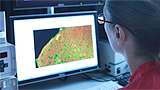
Dr Lowenna Holt examining muscle fibres under the microscope
Australian scientists have identified a gene that regulates muscle size, a finding that could help unlock therapies for Type 2 diabetes and diseases such as muscular dystrophy, where muscles are weakened and damaged.
Type 2 diabetes occurs when the body no longer controls blood sugar levels properly. We need insulin, a hormone released from the pancreas when we eat, to channel sugar from our blood into our cells.
While researching ways to improve the response of muscle to insulin, Dr Lowenna Holt, Associate Professor Greg Cooney and Professor Roger Daly from Sydney's Garvan Institute of Medical Research were surprised to see that a particular strain of genetically modified mice - missing the Grb10 protein - had large muscles. Even newborn mice missing Grb10 had larger muscles, indicating that this protein regulates muscle development before birth. The results are now published online in The FASEB Journal.
"Our main finding is that Grb10 plays a role in regulating the size of muscles during embryonic development, mainly by increasing the number of muscle fibres in the muscle, which is unusual. Usually muscles become bigger by increasing the size of each fibre" said Dr Lowenna Holt.
"We compared global gene expression in large versus normal muscle using gene microarrays and a computer program to visualize changes in gene networks. We saw more replication and proliferation gene sets in the Grb10 knockout muscle, telling us that processes causing proliferation of muscle stem cells could be controlled by Grb10 in the embryo. We also found that gene sets for muscle development were increased."
Apart from its implications in muscle regeneration during healing, the finding is important for diabetes research because muscles are the biggest users of glucose in the body. A drug able to reduce Grb10 expression would increase muscle mass, and so increase the capacity to move glucose from the blood stream into cells, a major goal for any diabetes therapy.
Journal reference:
FASEB Journal
Provided by
Garvan Institute
-
New hormone for lowering blood sugar
Apr 03, 2012 |
not rated yet |
0
-
Apple peel makes mice mighty
Jun 07, 2011 |
not rated yet |
0
-
Muscling in on type 2 diabetes
Feb 26, 2009 |
not rated yet |
0
-
Reprogrammed human adult stem cells rescue diseased muscle in mice
Dec 12, 2007 |
not rated yet |
0
-
Key finding in rare muscle disease
Jan 17, 2007 |
not rated yet |
0
-
Motion perception revisited: High Phi effect challenges established motion perception assumptions
Apr 23, 2013 |
3 / 5 (2) |
2
-
Anything you can do I can do better: Neuromolecular foundations of the superiority illusion (Update)
Apr 02, 2013 |
4.5 / 5 (11) |
5
-
The visual system as economist: Neural resource allocation in visual adaptation
Mar 30, 2013 |
5 / 5 (2) |
9
-
Separate lives: Neuronal and organismal lifespans decoupled
Mar 27, 2013 |
4.9 / 5 (8) |
0
-
Sizing things up: The evolutionary neurobiology of scale invariance
Feb 28, 2013 |
4.8 / 5 (10) |
14
-
Classical and Quantum Mechanics via Lie algebras
Apr 15, 2011
- More from Physics Forums - Independent Research
More news stories
Researchers identify first drug targets in childhood genetic tumor disorder
Two mutations central to the development of infantile myofibromatosis (IM)—a disorder characterized by multiple tumors involving the skin, bone, and soft tissue—may provide new therapeutic targets, according to researchers ...
Genetics
15 hours ago |
3 / 5 (2) |
0
|
Patenting the human genome
Can human genes be patented? That was the question posed by Alan J. Snyder, vice president and associate provost for research and graduate studies at Lehigh, and Lee Kaplan, scientific director of cellular and molecular genetics ...
Genetics
22 hours ago |
4 / 5 (1) |
0
Researchers complete largest genetic sequencing study of human disease
Researchers from Queen Mary, University of London have led the largest sequencing study of human disease to date, investigating the genetic basis of six autoimmune diseases.
Genetics
May 22, 2013 |
4.5 / 5 (4) |
0
|
Researchers develop model for better testing, targeting of malignant peripheral nerve sheath tumors
University of Minnesota Medical School researchers from the Masonic Cancer Center, University of Minnesota, in partnership with the University's Brain Tumor Program, have developed a new mouse model of malignant peripheral ...
Genetics
May 20, 2013 |
5 / 5 (1) |
0
|
Researchers identify new circadian clock component
Northwestern University scientists have shown a gene involved in neurodegenerative disease also plays a critical role in the proper function of the circadian clock.
Genetics
May 16, 2013 |
3 / 5 (1) |
1
|
Engineered cytomegalovirus protects monkeys from HIV equivalent
(Medical Xpress)—A new study by researchers in the US has shown that an ancient virus can be modified to help in the fight against the simian immunodeficiency virus SIV, which is the equivalent in monkeys ...
Hormone levels may provide key to understanding psychological disorders in women
Women at a particular stage in their monthly menstrual cycle may be more vulnerable to some of the psychological side-effects associated with stressful experiences, according to a study from UCL.
Are there atheists in foxholes? Study says they're the minority
Ernie Pyle – an iconic war correspondent in World War II – reportedly said "There are no atheists in foxholes." A new joint study between two brothers at Cornell and Virginia Wesleyan found that only ...
Help at hand for people with schizophrenia
How can healthy people who hear voices help schizophrenics? Finding the answer for this is at the centre of research conducted at the University of Bergen.
Going live: Immune cell activation in multiple sclerosis
Biological processes are generally based on events at the molecular and cellular level. To understand what happens in the course of infections, diseases or normal bodily functions, scientists would need to ...
Alzheimer's disease, the soft target of the euthanasia debate
(Medical Xpress)—The way Alzheimer's disease is portrayed by advocacy groups and the media is having undue influence on the euthanasia debate, according to a Deakin University nursing ethics professor.