Skin no barrier for cardiac charger
May 3, 2012 in Medical research
Heart-failure patients may someday get a life-saving charge from technology developed by students at Rice University.
A team of seniors designed and built a transcutaneous energy-transfer (TET) unit to power a minimally invasive ventricular assist device (VAD) being created by a Houston company. The VAD is a tiny pump inserted into the aorta via a catheter that helps increase blood flow and heal patients with heart failure.
Rice tCoil Michael Torre, Erin Watson, Tyler Young, Trevor Mitcham, Hana Wang and Alex Dobranich made a complementary device that sits a centimeter under the skin and feeds power to the VAD. The challenge presented to the seniors, who were required to complete a capstone design project by Rices George R. Brown School of Engineering, was to charge the unit wirelessly.
A lot of people need heart transplants, but there arent enough hearts available, Young said. One alternative is to have a heart pump implanted, but that carries risks. Its very invasive surgery, and afterward you have to have wire leads running out of your body to a battery pack.
The portal through the skin to a power supply can become infected, he said. But the problem is avoidable by sending power to the VAD without wires. The students prototype consists of a small coil and a battery that would be inserted one centimeter under the skin at the patients waist and wired to the VAD. The patient would also wear a belt-mounted external battery and coil to generate alternating magnetic fields and induce alternating current in the subcutaneous coil. The coils charge the battery, which can operate the pump for more than three hours.
This video is not supported by your browser at this time.
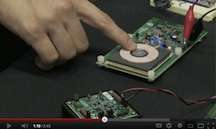
The patient can take the belt off for a short time, to take a shower, for instance, Young said. The pump will work safely off the coils or on the internal battery alone, but obviously its best when theyre both working.The team demonstrated tCoil at the Engineering Design Showcase that was part of Rices recent UnConvention open house. The students put the internal and external coils on either side of a baggie containing lunchmeat to simulate power transfer through the skin. The internal unit was wired to a demonstration pump that clearly pushed red-colored water through a sleeve inside a tank.
The student project was in response to a request from Rice alum Michael Cuchiara, director of research and development at Procyrion, developer of the pump.
I mentored two senior design teams while I did my Ph.D. in bioengineering at Rice and helped bring a project to Maria Oden (a professor in the practice of engineering and director of the Oshman Engineering Design Kitchen at Rice) for a different client company in 2009, Cuchiara said. For this project, until recently, our companys expertise was not heavy in electrical engineering design, and I knew Maria could put together a good team.
He said the students, who were mentored by Oden and Gary Woods, a Rice professor in the practice of computer technology and electrical and computer engineering, came through for him. The Rice team brought us a quick, capital- and resource-efficient proof-of-concept system to show we can power our device through TET, Cuchiara said. Theres was no reason to think we couldnt but until you do it, you dont have it.
The project is far from complete, Young said. Erin will work on it this summer, but at some point Procyrion will take it over and continue development, he said. The next steps will be to miniaturize it and put it in biocompatible casing. Once thats done, it can be implanted for large animal testing. Ideally, he said, the long process of approval by the Food and Drug Administration will follow.
But team members will graduate with the satisfaction of a job well done and two awards: for Best Interdisciplinary Design Project at the Design Showcase and for best medical and rehabilitation technology at the third annual Rice Undergraduate Elevator Pitch Competition last November.
Cuchiara said TET will make ventricular assist available to an ever broader set of patients. The concept that you can induce a current in another coil without connecting them electrically has been around since Tesla, he said. And VADs have been around for more than 10 years. But before, they were offered to people who were on their deathbeds. Now that were able to take the risk (of passing a wire through the skin) out of the equation, were starting to talk about bringing VADs to people who arent that sick and can just use a little bit of support.
Provided by
Rice University
-
Tiny heart pump helps heart attack, heart failure patients
Mar 25, 2011 |
not rated yet |
0
-
Laser music: BYU electrical engineers use light to beam songs across a room
Dec 20, 2011 |
not rated yet |
0
-
Babalung gets babies breathing again
Apr 13, 2012 |
not rated yet |
0
-
Researcher argues 'pretending to listen' OK, sometimes necessary in education
Oct 13, 2011 |
not rated yet |
0
-
King of the (lunar) road
Mar 30, 2011 |
not rated yet |
0
-
Motion perception revisited: High Phi effect challenges established motion perception assumptions
Apr 23, 2013 |
3 / 5 (2) |
2
-
Anything you can do I can do better: Neuromolecular foundations of the superiority illusion (Update)
Apr 02, 2013 |
4.5 / 5 (11) |
5
-
The visual system as economist: Neural resource allocation in visual adaptation
Mar 30, 2013 |
5 / 5 (2) |
9
-
Separate lives: Neuronal and organismal lifespans decoupled
Mar 27, 2013 |
4.9 / 5 (8) |
0
-
Sizing things up: The evolutionary neurobiology of scale invariance
Feb 28, 2013 |
4.8 / 5 (10) |
14
-
Pressure-volume curve: Elastic Recoil Pressure don't make sense
May 18, 2013
-
If you became brain-dead, would you want them to pull the plug?
May 17, 2013
-
MRI bill question
May 15, 2013
-
Ratio of Hydrogen of Oxygen in Dessicated Animal Protein
May 13, 2013
-
Alcohol and acetaminophen
May 13, 2013
-
Marie Curie's leukemia
May 13, 2013
- More from Physics Forums - Medical Sciences
More news stories
Study suggests new source of kidneys for transplant
Nearly 20 percent of kidneys that are recovered from deceased donors in the U.S. are refused for transplant due to factors ranging from scarring in small blood vessels of the kidney's filtering units to the organ going too ...
Medical research
15 hours ago |
5 / 5 (2) |
0
|
Discovery of circadian clock in mice hair reveals period of time when damage from radiotherapy can be quickly repaired
Discovering that mouse hair has a circadian clock - a 24-hour cycle of growth followed by restorative repair - researchers suspect that hair loss in humans from toxic cancer radiotherapy and chemotherapy ...
Medical research
15 hours ago |
5 / 5 (2) |
1
|
Do salamanders hold the solution to regeneration?
Salamanders' immune systems are key to their remarkable ability to regrow limbs, and could also underpin their ability to regenerate spinal cords, brain tissue and even parts of their hearts, scientists have ...
Medical research
16 hours ago |
4.9 / 5 (7) |
2
|
New study finds blind people have the potential to use their 'inner bat' to locate objects
New research from the University of Southampton has shown that blind and visually impaired people have the potential to use echolocation, similar to that used by bats and dolphins, to determine the location of an object.
Medical research
19 hours ago |
not rated yet |
1
|
Germ-fighting vaccine system makes great strides in delivery
A novel vaccine study from South Dakota State University (SDSU) will headline the groundbreaking research that will be unveiled at the American Association of Pharmaceutical Scientists' (AAPS) National Biotechnology Conference ...
Medical research
19 hours ago |
not rated yet |
0
Anti-CD47 antibody may offer new route to successful cancer vaccination
(Medical Xpress)—Scientists at the School of Medicine have shown that their previously identified therapeutic approach to fight cancer via immune cells called macrophages also prompts the disease-fighting killer T cells ...
Biomarker trio predicts near-term heart risk
(Medical Xpress)—Cardiologists have identified a trio of biomarkers that may predict which patients with heart disease have a high risk of heart attack or death in the next two years.
Primary care docs should play role in kids' dental health, experts say
(HealthDay)—When it comes to the care of your children's teeth, dentists aren't the only experts who can help.
New theory offers clues to vital 'repair and maintenance' role of sleep
(Medical Xpress)—We spend about a third of our life asleep, but why we need to do so remains a mystery. In a recent publication, researchers at University of Surrey and University College London suggest a new hypothesis, ...
Salt consumption in India: The need for data to initiate population-based prevention efforts
(Medical Xpress)—International researchers are studying the salt intake of Indian adults to provide vital new data to aid the development of a national salt reduction strategy.
Eyes on the sun: Child sunshine exposure and eye development
(Medical Xpress)—Exposure to sunshine as a small child is crucial to the development of a healthy eye according to results of long-term myopia study conducted by University of Sydney researchers.