Feeling strong emotions makes peoples' brains 'tick together'
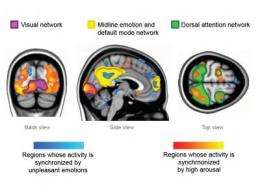
Experiencing strong emotions synchronises brain activity across individuals, research team at Aalto University and Turku PET Centre in Finland has revealed.
Human emotions are highly contagious. Seeing others' emotional expressions such as smiles triggers often the corresponding emotional response in the observer. Such synchronisation of emotional states across individuals may support social interaction: When all group members share a common emotional state, their brains and bodies process the environment in a similar fashion.
Researchers at Aalto University and Turku PET Centre have now found that feeling strong emotions makes different individuals' brain activity literally synchronous.
The results revealed that especially feeling strong unpleasant emotions synchronised brain's emotion processing networks in the frontal and midline regions. On the contrary, experiencing highly arousing events synchronised activity in the networks supporting vision, attention and sense of touch.
Sharing others' emotional states provides the observers a somatosensory and neural framework that facilitates understanding others' intentions and actions and allows to 'tune in' or 'sync' with them. Such automatic tuning facilitates social interaction and group processes, says Adjunct Professor Lauri Nummenmaa from the Aalto University.
The results have major implications for current neural models of human emotions and group behaviour. It also deepens our understanding of mental disorders involving abnormal socioemotional processing, Nummenmaa says.
Participants' brain activity was measured with functional magnetic resonance imaging while they were viewing short pleasant, neutral and unpleasant movies.


