A different drummer: Neural rhythms drive physical movement
Unlike their visual cousins, the neurons that control movement are not a predictable bunch. Scientists working to decode how such neurons convey information to muscles have been stymied when trying to establish a one-to-one relationship between a neuron's behavior and external factors such as muscle activity or movement velocity.
In an article published online June 3rd by the journal Nature, a team of electrical engineers and neuroscientists working at Stanford University propose a new theory of the brain activity behind arm movements. Their theory is a significant departure from existing understanding and helps to explain, in relatively simple and elegant terms, some of the more perplexing aspects of the activity of neurons in motor cortex.
In their paper, electrical engineering Associate Professor Krishna Shenoy and post-doctoral researchers Mark Churchland, now a professor at Columbia, and John Cunningham of Cambridge University, now a professor at Washington University in Saint Louis, have shown that the brain activity controlling arm movement does not encode external spatial information—such as direction, distance and speed—but is instead rhythmic in nature.
Understanding the brain
Neuroscientists have long known that the neurons responsible for vision encode specific, external-world information—the parameters of sight. It had been theorized and widely suggested that motor cortex neurons function similarly, conveying specifics of movement such as direction, distance and speed, in the same way the visual cortex records color, intensity and form.
"Visual neurons encode things in the world. They are a map, a representation," said Churchland, who is first author of the paper. "It's not a leap to imagine that neurons in the motor cortex should behave like neurons in the visual cortex, relating in a faithful way to external parameters, but things aren't so concrete for movement."
Scientists have disagreed about which movement parameters are being represented by individual neurons. They could not look at a particular neuron firing in the motor cortex and determine with confidence what information it was encoding.
"Many experiments have sought such lawfulness and yet none have found it. Our findings indicate an alternative principle is at play," said co-first author Cunningham.
"Our main finding is that the motor cortex is a flexible pattern generator, and sends rhythmic signals down the spinal cord," said Churchland.
Engine of movement
To employ an automotive analogy, the motor cortex is not the steering wheel, odometer or speedometer representing real-world information. It is more like an engine, comprised of parts whose activities appear complicated in isolation, but which cooperate in a lawful way as a whole to generate motion.
"If you saw a piston or a spark plug by itself, would you be able to explain how it makes a car move?" asked Cunningham rhetorically. "Motor-cortex neurons are like that, too, understandable only in the context of the whole."
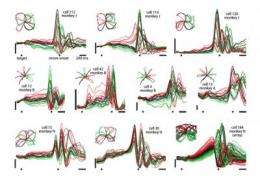
In monitoring electrical brain activity of motor-cortex neurons, researchers found that they typically exhibit a brief oscillatory response. These responses are not independent from neuron to neuron. Instead, the entire neural population oscillates as one in a beautiful and lawfully coordinated way.
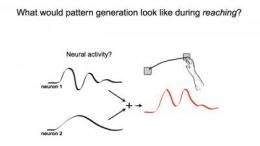
The electrical signal that drives a given movement is therefore an amalgam – a summation – of the rhythms of all the motor neurons firing at a given moment.
"Under this new way of looking at things, the inscrutable becomes predictable," said Churchland. "Each neuron behaves like a player in a band. When the rhythms of all the players are summed over the whole band, a cascade of fluid and accurate motion results."
Dr. Daofen Chen, Program Director, Systems and Cognitive Neuroscience at the National Institute of Neurological Disorders and Stroke at the National Institutes of Health, said Shenoy and team are working at the cutting edge of the field. "In trying to find the basic response properties of the motor cortex, Dr. Shenoy and his colleagues are searching for the holy grail of neuroscience," said Dr. Chen. "His team has been consistent in tackling important but tough questions, often in thought-provoking ways and in ambitious proposals. NIH is proud to support this kind of pioneering and transformative research."
Precedents in nature
In the new model, a few relatively simple rhythms explain neural features that had confounded science earlier.
"Many of the most-baffling aspects of motor-cortex neurons seem natural and straightforward in light of this model," said Cunnigham.
The team studied non-rhythmic reaching movements, which made the presence of rhythmic neural activity a surprise even though, the team notes, rhythmic neural activity has a long precedence in nature. Such rhythms are present in the swimming motion of leeches and the gait of a walking monkey, for instance.
"The brain has had an evolutionary goal to drive movements that help us survive. The primary motor cortex is key to these functions. The patterns of activity it displays presumably derive from evolutionarily older rhythmic motions such as swimming and walking. Rhythm is a basic building block of movement," explained Churchland.
Reaching for the grail
To test their hypothesis, the engineers studied the brain activity of monkeys reaching to touch a target. According to the researchers, experiments show this 'underlying rhythm' strategy works very well to explain both brain and muscle activity. In their reaching studies, the pattern of shoulder-muscle behavior could always be described by the sum of two underlying rhythms.
"Say you're throwing a ball. Beneath it all is a pattern. Maybe your shoulder muscle contracts, relaxes slightly, contracts again, and then relaxes completely, all in short order," explained Churchland. "That activity may not be exactly rhythmic, but it can be created by adding together two or three other rhythms. Our data argue that this may be how the brain solves the problem of creating the pattern of movement."
"Finding these brain rhythms surprised us a bit, as the reaches themselves were not rhythmic. In fact, they were decidedly arrhythmic, and yet underlying it all were these unmistakable patterns," said Churchland.
"This research builds on a strong theoretical framework and adds to growing evidence that rhythmic activity is important for many fundamental brain functions," said Yuan Liu of the National Institute of Neurological Disorders and Stroke, NIH. "Further research in this area may help us devise more effective technology for controlling prosthetic limbs." Liu is the co-lead of the NIH-NSF Collaborative Research in Computational Neuroscience program.
"In this model, the seemingly complex system that is the motor cortex can now be at least partially understood in more straightforward terms. The motor cortex is an engine of movement that obeys lawful dynamics," said Shenoy.
Stanford post-doctoral fellow Matthew Kaufman, bioengineering PhD student and medical science training program student Paul Nuyujukian, electrical engineering graduate student Justin Foster, and electrical engineering consulting assistant professor and Palo Alto Medical Foundation neurosurgeon Stephen Ryu were also authors on this paper.
More information: Churchland MM, Cunningham JP, Kaufman MT, Foster JD, Nuyujukian P, Ryu SI, Shenoy KV. Neural population dynamics during reaching. Nature, June 3, 2012, doi:10.1038/nature11129


