Front-most part of the cortex involved in making short-term predictions about what will happen next
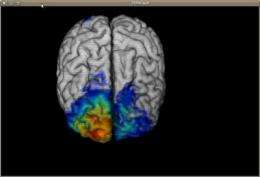
The image shows the overlap of lesions for eight subjects superimposed on a template brain -- red indicates maximum overlap (seven subjects) and dark blue is minimum overlap (one subject). The patient group was selected for lesions that include frontopolar cortex, but the lesions almost invariably extended outside to other parts of anterior prefrontal cortex. Credit: Christopher Kovach, University of Iowa
Researchers at the University of Iowa, together with colleagues from the California Institute of Technology and New York University, have discovered how a part of the brain helps predict future events from past experiences. The work sheds light on the function of the front-most part of the frontal lobe, known as the frontopolar cortex, an area of the cortex uniquely well developed in humans in comparison with apes and other primates.
Making the best possible decisions in a changing and unpredictable environment is an enormous challenge. Not only does it require learning from past experience, but it also demands anticipating what might happen under previously unencountered circumstances. Past research from the UI Department of Neurology was among the first to show that damage to certain parts of the frontal lobe can cause severe deficits in decision making in rapidly changing environments. The new study from the same department on a rare group of patients with damage to the very frontal part of their brains reveals a critical aspect of how this area contributes to decision making. The findings were published June 19 in the Journal of Neuroscience.
"We gave the patients four slot machines from which to pick in order to win money. Unbeknownst to the patients, the probability of getting money from a particular slot machine gradually and unpredictably changed during the experiment. Finding the strategy that pays the most in the long run is a surprisingly difficult problem to solve, and one we hypothesized would require the frontopolar cortex," explains Christopher Kovach, Ph.D., a UI post-doctoral fellow in neurosurgery and first author of the study.
Contrary to the authors' initial expectation, the patients actually did quite well on the task, winning as much money, on average, as healthy control participants.
"But when we compared their behavior to that of subjects with intact frontal lobe, we found they used a different set of assumptions about how the payoffs changed over time," Kovach says. "Both groups based their decisions on how much they had recently won from each slot machine, but healthy comparison subjects pursued a more elaborate strategy, which involved predicting the direction that payoffs were moving based on recent trends. This points towards a specific role for the frontopolar cortex in extrapolating recent trends."
Kovach's colleague and study author Ralph Adolphs, Ph.D., professor of neuroscience and psychology at the California Institute of Technology, adds that the study results "argue that the frontopolar cortex helps us to make short-term predictions about what will happen next, a strategy particularly useful in environments that change rapidly -- such as the stock market or most social settings."
Adolphs also hold an adjunct appointment in the UI Department of Neurology.
The study's innovative approach to understanding the function of this part of the brain uses model-based analyses of behavior of patients with specific and precisely characterized areas of brain damage. These patients are members of the UI's world-renowned Iowa Neurological Patient Registry, which was established in 1982 and has more than 500 active members with selective forms of damage, or lesions, to one or two defined regions in the brain.
"The University of Iowa is one of the few places in the world where you could carry out this kind of study, since it requires carefully assessed patients with damage to specific parts of their brain," says study author Daniel Tranel, Ph.D., UI professor of neurology and psychology and director of the UI Division of Behavioral Neurology and Cognitive Neuroscience.
In a final twist to the finding, the strategy taken by lesion patients was actually slightly better than the one used by comparison subjects. It happened that the task was designed so that the trends in the payoffs were, in fact, random and uninformative.
"The healthy comparison subjects seemed to perceive trends in what was just random noise," Kovach says.
This implies that the functions of the frontopolar cortex, which support more complex and detailed models of the environment, at times come with a downside: setting up mistaken assumptions.
"To the best of my knowledge this is the first study which links a normal tendency to see a nonexistent pattern in random noise, a type of cognitive bias, to a particular brain region," Kovach notes.
The researchers next want to investigate other parts of the frontal cortex in the brain, and have also begun to record activity directly from the brains of neurosurgical patients to see how single cells respond while making decisions. The work is also important to understand difficulties in decision making seen in disorders such as addiction.
More information: "Anterior prefrontal cortex contributes to action selection through tracking of recent reward trends," Journal of Neuroscience.
Journal reference:
Journal of Neuroscience
Provided by
University of Iowa
-
Evidence appears to show how and where frontal lobe works
Mar 02, 2009 |
not rated yet |
0
-
What you want vs. how you get it: New neuroconomics study
Oct 21, 2011 |
not rated yet |
0
-
Neural mechanism supports survival in an uncertain world
Jun 10, 2009 |
not rated yet |
0
-
New test may help distinguish between vegetative and minimally conscious state
May 13, 2011 |
not rated yet |
0
-
The brain can rapidly reorganise to recover from damage
May 04, 2007 |
not rated yet |
0
-
Motion perception revisited: High Phi effect challenges established motion perception assumptions
Apr 23, 2013 |
3 / 5 (2) |
2
-
Anything you can do I can do better: Neuromolecular foundations of the superiority illusion (Update)
Apr 02, 2013 |
4.5 / 5 (11) |
5
-
The visual system as economist: Neural resource allocation in visual adaptation
Mar 30, 2013 |
5 / 5 (2) |
9
-
Separate lives: Neuronal and organismal lifespans decoupled
Mar 27, 2013 |
4.9 / 5 (8) |
0
-
Sizing things up: The evolutionary neurobiology of scale invariance
Feb 28, 2013 |
4.8 / 5 (10) |
14
-
Pressure-volume curve: Elastic Recoil Pressure don't make sense
23 hours ago
-
If you became brain-dead, would you want them to pull the plug?
May 17, 2013
-
MRI bill question
May 15, 2013
-
Ratio of Hydrogen of Oxygen in Dessicated Animal Protein
May 13, 2013
-
Alcohol and acetaminophen
May 13, 2013
-
Marie Curie's leukemia
May 13, 2013
- More from Physics Forums - Medical Sciences
More news stories
For combat veterans suffering from post-traumatic stress disorder, 'fear circuitry' in the brain never rests
Chronic trauma can inflict lasting damage to brain regions associated with fear and anxiety. Previous imaging studies of people with post-traumatic stress disorder, or PTSD, have shown that these brain regions can over-or ...
Neuroscience
May 18, 2013 |
5 / 5 (1) |
0
|
Temporal processing in the olfactory system
The neural machinery underlying our olfactory sense continues to be an enigma for neuroscience. A recent review in Neuron seeks to expand traditional ideas about how neurons in the olfactory bulb might encode information about ...
Neuroscience
May 17, 2013 |
not rated yet |
0
|
Melon focus headband turns to Kickstarter for rollout plans
(Medical Xpress)—What if the quality of your work depends more on your focus on the piano keys or canvas or laptop than your musical or painting or computing skills? If target users can be convinced, they ...
Neuroscience
May 17, 2013 |
3.7 / 5 (3) |
0
|
Deep brain stimulation: A fix when the drugs don't work
Neurological disorders can have a devastating impact on the lives of sufferers and their families.
Neuroscience
May 17, 2013 |
5 / 5 (1) |
0
|
Brain makes call on which ear is used for cell phone
If you're a left-brain thinker, chances are you use your right hand to hold your cell phone up to your right ear, according to a newly published study from Henry Ford Hospital in Detroit.
Neuroscience
May 16, 2013 |
2 / 5 (2) |
0
|
Ketamine shows significant therapeutic benefit in people with treatment-resistant depression
Patients with treatment-resistant major depression saw dramatic improvement in their illness after treatment with ketamine, an anesthetic, according to the largest ketamine clinical trial to-date led by researchers from the ...
Consuming coffee linked to lower risk of detrimental liver disease, study finds
Regular consumption of coffee is associated with a reduced risk of primary sclerosing cholangitis (PSC), an autoimmune liver disease, Mayo Clinic research shows. The findings were being presented at the Digestive Disease ...
Research examines new methods for managing digestive health
Research presented at Digestive Disease Week (DDW) explores new methods for managing digestive health through diet and lifestyle.
New smartphone application improves colonoscopy preparation
The use of a smartphone application significantly improves patients' preparation for a colonoscopy, according to new research presented today at Digestive Disease Week (DDW). The preparation process, which begins days in ...
New research identifies practice changes to improve value and quality of GI procedures
There are significant cost and risk factors associated with two procedures commonly used to diagnose or treat gastrointestinal problems, according to research presented at Digestive Disease Week (DDW).
New research identifies risks, interventions for children's GI health
An increasing number of U.S. children are experiencing gastrointestinal issues that require interventions to resolve, according to research presented at Digestive Disease Week (DDW).
Jun 20, 2012
Rank: not rated yet
Why not doing research for those who are with Multiple Sclerosis ? How is their decision-making? Damages to their brains are severe.They also make smart decisions.