Four gene loci predispose people to most common subtype of migraine
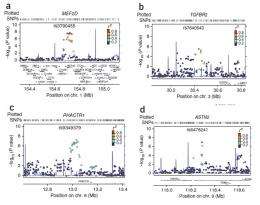
Regional plots for newly identified variants associated with migraine. Each regional plots shows the chromosomal position of SNPs in the specific region. [Nature Genetics doi: 10.1038/ng.2307]
An international research group has identified four new gene loci predisposing people to the most common subtype of migraine, migraine without aura. About two-thirds of migraine sufferers belong to this group. The study will be published in Nature Genetics on June 10, 2012.
Researchers studied genetic data of more than 11 000 people and found altogether six genes that predispose to migraine without aura. Four of these genes are new and two of them confirm previous findings.
The new genes identified in this study provide further evidence for the hypothesis that dysregulation of molecules important in transmitting signals between brain neurons contribute to migraine. Two of the genes support the hypothesis of a possible role of blood vessels and thus disturbances in blood flow.
The researchers carried out what is known as a genome-wide association study (GWAS) to zoom in on genome variants that could increase susceptibility to migraine; they compared genomes of 4800 migraine patients with more than 7000 non-migraine individuals. The project was performed by the International Headache Genetics Consortium consisting of leading migraine researches from Europe and Australia.
This was the third report on genes predisposing people to common forms of migraine, but the first one on the most common migraine subtype. "The study establishes for the first time a specific gene that contributes to this common disease" said Professor Aarno Palotie at FIMM and the Wellcome Trust Sanger Institute, the chair of the International Headache Genetics Consortium.
The carefully studied migraine patients collected from specialized headache clinics were provided a strong basis for the success of this study.
Migraine affects approximately one in six women and one in eight men, making it a leading cause of work absence and short-term incapacity: 25 million school or work days are lost for migraine each year. A US report measures its economic costs as similar to those of diabetes and WHO lists it as one of the top twenty diseases with the causes of years lived with disability (YLDs). In up to one third of migraine patients, the headache phase may be preceded or accompanied by transient neurological disturbances, the so-called aura (i.e. migraine with aura), while the majority of patients suffer from migraine without aura.
"Studies of this kind are possible only through large-scale international collaboration - bringing together the wealth of data with the right expertise and resources. The identified genes open new doors to investigate how this type of migraine comes about," said Dr. Arn van den Maagdenberg, one of the senior authors on the paper.
More information: Genome-wide association analysis identifies susceptibility loci for migraine without aura. Freilinger, T et al. Nature Genetics 2012. DOI: 10.1038/ng.2307
Journal reference:
Nature Genetics
Provided by
University of Helsinki
-
Migraine linked to increased risk of depression in women
Feb 22, 2012 |
not rated yet |
0
-
Many migraines may have a common genetic basis
Jun 13, 2011 |
not rated yet |
0
-
Study finds genetic testing may help people with severe type of migraine
Dec 03, 2007 |
not rated yet |
0
-
Research: Migraine increases stroke risk
Oct 28, 2009 |
not rated yet |
0
-
A pill to prevent migraine? Discovery of migraine gene could put it on the horizon
Jun 01, 2011 |
not rated yet |
0
-
Motion perception revisited: High Phi effect challenges established motion perception assumptions
Apr 23, 2013 |
3 / 5 (2) |
2
-
Anything you can do I can do better: Neuromolecular foundations of the superiority illusion (Update)
Apr 02, 2013 |
4.5 / 5 (11) |
5
-
The visual system as economist: Neural resource allocation in visual adaptation
Mar 30, 2013 |
5 / 5 (2) |
9
-
Separate lives: Neuronal and organismal lifespans decoupled
Mar 27, 2013 |
4.9 / 5 (8) |
0
-
Sizing things up: The evolutionary neurobiology of scale invariance
Feb 28, 2013 |
4.8 / 5 (10) |
14
-
Classical and Quantum Mechanics via Lie algebras
Apr 15, 2011
- More from Physics Forums - Independent Research
More news stories
Researchers identify new circadian clock component
Northwestern University scientists have shown a gene involved in neurodegenerative disease also plays a critical role in the proper function of the circadian clock.
Genetics
May 16, 2013 |
not rated yet |
0
|
Returning genetic incidental findings without patient consent violates basic rights, experts say
Informed consent is the backbone of patient care. Genetic testing has long required patient consent and patients have had a "right not to know" the results. However, as 21st century medicine now begins to use the tools of ...
Genetics
May 16, 2013 |
5 / 5 (1) |
3
|
Ethicists provide framework supporting new recommendations on reporting incidental findings in gene sequencing
In a paper published in Science Express, a group of experts led by bioethicists in the Center for Medical Ethics and Health Policy at Baylor College of Medicine provide a framework for the new American College of Medical Geneti ...
Genetics
May 16, 2013 |
not rated yet |
0
Experts urge caution over use of new genetic sequencing techniques
The use of genome-wide analysis (GWA), where the entirety of an individual's DNA is examined to look for the genomic mutations or variants which can cause health problems is a massively useful technology for diagnosing disease. ...
Genetics
May 16, 2013 |
not rated yet |
0
Collecting DNA for human rights: How to help while safeguarding privacy
DNA databases might help identify victims of crime and human trafficking, but how do we safeguard the personal privacy of innocent victims and family members? A new report online May 15 in the Cell Press journal Trends in ...
Genetics
May 15, 2013 |
not rated yet |
0
New research identifies risks, interventions for children's GI health
An increasing number of U.S. children are experiencing gastrointestinal issues that require interventions to resolve, according to research presented at Digestive Disease Week (DDW).
US psychiatry gets makeover in new manual
The latest makeover to a massive psychiatric tome honored by some, reviled by others and even called the "Bible" of mental disorders is being released Saturday with a host of new changes.
New case of SARS-like virus in Saudi: ministry
A new case of the deadly coronavirus has been detected in Saudi Arabia where 15 people have already died after contracting it, the health ministry announced on Saturday on its Internet website.
AIDS science at 30: 'Cure' now part of lexicon
Big names in medicine are set to give an upbeat assessment of the war on AIDS on Tuesday, 30 years after French researchers identified the virus that causes the disease.
For combat veterans suffering from post-traumatic stress disorder, 'fear circuitry' in the brain never rests
Chronic trauma can inflict lasting damage to brain regions associated with fear and anxiety. Previous imaging studies of people with post-traumatic stress disorder, or PTSD, have shown that these brain regions can over-or ...
New colonoscope provides ground-breaking view of colon
A ground-breaking advance in colonoscopy technology signals the future of colorectal care, according to research presented today at Digestive Disease Week(DDW). Additional research focuses on optimizing the minimal withdrawal ...