Researchers review muscular dystrophy therapies
June 22, 2012 in Medical research
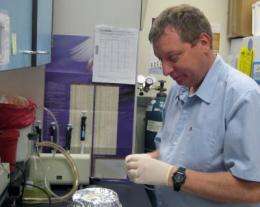
Dean Burkin, associate professor of pharmacology at the University of Nevada School of Medicine in Reno is working to develop a therapy for muscular dystrophy. He has co-authored a paper published this week in Science Translational Medicine that examines the potential MG53 protein therapy for Duchenne muscular dystrophy. Credit: Photo courtesy of University of Nevada, Reno
Leading muscular dystrophy researcher Dean Burkin, of the University of Nevada School of Medicine summarizes the impact of a new protein therapeutic, MG53, for the treatment of Duchenne muscular dystrophy in an article published this week in Science Translational Medicine.
"This is a focus article in which we summarize the impact of MG53 protein therapy as a treatment option and discuss the increasing number of new protein therapeutics being developed for the muscular dystrophies, including laminin-111 developed in our laboratory," Burkin, a pharmacological researcher and associate professor, said.
The article, "A Molecular Bandage for Diseased Muscle," co-authored by Ryan Wuebbles, a post-doctoral student in Burkin's lab in the University's Center for Molecular Medicine, is a review of the current status of therapeutic developments in the muscular dystrophy research field. These therapies represent significant strides and show great promise in treatment of muscular dystrophy.
Approaches to treat Duchenne muscular dystrophy include gene replacement therapy, gene repair and myoblast cell transfer.
In a study on MG53 by Noah Weislander and colleagues, presented in the same issue of Science Translational Medicine, it was found that mice that lack MG53 developed progressive muscle weakness and exhibit defective muscle repair after exercise or injury, and that MG53 facilitates rapid membrane repair to prevent damage to normal muscle.
The study suggests that treatment in combination with other protein therapies such as Burkin's laminin-111 therapy, are likely to have synergy as well for Duchenne and other muscular dystrophies.
Burkin's published research on laminin-111, a naturally occurring protein, showed it is quickly picked up in the bloodstream of mice and prevents muscle damage, an important finding for Duchenne muscular dystrophy, the most common form of muscular dystrophy.
He recently co-hosted Myomatrix 2012, a conference for leading muscular dystrophy scientists and clinicians to explore and share their latest findings and data on treatment breakthroughs. The conference was held at the University of Nevada, Reno campus, where research by Burkin has led to a potential new therapy for muscular dystrophy.
More information: The article by Burkin and Wuebbles can be found at stm.sciencemag.org… 139fs19.full
Burkin's work, which is funded by the National Institutes of Health, has also been featured on the website ScienCentral (www.sciencentral.com/video/2009/04/20/muscular-dystrophy-drug/). His work was published in the Proceedings of the National Academy of Sciences as well as the January 2009 edition of American Journal of Pathology.
Journal reference:
Science Translational Medicine
Proceedings of the National Academy of Sciences
American Journal of Pathology
Provided by
University of Nevada, Reno
-
Potential therapy for congenital muscular dystrophy
Dec 30, 2008 |
not rated yet |
0
-
MG53 protein shown to be useful for treating traumatic tissue damage
Jun 21, 2012 |
not rated yet |
0
-
Researchers prove the gene responsible for Duchenne muscular dystrophy can be repaired
Apr 15, 2010 |
not rated yet |
0
-
Stem cell foundation for muscular dystrophy treatment
Jul 14, 2011 |
not rated yet |
0
-
New therapy substitutes missing protein in those with muscular dystrophy
May 26, 2009 |
not rated yet |
0
-
Motion perception revisited: High Phi effect challenges established motion perception assumptions
Apr 23, 2013 |
3 / 5 (2) |
2
-
Anything you can do I can do better: Neuromolecular foundations of the superiority illusion (Update)
Apr 02, 2013 |
4.5 / 5 (11) |
5
-
The visual system as economist: Neural resource allocation in visual adaptation
Mar 30, 2013 |
5 / 5 (2) |
9
-
Separate lives: Neuronal and organismal lifespans decoupled
Mar 27, 2013 |
4.9 / 5 (8) |
0
-
Sizing things up: The evolutionary neurobiology of scale invariance
Feb 28, 2013 |
4.8 / 5 (10) |
14
-
Why is zone 1 in liver more prone to ischemic injury?
May 23, 2013
-
How can there be villous adenoma in colon, if there are no villi there
May 22, 2013
-
How can there be a term called "intestinal metaplasia" of stomach
May 21, 2013
-
Pressure-volume curve: Elastic Recoil Pressure don't make sense
May 18, 2013
-
If you became brain-dead, would you want them to pull the plug?
May 17, 2013
-
MRI bill question
May 15, 2013
- More from Physics Forums - Medical Sciences
More news stories
Study reveals new mechanism for estrogen suppression of liver lipid synthesis
By discovering the new mechanism by which estrogen suppresses lipid synthesis in the liver, UC Irvine endocrinologists have revealed a potential new approach toward treating certain liver diseases.
Medical research
May 23, 2013 |
5 / 5 (1) |
0
|
MRI-based measurement helps predict vascular disease in the brain
Aortic arch pulse wave velocity, a measure of arterial stiffness, is a strong independent predictor of disease of the vessels that supply blood to the brain, according to a new study published in the June issue the journal ...
Medical research
May 23, 2013 |
not rated yet |
0
Antibiotics: A new understanding of sulfonamide nervous system side effects
Since the discovery of Prontosil in 1932, sulfonamide antibiotics have been used to combat a wide spectrum of bacterial infections, from acne to chlamydia and pneumonia. However, their side effects can include serious neurological ...
Medical research
May 23, 2013 |
3 / 5 (1) |
0
|
Scientists discover molecule triggers sensation of itch
Scientists at the National Institutes of Health report they have discovered in mouse studies that a small molecule released in the spinal cord triggers a process that is later experienced in the brain as ...
Medical research
May 23, 2013 |
5 / 5 (3) |
0
|
Discarded immune cells induce the relocation of stem cells
Spanish researchers have discovered that the daily clearance of neutrophils from the body stimulates the release of hematopoietic stem cells from the bone marrow into the bloodstream, according to a report published today ...
Medical research
May 23, 2013 |
5 / 5 (2) |
0
First drug to improve heart failure mortality in over a decade
Coenzyme Q10 decreases all cause mortality by half, according to the results of a multicentre randomised double blind trial presented today at Heart Failure 2013 congress. It is the first drug to improve heart failure mortality ...
Heart failure accelerates male 'menopause'
Heart failure accelerates the aging process and brings on early andropausal syndrome (AS), according to research presented today at the Heart Failure Congress 2013. AS, also referred to as male 'menopause', was four times ...
Hormone levels may provide key to understanding psychological disorders in women
Women at a particular stage in their monthly menstrual cycle may be more vulnerable to some of the psychological side-effects associated with stressful experiences, according to a study from UCL.
Researchers identify first drug targets in childhood genetic tumor disorder
Two mutations central to the development of infantile myofibromatosis (IM)—a disorder characterized by multiple tumors involving the skin, bone, and soft tissue—may provide new therapeutic targets, according to researchers ...
Feds fight morning-after pill age ruling in NY
(AP)—Department of Justice lawyers have again asked a federal appeals court in New York to delay lifting age restrictions and prescription requirements on an emergency contraceptive popularly known as the morning-after ...
Death highest in heart failure patients admitted in January, on Friday, and overnight
Mortality and length of stay are highest in heart failure patients admitted in January, on Friday, and overnight, according to research presented today at the Heart Failure Congress 2013. The analysis of nearly 1 million ...