Some stem cells can trigger tumors
June 5, 2012 By Anne Ju in Cancer
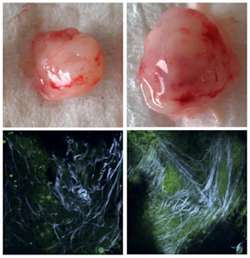
Tumor size and collagen fiber alignment in the absence (left) and presence (right) of adipose stem cells. (Fischbach lab)
(Medical Xpress) -- Stem cells often used in reconstructive surgery following mastectomies and other cancer-removal treatments may pose a danger: Cornell biomedical scientists have discovered that these cells, in contact with even trace amounts of cancer cells, can create a microenvironment suitable for more tumors to grow.
"It is necessary for us not only to think about what happens with these cells in an otherwise healthy patient, but also, what the fate of stem cells may be in a patient who is prone to disease," said Claudia Fischbach-Teschl, assistant professor of biomedical engineering, who led the research published in Proceedings of the National Academy of Sciences, June 4.
The cells the researchers studied are derived from fat and are called adipose-derived stem cells. They are useful for tissue engineering and reconstructive surgery because they are good at taking over healthy tissue function and recruiting new blood vessels to promote healing.
But they might be too good -- that is, the Cornell researchers observed that the presence of cancer cell media -- the soluble material that contains chemicals secreted by tumor cells -- prevents the stem cells from turning into fat cells as would be desired. Instead, they triggered the cells to secrete chemicals known as "factors" that promote blood vessel growth, or angiogenesis, and to develop into myofibroblasts, which are cells known to play a role in tumor development.
These alterations led to a stiffening of the extracellular matrix that surrounds the cells -- the stiffening is a characteristic feature of breast cancer (which is why tumors can be palpated). Myofibroblasts make the surrounding tissue more rigid, and this stiffness triggers more changes in the stem cell behavior that lead to even more tumor-promoting characteristics -- a positive feedback loop.
The researchers observed these changes in in vitro experiments using stem cells and breast cancer cell lines that varied in aggression. First they collected soluble media from tumor cells and observed how the stem cells changed in response. They found that TGF-beta and interleukin-8 are specific tumor-secreted factors that contribute to the stem cells' eventual change in phenotype to myofibroblasts. They confirmed their results with in vivo experiments by injecting stem cells and tumor cells into the mammary glands of mice.
The experimental results are also supported by the fact that obese women are more likely to develop breast cancer. The presence of more adipose tissue means larger numbers of adipose stem cells, and one could hypothesize that the larger stem cell pool could promote tumor-progression processes, Fischbach-Teschl said.
The paper, whose first authors are graduate students Emily Chandler and Bo Ri Seo, resulted from a multidisciplinary collaboration that included researchers from the College of Engineering, College of Veterinary Medicine and College of Arts and Sciences.
The research was supported by the National Institutes of Health, Cornell Center on the Microenvironment and Metastasis and the National Science Foundation.
Journal reference:
Proceedings of the National Academy of Sciences
Provided by
Cornell University
-
Cancer stem cell vaccine in development shows antitumor effect
Apr 02, 2012 |
not rated yet |
0
-
Cancer stem cells recruit normal stem cells to fuel ovarian cancer
Jul 18, 2011 |
not rated yet |
0
-
Fat stem cells safe for breast reconstruction when cancer is dormant: study
Sep 16, 2010 |
not rated yet |
0
-
Herceptin targets breast cancer stem cells
Jul 09, 2008 |
not rated yet |
0
-
Cancer stem cells: know thine enemy
Dec 21, 2007 |
not rated yet |
0
-
Motion perception revisited: High Phi effect challenges established motion perception assumptions
Apr 23, 2013 |
3 / 5 (2) |
2
-
Anything you can do I can do better: Neuromolecular foundations of the superiority illusion (Update)
Apr 02, 2013 |
4.5 / 5 (11) |
5
-
The visual system as economist: Neural resource allocation in visual adaptation
Mar 30, 2013 |
5 / 5 (2) |
9
-
Separate lives: Neuronal and organismal lifespans decoupled
Mar 27, 2013 |
4.9 / 5 (8) |
0
-
Sizing things up: The evolutionary neurobiology of scale invariance
Feb 28, 2013 |
4.8 / 5 (10) |
14
-
Pressure-volume curve: Elastic Recoil Pressure don't make sense
May 18, 2013
-
If you became brain-dead, would you want them to pull the plug?
May 17, 2013
-
MRI bill question
May 15, 2013
-
Ratio of Hydrogen of Oxygen in Dessicated Animal Protein
May 13, 2013
-
Alcohol and acetaminophen
May 13, 2013
-
Marie Curie's leukemia
May 13, 2013
- More from Physics Forums - Medical Sciences
More news stories
New smartphone application improves colonoscopy preparation
The use of a smartphone application significantly improves patients' preparation for a colonoscopy, according to new research presented today at Digestive Disease Week (DDW). The preparation process, which begins days in ...
Cancer
2 hours ago |
not rated yet |
0
Research examines new methods for managing digestive health
Research presented at Digestive Disease Week (DDW) explores new methods for managing digestive health through diet and lifestyle.
Cancer
3 hours ago |
not rated yet |
0
New colonoscope provides ground-breaking view of colon
A ground-breaking advance in colonoscopy technology signals the future of colorectal care, according to research presented today at Digestive Disease Week(DDW). Additional research focuses on optimizing the minimal withdrawal ...
Cancer
18 hours ago |
5 / 5 (2) |
0
ASCO: combo antibody therapy effective for melanoma
(HealthDay)—Concurrent use of two immune checkpoint antibodies—ipilimumab and nivolumab—may be effective for the treatment of advanced melanoma, according to a proof-of-principal study presented in ...
Cancer
May 17, 2013 |
not rated yet |
0
Risk factors ID'd for poor cutaneous cell CA outcomes
(HealthDay)—The risks of metastasis and death associated with cutaneous squamous cell carcinoma (CSCC) are low, but significant, and risk factors for poor outcome include tumor diameter, invasion beyond ...
Cancer
May 17, 2013 |
not rated yet |
0
|
Ketamine shows significant therapeutic benefit in people with treatment-resistant depression
Patients with treatment-resistant major depression saw dramatic improvement in their illness after treatment with ketamine, an anesthetic, according to the largest ketamine clinical trial to-date led by researchers from the ...
Consuming coffee linked to lower risk of detrimental liver disease, study finds
Regular consumption of coffee is associated with a reduced risk of primary sclerosing cholangitis (PSC), an autoimmune liver disease, Mayo Clinic research shows. The findings were being presented at the Digestive Disease ...
New research identifies risks, interventions for children's GI health
An increasing number of U.S. children are experiencing gastrointestinal issues that require interventions to resolve, according to research presented at Digestive Disease Week (DDW).
New research identifies practice changes to improve value and quality of GI procedures
There are significant cost and risk factors associated with two procedures commonly used to diagnose or treat gastrointestinal problems, according to research presented at Digestive Disease Week (DDW).
US psychiatry gets makeover in new manual
The latest makeover to a massive psychiatric tome honored by some, reviled by others and even called the "Bible" of mental disorders is being released Saturday with a host of new changes.
New case of SARS-like virus in Saudi: ministry
A new case of the deadly coronavirus has been detected in Saudi Arabia where 15 people have already died after contracting it, the health ministry announced on Saturday on its Internet website.