New survival factor for immune cells identified
June 11, 2012 in Medical research
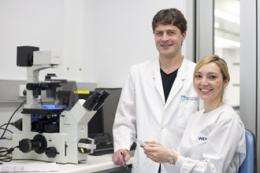
Ms Eleonora Ottina and Dr Marco Herold have identified a survival factor for immune cells
(Medical Xpress) -- An international team of researchers has discovered that many of the bodys infection-fighting immune cells require a cell survival protein, called A1, to develop and function. Their finding could lead to a better understanding of conditions including leukaemia, allergy and autoimmunity.
The team discovered that without A1, immune cells called lymphocytes and granulocytes could not develop, or could not respond appropriately to infectious stimuli.
A1 is part of the Bcl-2 protein family, which controls the survival of cells. The research team developed a method of depleting A1 from immune cells, allowing them to study the development and function of immune cells lacking A1. The findings were published online last month in the journal Blood.
The research was jointly led by Dr. Marco Herold, from the Walter and Eliza Hall Institutes Molecular Genetics of Cancer division, and Dr. Andreas Villunger of Innsbruck Medical University, Austria, a former postdoctoral researcher at the institute. Dr. Herold, who began the research while at the University of Wuerzburg, Germany, said the discovery had surprised many scientists working in the area. For more than a decade, we have known that cell survival proteins such as Bcl-2 are important for immune cell development and function, he said. A1 proved more difficult to work with than other, closely related, proteins so many researchers ignored it. Our work has shown that A1 has many important roles in the immune system.
Ms. Eleonora Ottina, a student visiting the institute from the Molecular Cell Biology and Oncology post-graduate program at Innsbruck Medical University, said the discovery had opened the door to several new fields of research into human disease. It is well known that conditions including leukaemia, allergy, and autoimmune conditions, such as lupus, can be caused by the survival of defective or unwanted immune cells, which should normally die, she said.
Our research has shown that A1 is important for immune cell development and survival, and has given us the tools to deplete cells of A1 protein. We are now working to determine whether the presence of A1 in cells is necessary for the development of leukaemia, autoimmunity or allergy. If it is, depleting or functionally blocking A1 could be a new treatment for these diseases.
Journal reference:
Blood
Provided by
Walter and Eliza Hall Institute of Medical Research
-
Cell survival protein research reveals surprise structure
Oct 14, 2011 |
not rated yet |
0
-
New research explains how estrogen could help protect women from cardiovascular disease
Aug 11, 2011 |
not rated yet |
0
-
Cell survival protein discovery rewrites immune system story
Oct 07, 2010 |
not rated yet |
0
-
New cell type offers new hope
Jun 14, 2011 |
not rated yet |
0
-
Cell death researchers identify new Achilles heel in acute myeloid leukemia
Jan 17, 2012 |
not rated yet |
0
-
Motion perception revisited: High Phi effect challenges established motion perception assumptions
Apr 23, 2013 |
3 / 5 (2) |
2
-
Anything you can do I can do better: Neuromolecular foundations of the superiority illusion (Update)
Apr 02, 2013 |
4.5 / 5 (11) |
5
-
The visual system as economist: Neural resource allocation in visual adaptation
Mar 30, 2013 |
5 / 5 (2) |
9
-
Separate lives: Neuronal and organismal lifespans decoupled
Mar 27, 2013 |
4.9 / 5 (8) |
0
-
Sizing things up: The evolutionary neurobiology of scale invariance
Feb 28, 2013 |
4.8 / 5 (10) |
14
-
If you became brain-dead, would you want them to pull the plug?
16 hours ago
-
MRI bill question
May 15, 2013
-
Ratio of Hydrogen of Oxygen in Dessicated Animal Protein
May 13, 2013
-
Alcohol and acetaminophen
May 13, 2013
-
Marie Curie's leukemia
May 13, 2013
-
Genetic variations within and between populations
May 12, 2013
- More from Physics Forums - Medical Sciences
More news stories
Now we know why old scizophrenia medicine works on antibiotics-resistant bacteria
In 2008 researchers from the University of Southern Denmark showed that the drug thioridazine, which has previously been used to treat schizophrenia, is also a powerful weapon against antibiotic-resistant bacteria such as ...
Medical research
10 hours ago |
3.7 / 5 (3) |
0
|
SUMO wrestling cells reveal new protective mechanism target for stroke
Scientists investigating the interaction of a group of proteins in the brain responsible for protecting nerve cells from damage have identified a new target that could increase cell survival.
Medical research
15 hours ago |
5 / 5 (1) |
0
How serotonin receptors can shape drug effects, from LSD to migraine medication
New findings by researchers carrying out experiments at the U.S. Department of Energy Office of Science's Advanced Photon Source (APS) help explain why some drugs that interact with two kinds of human serotonin ...
Medical research
17 hours ago |
not rated yet |
0
|
Preventing blood poisoning
Peptide molecules derived from the body's natural immune system can help boost the body's defence against life-threatening blood poisoning, joint University research has uncovered.
Medical research
18 hours ago |
4 / 5 (1) |
0
|
New mechanism to prevent type 2 diabetes in obese individuals
A new Montréal study conducted by Dr. May Faraj, associate research professor at the Université de Montréal and invited scientist at the IRCM, along with her research team and medical collaborators, shows ...
Medical research
18 hours ago |
not rated yet |
0
|
AIDS science at 30: 'Cure' now part of lexicon
Big names in medicine are set to give an upbeat assessment of the war on AIDS on Tuesday, 30 years after French researchers identified the virus that causes the disease.
For combat veterans suffering from post-traumatic stress disorder, 'fear circuitry' in the brain never rests
Chronic trauma can inflict lasting damage to brain regions associated with fear and anxiety. Previous imaging studies of people with post-traumatic stress disorder, or PTSD, have shown that these brain regions can over-or ...
Temporal processing in the olfactory system
The neural machinery underlying our olfactory sense continues to be an enigma for neuroscience. A recent review in Neuron seeks to expand traditional ideas about how neurons in the olfactory bulb might encode information about ...
Melon focus headband turns to Kickstarter for rollout plans
(Medical Xpress)—What if the quality of your work depends more on your focus on the piano keys or canvas or laptop than your musical or painting or computing skills? If target users can be convinced, they ...
Flesh-eating disease victim gets prosthetic hands
(AP)—A woman who lost both hands, her left leg and right foot after contracting a flesh-eating disease has been fitted with prosthetic hands.
Study identifies new approach to improving treatment for MS and other conditions
(Medical Xpress)—Working with lab mice models of multiple sclerosis (MS), UC Davis scientists have detected a novel molecular target for the design of drugs that could be safer and more effective than current FDA-approved ...