Brain abnormalities seen in children with severe form of diabetes
July 12, 2012 By Jim Dryden in Medical research
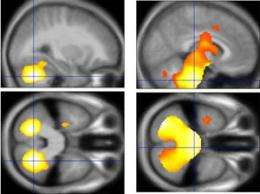
Brain scans identified regions of significantly reduced gray matter (right column) and white matter (left column) in young people with Wolfram syndrome. The brainstem and the cerebellum were particularly affected. (TAMARA HERSHEY, PHD)
(Medical Xpress) -- Children with a rare syndrome that includes a form of insulin-dependent diabetes have brain abnormalities that appear to set the stage for cognitive problems later in life, according to new research at Washington University School of Medicine in St. Louis.
The scientists studied children with Wolfram syndrome, which causes insulin-dependent diabetes in childhood. The disorder also causes hearing and vision loss and kidney problems. As patients get older, they can develop cognitive difficulties and dementia, and more than half die before their 30th birthday.
Earlier case studies had used imaging to identify brain abnormalities, but scientists had assumed those changes occurred late in the disease process when Wolframs patients got older. The new findings suggest, however, that some changes in the brain occur early in childhood.
The study is published in the online journal Public Library of Science (PLoS) One.
This video is not supported by your browser at this time.
This work strongly suggests that brain changes occur very early in the disease, says first author Tamara Hershey, PhD. The Wolfram gene is important throughout the body in the heart, retina, pancreas and so on. The pancreas is affected very early in development eventually leading to diabetes, so it stands to reason that other organs like the brain may also be affected at an early age, even before a child experiences any cognitive problems.Wolfram syndrome results from mutations in a single gene called WSF-1, which was first identified in 1998 by the late M. Alan Permutt, MD, a former professor of medicine and of cell biology and physiology. He later developed an animal model of the disorder.
In 2010, Permutt organized the worlds first clinic exclusively for patients with Wolfram syndrome. The initiative drew children worldwide to St. Louis for testing and evaluation. Another clinic was held last year, and a third will take place this summer at St. Louis Childrens Hospital.
Hershey, a professor of psychiatry, of neurology and of radiology, focuses on the neurological aspects of Wolfram syndrome. She leads the scientific efforts of the interdisciplinary clinic, along with Bess A. Marshall, MD, associate professor of pediatrics, who is the clinics medical director. Nearly a dozen Washington University faculty members evaluate patients at the Wolfram clinic as part of studies to better understand the syndrome.
For the new study, Hershey obtained brain scans of Wolfram patients ages 5-25 and other young patients who only had type 1 diabetes, along with healthy controls in the same age range. The study represents the first time that scientists have attempted to measure and statistically quantify brain differences in patients with Wolfram syndrome.
These individuals are intact cognitively, and some of them are very smart, high-functioning kids, she says. But we have been able to detect significant differences in the size of certain brain structures, leading us to believe that some of these differences must happen during brain development.
In particular, Hersheys group has identified changes in the brainstem and the cerebellum. They also found that the skulls of these children tended to be smaller than would have been expected, based on their ages at the time of the study. The investigators also detected differences in the thickness of the brains cortex, particularly in parts of the cortex related to vision.
We were able to pinpoint those regions of the brain that are most affected in terms of size the brainstem and the cerebellum, she says. And we also used a type of imaging called diffusion tensor imaging that allowed us to measure the integrity of white matter pathways in the brain. Again, we found evidence that the brainstem and the cerebellum white matter were affected in patients with Wolfram syndrome, compared to those with type 1 diabetes only and healthy controls.
Wolfram syndrome is very rare, affecting an estimated one in 770,000 children. Before these comprehensive research clinics were established, most of what scientists knew about the brains of patients with the disorder had come from clinical exams of adult patients or autopsies of patients with Wolframs.
Hershey believes that by conducting annual MRI scans and continuing to track patients with Wolfram syndrome over time, it may be possible to distinguish changes that occur during brain development from those that occur due to degeneration related to the disorder.
More information: Hershey T, Lugar HM, Shimony JS, Rutlin J, Koller JM, Perantie DC, Paciorkowski AR, Eisenstein SA, Permutt MA. Early brain vulnerability in Wolfram Syndrome. PLoS One, July 11, 2012. dx.plos.org/10.137… pone.0040604.
Journal reference:
PLoS ONE
Provided by
Washington University School of Medicine in St. Louis
-
Researchers study children at risk for Tourette syndrome
Jan 04, 2011 |
not rated yet |
0
-
Wolfram Research introduces new programmable document type
Jul 25, 2011 |
not rated yet |
0
-
Wolfram Alpha shows flights overhead
Nov 18, 2011 |
not rated yet |
0
-
Falls may be early sign of Alzheimer's
Jul 18, 2011 |
not rated yet |
0
-
Soldiers screened for potential vulnerability to tinnitus
Mar 29, 2011 |
not rated yet |
0
-
Motion perception revisited: High Phi effect challenges established motion perception assumptions
Apr 23, 2013 |
3 / 5 (2) |
2
-
Anything you can do I can do better: Neuromolecular foundations of the superiority illusion (Update)
Apr 02, 2013 |
4.5 / 5 (11) |
5
-
The visual system as economist: Neural resource allocation in visual adaptation
Mar 30, 2013 |
5 / 5 (2) |
9
-
Separate lives: Neuronal and organismal lifespans decoupled
Mar 27, 2013 |
4.9 / 5 (8) |
0
-
Sizing things up: The evolutionary neurobiology of scale invariance
Feb 28, 2013 |
4.8 / 5 (10) |
14
-
Pressure-volume curve: Elastic Recoil Pressure don't make sense
May 18, 2013
-
If you became brain-dead, would you want them to pull the plug?
May 17, 2013
-
MRI bill question
May 15, 2013
-
Ratio of Hydrogen of Oxygen in Dessicated Animal Protein
May 13, 2013
-
Alcohol and acetaminophen
May 13, 2013
-
Marie Curie's leukemia
May 13, 2013
- More from Physics Forums - Medical Sciences
More news stories
Computational tool translates complex data into simplified 2-dimensional images
In their quest to learn more about the variability of cells between and within tissues, biomedical scientists have devised tools capable of simultaneously measuring dozens of characteristics of individual ...
Medical research
13 hours ago |
5 / 5 (3) |
0
|
Now we know why old scizophrenia medicine works on antibiotics-resistant bacteria
In 2008 researchers from the University of Southern Denmark showed that the drug thioridazine, which has previously been used to treat schizophrenia, is also a powerful weapon against antibiotic-resistant bacteria such as ...
Medical research
May 17, 2013 |
4 / 5 (4) |
0
|
SUMO wrestling cells reveal new protective mechanism target for stroke
Scientists investigating the interaction of a group of proteins in the brain responsible for protecting nerve cells from damage have identified a new target that could increase cell survival.
Medical research
May 17, 2013 |
5 / 5 (1) |
0
How serotonin receptors can shape drug effects, from LSD to migraine medication
New findings by researchers carrying out experiments at the U.S. Department of Energy Office of Science's Advanced Photon Source (APS) help explain why some drugs that interact with two kinds of human serotonin ...
Medical research
May 17, 2013 |
4 / 5 (1) |
0
|
Preventing blood poisoning
Peptide molecules derived from the body's natural immune system can help boost the body's defence against life-threatening blood poisoning, joint University research has uncovered.
Medical research
May 17, 2013 |
4 / 5 (1) |
0
|
Blame your parents for bunion woes
A novel study reports that white men and women of European descent inherit common foot disorders, such as bunions (hallux valgus) and lesser toe deformities, including hammer or claw toe. Findings from the Framingham Foot ...
Whole-cell vaccine was more effective than acellular vaccine during CA pertussis outbreak
Whole-cell pertussis vaccines were more effective at protecting against pertussis than acellular pertussis vaccines during a large recent outbreak, according to a new Kaiser Permanente study published in Pediatrics.
Commonly used catheters double risk of blood clots in ICU and cancer patients
Touted for safety, ease and patient convenience, peripherally inserted central catheters have become many clinicians' go-to for IV delivery of antibiotics, nutrition, chemotherapy, and other medications.
Molecular marker from pancreatic 'juices' helps identify pancreatic cancer
Researchers at Mayo Clinic have developed a promising method to distinguish between pancreatic cancer and chronic pancreatitis—two disorders that are difficult to tell apart. A molecular marker obtained from pancreatic ...
New theory on genesis of osteoarthritis comes with successful therapy in mice
Scientists at Johns Hopkins have turned their view of osteoarthritis (OA) inside out. Literally. Instead of seeing the painful degenerative disease as a problem primarily of the cartilage that cushions joints, ...
Researchers identify a potential new risk for sleep apnea: Asthma
Researchers at the University of Wisconsin have identified a potential new risk factor for obstructive sleep apnea: asthma. Using data from the National Institutes of Health (Heart, Lung, and Blood Institute)-funded Wisconsin ...