Brain variants of protein associated with Huntington's and other neurodegenerative diseases identified
(Medical Xpress) -- A protein essential for metabolism and recently associated with neurodegenerative diseases also occurs in several brain-specific forms. This discovery emerged in the course of a research project funded by the Austrian Science Fund FWF, the findings of which have now been published in the journal Human Molecular Genetics. The scientists working on the project discovered a large new region in the genetic code of the protein PGC-1alpha. Previously unknown variations of the protein, which can be found specifically in the brain, are produced from this region. This discovery may provide tissue-specific starting points for the development of new treatments for neurodegenerative diseases like Huntington's, Parkinson's and Alzheimer's.
PGC-1alpha is a real jack-of-all-trades. As a central regulator of metabolic genes that coordinate energy metabolism, the protein, which functions as a "transcriptional coactivator", influences major body functions. The extent to which the protein also influences medical conditions like obesity, diabetes and metabolic syndrome is unclear, and was under further investigation as part of a research project funded by the Austrian Science Fund FWF. In the course of their research, however, the scientists stumbled on unexpected findings with a particular relevance for neurodegenerative diseases.
Major Difference
A research team headed by Prof. Wolfgang Patsch from the Departments of Pharmacology and Toxicology, and Laboratory Medicine at the Paracelsus Medical University established that the gene which codes for PGC-1alpha (PPARGC1A) is six times larger than hitherto assumed. A new promoter was actually found at some distance (ca. 580 kb) from the previously known gene. A promoter is a DNA segment usually occurring upstream from a gene that can ultimately control how that gene is expressed as a protein. The transmission of genetic information from DNA to RNA molecules, i.e. transcription, is an important intermediate step in this process.
Transcripts, which are produced from the newly discovered promoter, were now examined in detail as part of the research project. "These transcripts differ in important regions from those encoded by the previously characterized - reference - PPARGC1A locus. Based on these differences, we were able to show that these previously unknown transcripts are produced specifically in human brain cells and are at least as common there as the reference transcripts," explains Dr. Selma M. Soyal, first author of the article currently published in Human Molecular Genetics. Further analyzes showed that the differences in the transcripts lead to the formation of proteins which differ from the protein that acts as a reference, in particular at the N-terminus. Other differences were found within the PGC-1alpha amino acid chain.
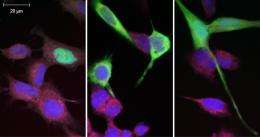
When the different PGC-1alpha proteins were localized in human cells (SH-SY5Y), another surprise awaited the scientists: whereas the reference protein was located mainly in the cell nucleus, one of the newly discovered variants was mainly found in the surrounding cytoplasm; another was found both in the nucleus and in the cytoplasm. According to Prof. Patsch: "It is likely that the differences we found in the transcripts influence mechanisms in the finished proteins which control their localization in the cell."
A Protein With Impact
The detailed functional characterization of the brain-specific proteins could prove significant, as PGC-1alpha is associated with various neurodegenerative diseases such as Huntington's disease, Parkinson's and Alzheimer's - a link that was also confirmed by the project. Using complex statistical analyses, sequence differences in the new promoter were examined in 1.706 Huntington patients as part of a collaboration with the European Huntington's Disease Network. A clear correlation emerged here between different sequence patterns and the age of onset of the disease in the patients. In addition, the scientists were also able to show that the newly discovered promoter is active in nerve tissue. This indicates that it may actually play an important role in the only partly known links between PGC-1alpha and the neurodegenerative diseases in question.
Overall, the findings of this project, which is funded by the Austrian Science Fund FWF, indicate complex functions of PGC-1alpha in humans. If the scientists succeed in reaching a better understanding of this complexity, PGC-1alpha could provide new possibilities for future therapeutic intervention in key neurodegenerative diseases.
More information: A greatly extended PPARGC1A genomic locus encodes several new brain-specific isoforms and influences Huntington disease age of onset. S. M. Soyal, et al. and For the European Huntington Disease Network. Human Molecular Genetics, 2012, doi: 10.1093/hmg/dds177


