Demystifying the immortality of cancer cells
July 5, 2012 in Cancer

Demystifying the immortality of cancer cells

Enlarge

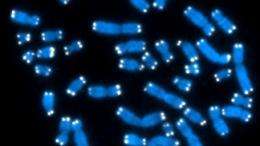
The telomeres can be seen as white dots on these chromosomes© National Institute of Health

(Medical Xpress) -- In cancer cells, normal mechanisms governing the cellular life cycle have gone haywire. Cancer cells continue to divide indefinitely, without ever dying off, thus creating rapidly growing tumors. Swiss scientists have discovered a protein complex involved this deregulated process, and hope to be able to exploit it to stop tumor formation in its tracks.

All our cells come equipped with an automatic self-destruct mechanism; they are programmed to die after a certain number of divisions. This is of great interest to cancer researchers, because most forms of cancer exhibit a defect in this innate timing mechanism. Cancer cells continue to divide indefinitely, long past the moment at which a normal cell would self-destruct. A team of researchers from professor Joachim Lingner’s laboratory at EPFL has learned how this defect is regulated in a . Post-doctoral researcher Liuh-Yow Chen led the team in publishing an article appearing in the journal Nature on the 4th of July 2012. Their hope is that the discovery will provide new targets for drug therapies to combat the deadly disease.

Cellular immortality, which is responsible for cancer formation, hearkens back to a critical function of the cells of the developing embryo. At the ends of every chromosome there is a special sequence of DNA known as a telomere, whose length is governed by the telomerase enzyme. This sequence represents the lifespan of the cell. Every time the cell divides, it is shortened, and when the telomere finally runs out, the cell dies. This reserve allows most cells to divide about 60 times – sufficient for the cell to play its given role in the organism, without succumbing to inevitable genetic mutation.

Cellular immortality, cancer’s common denominator

Normally, once the embryonic stage is completed, our cells stop producing telomerase – with the notable exception of somatic stem cells. But occasionally, a cell will mutate and reactivate production of the enzyme, so that when the cell divides, the telomere gets longer instead of shorter. This is what gives cancer cells their immortality.

“This mutation, on its own, is not enough to cause cancer,” explains Joachim Lingner, co-author and head of the lab. “But cellular immortality is a critical element in in 90% of known cancers.” Researchers the world over hope to be able to stop the runaway growth of cancer cells by targeting this mechanism with drug therapy.

But interestingly enough, even in a cancer cell the telomere doesn’t grow indefinitely long. With each cell division it loses some 60 nucleotides, like most cells, but then the activated telomerase causes it to gain just as many back. The internal clock is reset to zero, and the cell becomes immortal. But there’s one interesting question here: What is stopping the telomere from getting indefinitely long?

Stopping the clock with three proteins

The EPFL team was able to provide an answer to this question; they identified three proteins that join together and then attach themselves to the telomere. A bit like a lid on a pot, this protein complex prevents telomerase from acting on the telomere. But in the cancer cell, their timing is off – their involvement takes place too late.

“If we could cause these proteins to act earlier, or if we could recreate a similar , the cancer cell would no longer be immortal,” explains Ligner. The would die a normal death. Clinical applications are still a long way off, however, he insists. “Our discovery may allow us to identify potential targets - for example, a secondary to which these three proteins also attach. But right now our work is still in the basic research stages.”

Journal reference: Nature search and more info website

Provided by Ecole Polytechnique Federale de Lausanne search and more info website

5 /5 (11 votes)  

Filter


Move the slider to adjust rank threshold, so that you can hide some of the comments.


Display comments: newest first

antialias_physorg
Jul 05, 2012

Rank: not rated yet
"But right now our work is still in the basic research stages."

But it's finally someone who acts on the root cause for cancer cells. Treatments nowadays are geared towrads highly specific cancer cells. However, if they manage to rectify the telomere/telomerase problem (and find a way to deliver it to cancer cells) then that's the silver bullet for ALL cancer types.
Robert L Mayo
Jul 08, 2012

Rank: not rated yet
"even in a cancer cell the telomere doesnt grow indefinitely long."

This statement is not correct. 10-15% of cancer cells use a non-telomerase based method of telomere elongation called "alternative lengthening of telomeres pathway" or ALT-pathway. The ALT-pathway produces extreme variability in telomere length up to many thousands of bases. If there is no interdependence between the two pathways, restricting telomerase mediated telomere lengthening would only select for ALT-pathway cancer cells, causing a recurrence of the disease in a telomerase independent form. (Please take this with a grain of salt; I am not a scientist, I just read things.)
Rank 5 /5 (11 votes)
Relevant PhysicsForums posts

More news stories

Small cancer risk following CT scans in childhood and adolescence confirmed

The gap between life expectancy in patients with a mental illness and the general population has widened since 1985 and efforts to reduce this gap should focus on improving physical health, suggest researchers in a paper ...

Cancer created 8 hours ago | popularity not rated yet | comments 0

Changing cancer's environment to halt its spread

By studying the roles two proteins, thrombospondin-1 and prosaposin, play in discouraging cancer metastasis, a trans-Atlantic research team has identified a five-amino acid fragment of prosaposin that significantly reduces ...

Cancer created 9 hours ago | popularity not rated yet | comments 0

Novel RNA-based classification system for colorectal cancer

A novel transcriptome-based classification of colon cancer that improves the current disease stratification based on clinicopathological variables and common DNA markers is presented in a study published in PLOS Medicine this w ...

Cancer created 10 hours ago | popularity not rated yet | comments 0

Low radiation scans help identify cancer in earliest stages

A study of veterans at high risk for developing lung cancer shows that low-dose computed tomography (LDCT) can be highly effective in helping clinicians spot tiny lung nodules which, in a small number of patients, may indicate ...

Cancer created 11 hours ago | popularity not rated yet | comments 0

Poliovirus vaccine trial shows early promise for recurrent glioblastoma

An attack on glioblastoma brain tumor cells that uses a modified poliovirus is showing encouraging results in an early study to establish the proper dose level, researchers at Duke Cancer Institute report.

Cancer created 13 hours ago | popularity not rated yet | comments 0


If you can remember it, you can remember it wrong

(Medical Xpress)—Native peoples in regions where cameras are uncommon sometimes react with caution when their picture is taken. The fear that something must have been stolen from them to create the photo ...

B vitamins could delay dementia

(Medical Xpress)—Despite spending billions of dollars on research and development, drug companies have been unable to come up with effective treatments for dementia and Alzheimer's Disease (AD). Now, A. ...

Insight into the dazzling impact of insulin in cells

Australian scientists have charted the path of insulin action in cells in precise detail like never before. This provides a comprehensive blueprint for understanding what goes wrong in diabetes.

New sleeping pill poised to hit US markets

An experimental sleeping pill from US drug company Merck is effective at helping people fall and stay asleep, according to reviewers at the US Food and Drug Administration, which could soon approve the new drug.

Reducing caloric intake delays nerve cell loss

Activating an enzyme known to play a role in the anti-aging benefits of calorie restriction delays the loss of brain cells and preserves cognitive function in mice, according to a study published in the May ...

Antidepressant reduces stress-induced heart condition

A drug commonly used to treat depression and anxiety may improve a stress-related heart condition in people with stable coronary heart disease, according to researchers at Duke Medicine.