Finished heart switches stem cells off
July 12, 2012 in Medical research

Finished heart switches stem cells off

Enlarge

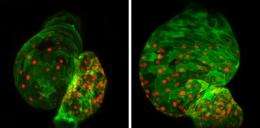
Cardiac development out of control: Absence of the transcription factor Ajuba during cardiac development, as is the case in the right-hand photo due to genetic intervention, disrupts development of the heart in the fish embryo. In addition to an increased number of cardiac muscle cells (green with red-stained nuclei), the heart is additionally deformed during development. Credit: Max Planck Institute for Heart and Lung Research

It is not unusual for babies to be born with congenital heart defects. This is because the development of the heart in the embryo is a process which is not only extremely complex, but also error-prone. Scientists from the Max Planck Institute for Heart and Lung Research in Bad Nauheim have now identified a key molecule that plays a central role in regulating the function of stem cells in the heart. As a result, not only could congenital heart defects be avoided in future, but new ways of stimulating the regeneration of damaged hearts in adults may be opened up.

It's a long road from a cluster of cells to a finished heart. Cell division transforms what starts out as a collection of only a few cardiac stem cells into an ever-larger structure from which the various parts of the heart, such as , atria, valves and , develop. This involves the stem and precursor cells undergoing a complex process which, in addition to tightly regulated cell division, also includes , differentiation and specialisation. Once the heart is complete, the stem cells are finally switched off.

Scientists from the Institute for Heart and Lung Research in Bad Nauheim have now discovered how major parts of this development process are regulated. Their search initially focused on finding binding partners for transcription factor Isl1. Isl1 is characteristic of a specific group of cardiac stem cells which are consequently also known as Isl1+ cells. During their search, the researchers came across Ajuba, a transcription factor from the group of LIM proteins. "We then took a closer a look at the interaction between these two molecules and came to the conclusion that Ajuba must be an important switch", says Gergana Dobreva, head of the "Origin of Cardiac " Research Group at the Bad Nauheim-based Max Planck Institute.

Using an , the scientists then investigated the effects of a defective switch on cardiac development. Embryonic development can be investigated particularly effectively in the zebrafish. The Bad Nauheim-based researchers therefore produced a genetically modified fish that lacked a functioning Ajuba protein. Cardiac development in these fishes was in fact severely disrupted. In addition to deformation of the heart, caused by twisting of the cardiac axis, what particularly struck the researchers was a difference in size in comparison with control animals. "In almost all the investigated fish we observed a dramatic enlargement of the heart. If Ajuba is absent, there is clearly no other switch that finally silences the Isl1-controlled part of cardiac development", says Dobreva.

Further investigations revealed that the enlargement of the heart is in fact attributable to a greatly increased number of cardiac muscle cells. The reason for this was in turn that the number of Isl1+ cells, i.e. the cardiac muscle , was distinctly raised right from an early phase of development. Ajuba is a decisive factor in controlling stem cell activity: it binds to Isl1 molecules, thus blocking their stimulant effect.

The results from the study could have potential future applications. "Once we understand how cardiac development is regulated, we will also be more familiar with the causes of and will consequently be able to consider therapeutic approaches", comments Dobreva. Damaged adult hearts can also be repaired in this way: "One possibility would be to optimise the production of replacement cells from embryonic or artificially produced in the laboratory. Silencing Ajuba in these cells might enhance their development into functional cardiac muscle cells. Sufficient replacement cells for treating patients could be cultured in this way." Another possibility is to stimulate stem cell activity by silencing Ajuba in the damaged heart and so cause the heart to regenerate itself. Further studies are now set to investigate how feasible this might be.

Provided by Max Planck Society search and more info website

4.7 /5 (6 votes)  

Rank 4.7 /5 (6 votes)
Related Stories
Relevant PhysicsForums posts

More news stories

Study suggests new source of kidneys for transplant

Nearly 20 percent of kidneys that are recovered from deceased donors in the U.S. are refused for transplant due to factors ranging from scarring in small blood vessels of the kidney's filtering units to the organ going too ...

Medical research created 9 hours ago | popularity 5 / 5 (1) | comments 0 | with audio podcast

Discovery of circadian clock in mice hair reveals period of time when damage from radiotherapy can be quickly repaired

Discovering that mouse hair has a circadian clock - a 24-hour cycle of growth followed by restorative repair - researchers suspect that hair loss in humans from toxic cancer radiotherapy and chemotherapy ...

Medical research created 10 hours ago | popularity 5 / 5 (2) | comments 1 | with audio podcast

Do salamanders hold the solution to regeneration?

Salamanders' immune systems are key to their remarkable ability to regrow limbs, and could also underpin their ability to regenerate spinal cords, brain tissue and even parts of their hearts, scientists have ...

Medical research created 11 hours ago | popularity 4.8 / 5 (6) | comments 2 | with audio podcast

New study finds blind people have the potential to use their 'inner bat' to locate objects

New research from the University of Southampton has shown that blind and visually impaired people have the potential to use echolocation, similar to that used by bats and dolphins, to determine the location of an object.

Medical research created 13 hours ago | popularity not rated yet | comments 1 | with audio podcast

Germ-fighting vaccine system makes great strides in delivery

A novel vaccine study from South Dakota State University (SDSU) will headline the groundbreaking research that will be unveiled at the American Association of Pharmaceutical Scientists' (AAPS) National Biotechnology Conference ...

Medical research created 14 hours ago | popularity not rated yet | comments 0


Early-life traffic-related air pollution exposure linked to hyperactivity

Early-life exposure to traffic-related air pollution was significantly associated with higher hyperactivity scores at age 7, according to new research from the University of Cincinnati (UC) and Cincinnati Children's Hospital ...

New immune system discovered

(Medical Xpress)—A research team, led by Jeremy Barr, a biology post-doctoral fellow, unveils a new immune system that protects humans and animals from infection.

Resistance to last-line antibiotic makes bacteria resistant to immune system

Bacteria resistant to the antibiotic colistin are also commonly resistant to antimicrobial substances made by the human body, according to a study in mBio, the online open-access journal of the American Society for Microb ...

The compound in the Mediterranean diet that makes cancer cells 'mortal'

New research suggests that a compound abundant in the Mediterranean diet takes away cancer cells' "superpower" to escape death. By altering a very specific step in gene regulation, this compound essentially re-educates cancer ...

Scientists identify molecular trigger for Alzheimer's disease

Researchers have pinpointed a catalytic trigger for the onset of Alzheimer's disease – when the fundamental structure of a protein molecule changes to cause a chain reaction that leads to the death of neurons ...

Practice makes perfect? Not so much

Turns out, that old "practice makes perfect" adage may be overblown. New research led by Michigan State University's Zach Hambrick finds that a copious amount of practice is not enough to explain why people ...