Lung transplant recipient defies all odds
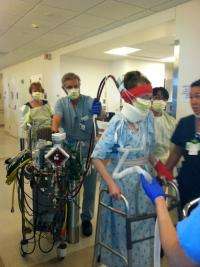
Meara Schmidt, 28, almost died a few weeks ago. Lying in her hospital bed at UCLA, the seriously ill cystic fibrosis patient felt herself slipping away and her life flashing by. But then the image of her husband appeared, and she knew she was not ready to go.
With a strong will to live and a generous "gift of life" from an organ donor who provided her with two lungs, Schmidt has now been given a second chance.
Cystic fibrosis is a genetic disease characterized by the build-up in the lungs of thick, sticky mucus that traps infection-causing bacteria. There is no cure, but lung transplantation can help alleviate many of the symptoms.
Schmidt grew up with the condition but always enjoyed activities like hiking, cooking and singing. However, her illness started getting worse about two years ago. Walking became an exercise in logistics as she was constantly forced to calculate if she had enough breath to get from point A to point B.
In March of this year, she developed respiratory failure and was admitted to Ronald Reagan UCLA Medical Center with the goal of getting a double lung transplant. While candidates considered "high risk" are often declined by most transplant programs, UCLA is well-recognized for accepting individuals like Schmidt who have drug-resistant lung infections and other patients who suffer from collagen-vascular diseases such as scleroderma, individuals experiencing chronic rejection who need re-transplantation, older patients, lymphoma patients, and those with heart problems.
However, a series of dramatic medical ups and downs had Schmidt "on" the transplant list, then "off" the list. At one point, her right lung stopped functioning, her left lung only partially worked and a machine that provided oxygen had to be dialed up to 100 percent.
Twice, when her tracheostomy and mechanical ventilation was insufficient to provide enough oxygen, she was put on a last-ditch life-support system called extra-corporeal membrane oxygenation, or ECMO, which took over her breathing function through a cannula surgically placed in her neck.
But she would not give up.
In fact, while on ECMO and attached to a tower of medicine lines and pumps, she was able to get up and walk. Traditionally, patients on ECMO are sedated and immobile, but a new innovative ambulatory ECMO approach has been shown to help certain patients gain strength and muscle mass in preparation for surgery. With this new "bridge" approach, Schmidt was not sedated but alert and able to walk, which helped keep her well enough for transplant surgery. She was also working hard to gain weight and fight off various disease-related infections.
But despite her determination, her condition was declining and time was running out.
"Meara's tenaciousness and her sufficient recovery from ECMO convinced us that we should still pursue transplantation," said Dr. David Ross, a professor of pulmonology and medical director of the UCLA Lung Transplant Program. "I seldom witness 'miracles of medicine,' but shortly after she was listed again on the active transplant list, the perfect pair of donor lungs became available."
On a recent Thursday at 3 a.m., a nurse woke Schmidt up to tell her the good news: "We've got lungs for you!" Meara asked her to repeat the news because she couldn't believe it. She was wheeled into surgery that same night, where Dr. Abbas Ardehali, a professor of cardiothoracic surgery and surgical director of the UCLA Lung Transplant Program, led the six-and-a-half hour operation.
Schmidt's quick recovery from surgery impressed the medical team. Out of the operating room at 7 a.m. on a Friday, she was talking by 10:30 a.m. and walking by Saturday. Her tracheostomy was out by Tuesday, and she left the intensive care unit and was breathing effortlessly on her own within a week. She credits the compassionate care she received from the nurses, resident technicians and perfusionists, who pushed her forward and helped make her battle a little easier.
"I feel amazing," said Schmidt, who attributes her amazing outcome to maintaining a positive, can-do attitude. "Before, I felt like I was confined in a body that was not mine, but now I can only describe this wonderful feeling as something as good as chocolate!"
Schmidt looks forward to living life with her veterinarian husband, their four cats and one dog, and her close-knit, supportive family. She and her husband are planning to have children some day, and she looks forward to returning to work.
Schmidt will also remember her special organ donor each day.
"My donor's gift affected not only my life, but the lives of my extended family and friends," she said. "I hope the donor's family finds solace in knowing their loved one gave life to someone else. And through this gift, their loved one's hopes and dreams can live on. "


