How tumor cells create their own pathways
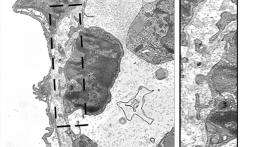
The picture shows a tumor cell that migrates through the wall of a blood vessel into the neighboring tissue. Credit: Marco Prinz/Universitaet Freiburg
Metastasis occurs when tumor cells "migrate" to other organs through the bloodstream. Scientists have now discovered the trick tumor cells use to invade tissue from the blood vessels: They produce signaling proteins to make the arterial walls permeable - thus clearing their pathway to a different organ. The latest findings are published in the current issue of the journal Cancer Cell.
How does a tumor cell set up a signaling pathway in order to metastasize? Scientists at Technische Universität München's (TUM) Klinikum rechts der Isar and Helmholtz Zentrum München have made a significant discovery in this area by studying colon cancer. They have learned that the tumor cells release certain proteins known as chemokines. In the case of metastatic colon cancer cells, the chemokine concerned is CCL2. The CCL2 chemokine docks on to the cells of the inner blood vessel walls (endothelial cells) and activates the corresponding receptor (CCR2 receptor). This connection makes the endothelial cells permeable creating a clear path for the tumor cells.
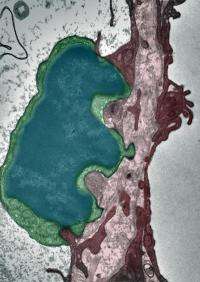
This is an electron microscopy from a tumor cell that is on the way to extravasate through an alveolar endothelium blood capillaries - the tumor cell is depicted in blue green, the endothelial cell in purple red. The protrusion of the tumor cell are seen that form their way through the endothelial cell. Credit: UZH
Professor Mathias Heikenwälder of TUM's Institute of Virology explains that the tumor cells use a clever trick to migrate: "The tumor cells outwit the endothelial cells by emitting a signal used by healthy cells." To date, research has mainly focused on macrophage cells attracted by the chemokines of the tumors. "By understanding the role of chemokine receptors in relation to endothelial cells we have potentially uncovered a brand new approach to cancer treatment," says Heikenwälder."Measuring the number of chemokines could allow us to draw clear conclusions on the likely spread of a primary tumor to other organs and predict the risk of metastasis in patients," continues Heikenwälder. "Furthermore, the option of blocking the chemokine receptor CCR2 at the endothelial cells gives healthcare professionals a new way of preventing metastases both before and following an operation."
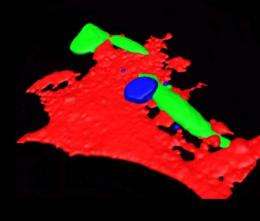
Tumor cells (green) adhere on the endothelium (red) that gets activated and permeable through CCL2-CCR2 signaling. Tumor cell extravasation is facilitated by recruited monocytic cells (blue). Technique: Adaptation of confocal image stacks creating an artificial surface. Credit: UZH
For their research, the scientists used colon cancer tissue and colon cancer cell lines from mice and humans. The next steps will involve studying the findings in greater detail and examining how the new concept can be transferred to other types of cancer.More information: Monika Wolf et al., 2012. Endothelial CCR2 signaling induced by colon carcinoma cells enables extravasation via the JAK2-Stat5 and p38MAPK pathway, Cancer Cell, July 2012.
Journal reference:
Cancer Cell
Provided by
Technical University Munich
-
Crucial molecule that involved in spread of breast cancer found
Jun 08, 2011 |
not rated yet |
0
-
Hide and seek signals
Dec 15, 2011 |
not rated yet |
0
-
Tumor environment keeps tumor-fighting T cells away
Sep 19, 2011 |
not rated yet |
0
-
Cell receptor could allow measles virus to target tumors
Aug 25, 2011 |
not rated yet |
0
-
Migration alert -- How tumor cells home in on the lymphatic system
Jun 11, 2007 |
not rated yet |
0
-
Motion perception revisited: High Phi effect challenges established motion perception assumptions
Apr 23, 2013 |
3 / 5 (2) |
2
-
Anything you can do I can do better: Neuromolecular foundations of the superiority illusion (Update)
Apr 02, 2013 |
4.5 / 5 (11) |
5
-
The visual system as economist: Neural resource allocation in visual adaptation
Mar 30, 2013 |
5 / 5 (2) |
9
-
Separate lives: Neuronal and organismal lifespans decoupled
Mar 27, 2013 |
4.9 / 5 (8) |
0
-
Sizing things up: The evolutionary neurobiology of scale invariance
Feb 28, 2013 |
4.8 / 5 (10) |
14
-
Pressure-volume curve: Elastic Recoil Pressure don't make sense
May 18, 2013
-
If you became brain-dead, would you want them to pull the plug?
May 17, 2013
-
MRI bill question
May 15, 2013
-
Ratio of Hydrogen of Oxygen in Dessicated Animal Protein
May 13, 2013
-
Alcohol and acetaminophen
May 13, 2013
-
Marie Curie's leukemia
May 13, 2013
- More from Physics Forums - Medical Sciences
More news stories
Team finds mechanism linking key inflammatory marker to cancer
In a new study described in the journal Oncogene, researchers reveal how a key player in cell growth, immunity and the inflammatory response can be transformed into a primary contributor to tumor growth.
Cancer
55 minutes ago |
not rated yet |
0
|
Study of young Israelis emphasizes need for avoidance of sun exposure for the very young
A new study conducted using extensive medical records of over one million Israeli adolescents before military service shows clearly how exposure to the Israeli sun of young, light-skinned children increases substantially ...
Cancer
2 hours ago |
not rated yet |
0
Genetic diversity within tumors predicts outcome in head and neck cancer
A new measure of the heterogeneity – the variety of genetic mutations – of cells within a tumor appears to predict treatment outcomes of patients with the most common type of head and neck cancer. In the May 20 issue ...
Cancer
6 hours ago |
not rated yet |
0
Molecular marker from pancreatic 'juices' helps identify pancreatic cancer
Researchers at Mayo Clinic have developed a promising method to distinguish between pancreatic cancer and chronic pancreatitis—two disorders that are difficult to tell apart. A molecular marker obtained from pancreatic ...
Cancer
7 hours ago |
not rated yet |
0
New smartphone application improves colonoscopy preparation
The use of a smartphone application significantly improves patients' preparation for a colonoscopy, according to new research presented today at Digestive Disease Week (DDW). The preparation process, which begins days in ...
Cancer
May 19, 2013 |
not rated yet |
0
Neurons that can multitask greatly enhance the brain's computational power, study finds
Over the past few decades, neuroscientists have made much progress in mapping the brain by deciphering the functions of individual neurons that perform very specific tasks, such as recognizing the location ...
New study identifies risk factors for depression among COPD patients
Patients suffering from chronic obstructive pulmonary disease (COPD) typically suffer from depression more frequently than those without COPD, resulting in higher levels of disability and illness and increasing the overall ...
Half time warm-ups boost athletic performance
High-intensity, short duration warm up activities at half time intervals boost athletic performance, a study of soccer players has found.
Youth bullying because of perceived sexual orientation widespread and damaging
(Medical Xpress)—Bullying because of perceived sexual orientation is prevalent among school-aged youths, according to a study led by Donald Patrick, professor of health services at the UW School of Public ...
Inflammatory bowel disease raises risk of melanoma
Patients with inflammatory bowel disease (IBD) are at higher risk of melanoma, a form of skin cancer, report researchers at Mayo Clinic. Researchers found that IBD is associated with a 37 percent greater risk for the disease. ...
Pharmaceutical advances offer new options for health outcomes
Research presented at Digestive Disease Week (DDW) explores pharmaceutical advances for treating irritable bowel syndrome with diarrhea (IBS-D) and hepatitis C.

