Virginia Tech researchers highlight danger of firework projectiles toward eyes
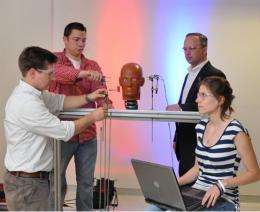
Virginia Tech researchers test fireworks and the risk of eye injuries for a research paper to be published in the publication in the Journal of the American Medical Association. Left to right are Andrew Kemper, Brock Strom, Stefan Duma, and Vanessa Alphonse.
(Medical Xpress) -- Just in time for the July Fourth holiday, Virginia Tech College of Engineering researchers have published a study that shines a new spotlight on the dangers of fireworks on the human eye, that projectiles from fireworks are more likely to cause severe eye injuries than the previously believed culprit blast overpressure.
The study, released July 3 and published in the latest issue of the Journal of the American Medical Association, reinforces why states that have passed laws restricting firework projectiles observe fewer fireworks-related eye injuries.
This is the first time anyone has quantified the pressures and it illustrates that projectiles are the problem, said Stefan Duma, Virginia Tech professor of biomedical engineering and head of the Virginia TechWake Forrest School of Biomedical Engineering and Sciences, and one of the leaders of the study.
Roughly 2 million people in the United States suffer eye injuries that require treatment annually, said Duma. The U.S. Consumer Product Safety Commission has estimated that approximately 10,000 people are treated in an emergency department for fireworks-related injuries per year, and that slightly more than 2,100 of these are specifically related to the eye. Bottle rockets and firecrackers comprise nearly half of these injuries.
The economic burden for adult visual disorders related to these injuries is huge: Nearly $50 billion per year, Duma added.
Firework-related injuries in the United States -- especially in the month surrounding the Fourth of July -- are prevalent among children and adolescents.
During the study, total and static overpressures were measured outside the test-subject eye using sensors mounted perpendicular and parallel to the explosion, respectively. Intraocular pressure was measured with a miniature pressure sensor inserted through the optic nerve. High speed video was recorded for each event, and the eyes were carefully examined for injury after each test blast. Intraocular pressure was correlated to injury risk using previously published risk functions related to the eye.
This is the first study to document the pressure wave interaction with the eye, and to show that the pressure alone is not causing eye injuries at this level, said Vanessa Alphonse of Shrewsbury, Mass., a doctoral student in the School of Biomedical Engineering and Sciences, who led the study as part of her thesis project while a masters student at Virginia Tech.
Provided by
Virginia Tech
-
Majority of Americans think they pay more toward social security and medicare than they do
Jun 29, 2011 |
not rated yet |
0
-
Research focuses on common cause of blindness
Dec 13, 2011 |
not rated yet |
0
-
Study: Youths in residential treatment have high rates of health problems
Oct 19, 2011 |
not rated yet |
0
-
Microsoft research shows augmented projectors (w/ video)
Nov 02, 2011 |
not rated yet |
0
-
Doctors urge caution with July Fourth fireworks
Jul 02, 2012 |
not rated yet |
0
-
Motion perception revisited: High Phi effect challenges established motion perception assumptions
Apr 23, 2013 |
3 / 5 (2) |
2
-
Anything you can do I can do better: Neuromolecular foundations of the superiority illusion (Update)
Apr 02, 2013 |
4.5 / 5 (11) |
5
-
The visual system as economist: Neural resource allocation in visual adaptation
Mar 30, 2013 |
5 / 5 (2) |
9
-
Separate lives: Neuronal and organismal lifespans decoupled
Mar 27, 2013 |
4.9 / 5 (8) |
0
-
Sizing things up: The evolutionary neurobiology of scale invariance
Feb 28, 2013 |
4.8 / 5 (10) |
14
-
Classical and Quantum Mechanics via Lie algebras
Apr 15, 2011
- More from Physics Forums - Independent Research
More news stories
Driving and hands-free talking lead to spike in errors, study shows
Talking on a hands-free device while behind the wheel can lead to a sharp increase in errors that could imperil other drivers on the road, according to new research from the University of Alberta.
Health
8 hours ago |
not rated yet |
0
About one in four uninsured could be excluded from ACA
(HealthDay)—More than one in four of those eligible for new premium assistance tax credits under the Affordable Care Act (ACA) do not have a checking account and will not be able to receive premiums from ...
Health
10 hours ago |
not rated yet |
0
Audiologists recommend smart phone apps to monitor noise levels
After studying noise in one French Quarter neighborhood of New Orleans to determine whether or not noise levels exceeded municipal ordinances, Annette Hurley, PhD, Assistant Professor of Audiology at LSU Health Sciences Center ...
Health
12 hours ago |
not rated yet |
0
Young children who miss well-child visits are more likely to be hospitalized
Young children who missed more than half of recommended well-child visits had up to twice the risk of hospitalization compared to children who attended most of their visits, according to a study published today in the American Jo ...
Health
12 hours ago |
not rated yet |
0
Do doctors understand the individualisation of treatments?
The individualisation of drug treatments to support patients to self-manage their conditions is a concept that sits at the heart of policy, but a recent study in BMJ Open shows that there is no concrete defini ...
Health
14 hours ago |
3 / 5 (1) |
0
Engineered cytomegalovirus protects monkeys from HIV equivalent
(Medical Xpress)—A new study by researchers in the US has shown that an ancient virus can be modified to help in the fight against the simian immunodeficiency virus SIV, which is the equivalent in monkeys ...
Researchers identify first drug targets in childhood genetic tumor disorder
Two mutations central to the development of infantile myofibromatosis (IM)—a disorder characterized by multiple tumors involving the skin, bone, and soft tissue—may provide new therapeutic targets, according to researchers ...
Hormone levels may provide key to understanding psychological disorders in women
Women at a particular stage in their monthly menstrual cycle may be more vulnerable to some of the psychological side-effects associated with stressful experiences, according to a study from UCL.
Going live: Immune cell activation in multiple sclerosis
Biological processes are generally based on events at the molecular and cellular level. To understand what happens in the course of infections, diseases or normal bodily functions, scientists would need to ...
Help at hand for people with schizophrenia
How can healthy people who hear voices help schizophrenics? Finding the answer for this is at the centre of research conducted at the University of Bergen.
Depression raises diabetics' risk of severe low blood sugar episodes
(Medical Xpress)—Patients with diabetes who are depressed are much more likely to develop episodes of dangerously low blood sugars, or hypoglycemia, than are those who are not depressed, a new study has ...