Artificial butter flavoring ingredient linked to key Alzheimer's disease process
August 1, 2012 in Alzheimer's disease & dementia

Artificial butter flavoring ingredient linked to key Alzheimer's disease process

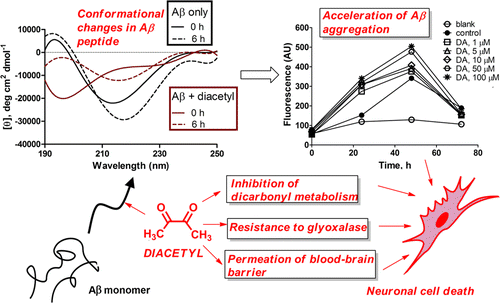
A new study raises concern about chronic exposure of workers in industry to a food flavoring ingredient used to produce the distinctive buttery flavor and aroma of microwave popcorn, margarines, snack foods, candy, baked goods, pet foods and other products. It found evidence that the ingredient, diacetyl (DA), intensifies the damaging effects of an abnormal brain protein linked to Alzheimer's disease. The study appears in ACS' journal Chemical Research in Toxicology.

Robert Vince and colleagues Swati More and Ashish Vartak explain that DA has been the focus of much research recently because it is linked to respiratory and other problems in workers at microwave popcorn and food-flavoring factories. DA gives microwave popcorn its distinctive buttery taste and aroma. DA also forms naturally in fermented beverages such as beer, and gives some chardonnay wines a buttery taste. Vince's team realized that DA has an architecture similar to a substance that makes beta- clump together in the brain — clumping being a hallmark of Alzheimer's disease. So they tested whether DA also could clump those proteins.

DA did increase the level of beta-amyloid clumping. At real-world occupational exposure levels, DA also enhanced beta-amyloid's toxic effects on nerve cells growing in the laboratory. Other lab experiments showed that DA easily penetrated the so-called "blood-brain barrier," which keeps many harmful substances from entering the brain. DA also stopped a protective protein called glyoxalase I from safeguarding nerve cells. "In light of the chronic exposure of industry workers to DA, this study raises the troubling possibility of long-term neurological toxicity mediated by DA," say the researchers.

More information: “The Butter Flavorant, Diacetyl, Exacerbates ß-Amyloid Cytotoxicity” Chem. Res. Toxicol., Article ASAP. DOI: 10.1021/tx3001016

Abstract
Diacetyl (DA), an ubiquitous butter-flavoring agent, was found to influence several aspects of amyloid-β (Aβ) aggregation—one of the two primary pathologies associated with Alzheimer's disease. Thioflavin T fluorescence and circular dichroism spectroscopic measurements revealed that DA accelerates Aβ1–42 aggregation into soluble and ultimately insoluble β-pleated sheet structures. DA was found to covalently bind to Arg5 of Aβ1–42 through proteolytic digestion–mass spectrometric experiments. These biophysical and chemical effects translated into the potentiation of Aβ1–42 cytotoxicity by DA toward SH-SY5Y cells in culture. DA easily traversed through a MDR1-MDCK cell monolayer, an in vitro model of the blood–brain barrier. Additionally, DA was found not only to be resistant to but also inhibitory toward glyoxalase I, the primary initiator of detoxification of amyloid-promoting reactive dicarbonyl species that are generated naturally in large amounts by neuronal tissue. In light of the chronic exposure of industry workers to DA, this study raises the troubling possibility of long-term neurological toxicity mediated by DA.

Journal reference: Chemical Research in Toxicology search and more info website

Provided by American Chemical Society search and more info website

5 /5 (2 votes)  

Filter


Move the slider to adjust rank threshold, so that you can hide some of the comments.


Display comments: newest first

knikiy
Aug 03, 2012

Rank: not rated yet
So if I eat enough buttered popcorn, I could watch the same movie over and over and never know it. Its a win-win situation.
Rank 5 /5 (2 votes)
Related Stories
Relevant PhysicsForums posts

More news stories

A new strategy required in the search for Alzheimer's drugs?

In the search for medication against Alzheimer's disease, scientists have focused – among other factors – on drugs that can break down Amyloid beta (A-beta). After all, it is the accumulation of A-beta that causes the ...

Alzheimer's disease & dementia created 14 hours ago | popularity not rated yet | comments 0

Alzheimer's disease, the soft target of the euthanasia debate

(Medical Xpress)—The way Alzheimer's disease is portrayed by advocacy groups and the media is having undue influence on the euthanasia debate, according to a Deakin University nursing ethics professor.

Alzheimer's disease & dementia created 15 hours ago | popularity not rated yet | comments 2

Scientists discover cinnamon compounds' potential ability to prevent Alzheimer's

Cinnamon: Can the red-brown spice with the unmistakable fragrance and variety of uses offer an important benefit? The common baking spice might hold the key to delaying the onset of –– or warding off ...

Alzheimer's disease & dementia created May 23, 2013 | popularity 5 / 5 (5) | comments 0 | with audio podcast

Drug reverses Alzheimer's disease deficits in mice, research confirms

An anti-cancer drug reverses memory deficits in an Alzheimer's disease mouse model, University of Pittsburgh Graduate School of Public Health researchers confirm in the journal Science.

Alzheimer's disease & dementia created May 23, 2013 | popularity not rated yet | comments 0 | with audio podcast

Multiple research teams unable to confirm high-profile Alzheimer's study

Teams of highly respected Alzheimer's researchers failed to replicate what appeared to be breakthrough results for the treatment of this brain disease when they were published last year in the journal Science.

Alzheimer's disease & dementia created May 23, 2013 | popularity 3 / 5 (2) | comments 3 | with audio podcast


Engineered cytomegalovirus protects monkeys from HIV equivalent

(Medical Xpress)—A new study by researchers in the US has shown that an ancient virus can be modified to help in the fight against the simian immunodeficiency virus SIV, which is the equivalent in monkeys ...

Researchers identify first drug targets in childhood genetic tumor disorder

Two mutations central to the development of infantile myofibromatosis (IM)—a disorder characterized by multiple tumors involving the skin, bone, and soft tissue—may provide new therapeutic targets, according to researchers ...

Hormone levels may provide key to understanding psychological disorders in women

Women at a particular stage in their monthly menstrual cycle may be more vulnerable to some of the psychological side-effects associated with stressful experiences, according to a study from UCL.

Going live: Immune cell activation in multiple sclerosis

Biological processes are generally based on events at the molecular and cellular level. To understand what happens in the course of infections, diseases or normal bodily functions, scientists would need to ...

Driving and hands-free talking lead to spike in errors, study shows

Talking on a hands-free device while behind the wheel can lead to a sharp increase in errors that could imperil other drivers on the road, according to new research from the University of Alberta.

Depression raises diabetics' risk of severe low blood sugar episodes

(Medical Xpress)—Patients with diabetes who are depressed are much more likely to develop episodes of dangerously low blood sugars, or hypoglycemia, than are those who are not depressed, a new study has ...