Epicardial fat tissue thickness predicts coronary artery disease
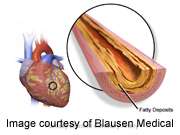
(HealthDay) -- Asymptomatic patients with coronary artery disease (CAD) have significantly more epicardial adipose tissue (EAT) than those without CAD, with an average EAT thickness of 2.4 mm or higher predictive of significant CAD, according to a study published online in the August issue of The American Journal of Cardiology.
In an effort to evaluate the relationship between EAT thickness and CAD, Gil N. Bachar, M.D., of the Rabin Medical Center in Petah Tiqwa, Israel, and colleagues conducted a study involving 190 asymptomatic patients with one or more cardiovascular risk factors who were referred for computed tomographic angiography.
The researchers found that the mean EAT thickness values were significantly higher in patients with atherosclerosis compared to those without (3.54 ± 1.59 mm versus 1.85 ± 1.28 mm). On receiver operating characteristic analysis, a cut-off EAT value of ≥2.4 mm was established as an indicator of significant coronary artery stenosis (>50 percent diameter). EAT values were significantly higher for patients with metabolic syndrome compared to those without and for patients with a calcium Agatston score >400 compared with <400.
"Together, these results suggest that an increased EAT thickness may serve as a marker for severe atherosclerosis and might also be a risk factor for significant CAD in the general population," the authors write.
More information:
Abstract
Full Text (subscription or payment may be required)
Copyright © 2012 HealthDay. All rights reserved.


