Math ability requires crosstalk in the brain
August 29, 2012 in Neuroscience
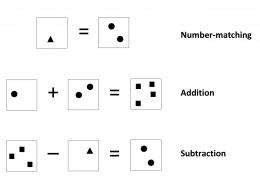
Examples of the simple numerical and arithmetic tasks used in the study. Participants were asked to judge whether the numerical operation was correct or not. Credit: Center for Vital Longevity, University of Texas at Dallas
A new study by researchers at UT Dallas' Center for Vital Longevity, Duke University, and the University of Michigan has found that the strength of communication between the left and right hemispheres of the brain predicts performance on basic arithmetic problems. The findings shed light on the neural basis of human math abilities and suggest a possible route to aiding those who suffer from dyscalculia— an inability to understand and manipulate numbers.
It has been known for some time that the parietal cortex, the top/middle region of the brain, plays a central role in so-called numerical cognition—our ability to process numerical information. Previous brain imaging studies have shown that the right parietal region is primarily involved in basic quantity processing (like gauging relative amounts of fruit in baskets), while the left parietal region is involved in more precise numerical operations like addition and subtraction. What has not been known is whether the two hemispheres can work together to improve math performance. The new study demonstrates that they can. The findings were recently published online in Cerebral Cortex.
In the study, conducted in Dallas and led by Dr. Joonkoo Park, now a postdoctoral fellow at Duke University, researchers used functional magnetic resonance imaging, or fMRI, to measure the brain activity of 27 healthy young adults while they performed simple numerical and arithmetic tasks. In one task, participants were asked to judge whether two groups of shapes contained the same or different numbers of items. In two other tasks, participants were asked to solve simple addition and subtraction problems.
Consistent with previous studies, the researchers found that the basic number-matching task activated the right parietal cortex, while the addition and subtraction tasks produced additional activity in the left parietal cortex. But they also found something new: During the arithmetic tasks, communication between the left and right hemispheres increased significantly compared with the number-matching task. Moreover, people who exhibited the strongest connection between hemispheres were the fastest at solving the subtraction problems.
"Our results suggest that subtraction performance is optimal when there is high coherence in the neural activity in these two brain regions. Two brain areas working together rather than either region alone appears to be key" said co-author Dr. Denise C. Park, co-director of the UT Dallas Center for Vital Longevity and Distinguished University Chair in the School of Behavioral and Brain Sciences. Park (no relation to the lead author) helped direct the study along with Dr. Thad Polk, professor of psychology at the University of Michigan.
Lead author Dr. Joonkoo Park points out that the findings suggest that disrupted or inefficient neural communication between the hemispheres may contribute to the impaired math abilities seen in dyscalculia, the numerical equivalent of dyslexia. "If such a causal link exists," he said, "one very interesting avenue of research would be to develop training tasks to enhance parietal connectivity and to test whether they improve numerical competence."
Such a training program might help develop math ability in children and could also help older adults whose arithmetic skills begin to falter as a normal part of age-related cognitive decline.
Journal reference:
Cerebral Cortex
Provided by
University of Texas at Dallas
-
How early math lessons change children's brains
Jun 07, 2011 |
not rated yet |
0
-
Twins Study Looks at Genetic Influences on Thinking
Feb 16, 2010 |
not rated yet |
0
-
Electrical brain stimulation improves math skills
Nov 04, 2010 |
not rated yet |
0
-
Brain study reveals how successful students overcome math anxiety
Oct 20, 2011 |
not rated yet |
0
-
Preschoolers' grasp of numbers predicts math performance in school years
Sep 14, 2011 |
not rated yet |
0
-
Motion perception revisited: High Phi effect challenges established motion perception assumptions
Apr 23, 2013 |
3 / 5 (2) |
2
-
Anything you can do I can do better: Neuromolecular foundations of the superiority illusion (Update)
Apr 02, 2013 |
4.5 / 5 (11) |
5
-
The visual system as economist: Neural resource allocation in visual adaptation
Mar 30, 2013 |
5 / 5 (2) |
9
-
Separate lives: Neuronal and organismal lifespans decoupled
Mar 27, 2013 |
4.9 / 5 (8) |
0
-
Sizing things up: The evolutionary neurobiology of scale invariance
Feb 28, 2013 |
4.8 / 5 (10) |
14
-
Why is zone 1 in liver more prone to ischemic injury?
7 hours ago
-
How can there be villous adenoma in colon, if there are no villi there
May 22, 2013
-
How can there be a term called "intestinal metaplasia" of stomach
May 21, 2013
-
Pressure-volume curve: Elastic Recoil Pressure don't make sense
May 18, 2013
-
If you became brain-dead, would you want them to pull the plug?
May 17, 2013
-
MRI bill question
May 15, 2013
- More from Physics Forums - Medical Sciences
More news stories
Breakthrough on Huntington's disease
Researchers at Lund University have succeeded in preventing very early symptoms of Huntington's disease, depression and anxiety, by deactivating the mutated huntingtin protein in the brains of mice.
Neuroscience
5 minutes ago |
not rated yet |
0
Researchers identify networks of neurons in the brain that are disrupted in psychiatric disease
Studying the networks of connections in the brains of people affected by schizophrenia, bipolar disease or depression has allowed Dr. Peter Williamson, from Western University, to gain a better understanding of the biological ...
Neuroscience
1 hour ago |
not rated yet |
0
Pay attention: How we focus and concentrate
Scientists at Newcastle University have shed new light on how the brain tunes in to relevant information.
Neuroscience
1 hour ago |
5 / 5 (1) |
0
|
New imaging techniques used to help patients suffering from epilepsy
New techniques in imaging of brain activity developed by Jean Gotman, from McGill University's Montreal Neurological Institute, and his colleagues lead to improved treatment of patients suffering from epilepsy. The combination ...
Neuroscience
1 hour ago |
not rated yet |
0
Common brain processes of anesthetic-induced unconsciousness identified
A study from the June issue of Anesthesiology found feedback from the front region of the brain is a crucial building block for consciousness and that its disruption is associated with unconsciousness when the anesthetics ketami ...
Neuroscience
2 hours ago |
5 / 5 (1) |
0
Researchers suggest boosting body's natural flu killers
A known difficulty in fighting influenza (flu) is the ability of the flu viruses to mutate and thus evade various medications that were previously found to be effective. Researchers at the Hebrew University of Jerusalem have ...
Anxious men fare worse during job interviews, study finds
Nervous about that upcoming job interview? You might want to take steps to reduce your jitters, especially if you are a man.
Frequent heartburn may predict cancers of the throat and vocal cord
Frequent heartburn was positively associated with cancers of the throat and vocal cord among nonsmokers and nondrinkers, and the use of antacids, but not prescription medications, had a protective effect, according to data ...
Second-generation TAVI device—Lotus Valve—shows good performance in REPRISE II
22 May 2013, Paris, France: The Lotus Valve, a second-generation transcatheter aortic valve implantation (TAVI) device, was successfully implanted in all of the first 60 patients in results from REPRISE II reported at EuroPCR ...
Major human drug trial underway for Alzheimer's
A potentially ground-breaking human drug trial is currently underway, which aims to discover whether blood pressure medication can slow or halt the progression of Alzheimer's Disease (AD). This is the latest ...
New discovery in fight against deadly meningococcal disease
Professor Michael Jennings, Deputy Director of the Institute for Glycomics at Griffith University, was part of an international team that discovered the previously unknown pathway of how the bacterium colonizes people.
Aug 29, 2012
Rank: 5 / 5 (1)
Aug 29, 2012
Rank: 2.3 / 5 (3)
Aug 30, 2012
Rank: not rated yet
(regardless if 'solvable' or 'unsolvable')
Whether answers lay within or outside the scope of a language depends on your ability to associate any and/or all thoughts independent of source or 'location'.
Return to the drawing board. Nice try though.
Aug 30, 2012
Rank: not rated yet
Giving a child the opportunity to learn to play a musical instrument or how to play chess would activate the same and other neural networks while increasing their intelligence and appreciation for culture.
Aug 30, 2012
Rank: not rated yet
'Teaching' is an invention which never existed to be discovered.
Aug 30, 2012
Rank: not rated yet
Aug 30, 2012
Rank: not rated yet
You feel the need to express your mathematical competence in 'conventional' math terms and language.
You were taught this. And told you lack this 'ability'.
Sep 02, 2012
Rank: not rated yet
- Laarsø
Sep 03, 2012
Rank: not rated yet