UCLA uses new device to replace aortic valve in patients who can't have open-heart surgery
August 16, 2012 By Rachel Champeau in Cardiology
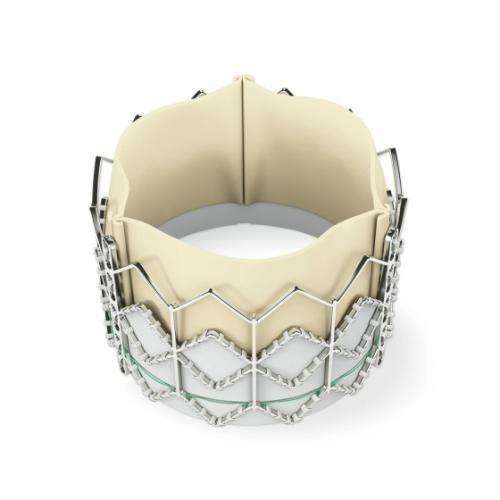
Edwards SAPIEN Transcatheter Heart Valve
(Medical Xpress) -- UCLA has performed its first transcatheter aortic valve replacement (TAVR), using a new device approved by the U.S. Food and Drug Administration to replace an aortic valve in a patient who was not a candidate for open-heart surgery. The procedure took place on Aug. 9.
Ronald Reagan UCLA Medical Center is part of a growing trend of hospitals nationwide offering this new minimally invasive procedure.
As the U.S. population ages, an increasing number of patients will develop aortic stenosis, a narrowing of the heart's aortic valve caused by calcium deposits, which impedes blood flow, causing the heart to work harder to pump blood to the body and placing patients at higher risk of heart failure or death.
Although minimally invasive surgical procedures have been used on the aortic valve in the past, these operations relied on incisions in the chest wall and required cardiopulmonary bypass. The TAVR allows doctors for the first time to replace the aortic valce without either of these components of conventional surgery.
This video is not supported by your browser at this time.
The aortic valve's leaflets act as sentries to help blood flow from the heart into the aorta while preventing blood from leaking backward into the heart. When the leaflets aren't doing their job properly due to aortic stenosis, the heart needs to generate higher pressure to push the blood through the valve into the aorta. Patients with aortic stenosis have a number of symptoms, including chest pressure or angina, shortness of breath, edema, and fainting.Many patients are not good candidates for conventional valve replacement because they suffer from a number of other health issues, and it is estimated that 40 percent of patients do not undergo aortic valve relacement because they are considered inoperable.
The new device is deployed through a catheter a long tube that is advanced through an artery in the groin up to the heart. Once in place, a balloon at the end of the catheter is inflated, opening the new valve, which starts working instantly.
TAVR is the latest in a trend of major surgical procedures now being performed without invasive surgery at UCLA. The team's cardiologists, heart surgeons, anesthesiologists, nurses and technologists work closely together to address the needs of each individual patient.
"The new valve procedure offers hope to patients who previously had few options," said Dr. Jonathan Tobis, a clinical professor of cardiology and director of interventional cardiology for the David Geffen School of Medicine at UCLA and the UCLA Health System. "The initial roll-out will include patients who are not candidates for open surgery. The FDA is considering this procedure for high-risk patients who are also surgical candidates, so we look forward to offering TAVR to even more patients in the near future."
Studies have shown the new valve procedure dramatically improves quality of life and survival rates. A recent randomized clinical study showed a significantly higher one-year survival rate among patients treated with the new valve, compared with those who received medical therapy.
"We expect to see substantial quality-of-life gains from this new procedure," said Dr. Richard. J. Shemin, chief of cardiothoracic surgery at the Geffen School of Medicine and the UCLA Health System. "Many patients who were formerly bedridden and hopeless will be able to resume a more normal life with this novel new therapy."
More information: For more information about the new TAVR procedure at UCLA, please visit www.uclahealth.org/TAVR or contact 310-206-8232.
Provided by
University of California, Los Angeles
-
UofL physicians, Jewish Hospital first in Kentucky to offer new aortic valve replacement
Jan 03, 2012 |
not rated yet |
0
-
New option for patients with untreatable, non-perative heart condition
Jun 28, 2011 |
not rated yet |
0
-
Heart patients do better with non-surgical valve replacement than standard medical therapy
Mar 26, 2012 |
not rated yet |
0
-
Study begins of minimally invasive treatment for blocked heart valves
Jul 13, 2011 |
not rated yet |
0
-
Transcatheter aortic valve implantation as good as traditional surgery for high risk, operable patients
Apr 05, 2011 |
not rated yet |
0
-
Motion perception revisited: High Phi effect challenges established motion perception assumptions
Apr 23, 2013 |
3 / 5 (2) |
2
-
Anything you can do I can do better: Neuromolecular foundations of the superiority illusion (Update)
Apr 02, 2013 |
4.5 / 5 (11) |
5
-
The visual system as economist: Neural resource allocation in visual adaptation
Mar 30, 2013 |
5 / 5 (2) |
9
-
Separate lives: Neuronal and organismal lifespans decoupled
Mar 27, 2013 |
4.9 / 5 (8) |
0
-
Sizing things up: The evolutionary neurobiology of scale invariance
Feb 28, 2013 |
4.8 / 5 (10) |
14
-
Calculating on-axis elements of a solenoid
1 hour ago
-
latitude & longitude & air pressure
2 hours ago
-
Differences of Classical Mechanics when learned with Calc vs algebra?
5 hours ago
-
what is the distance traveled
9 hours ago
-
Image of a Convex Lens Cut in Half Horizontally
13 hours ago
-
Ray tracing throught optical system of thick lenses
13 hours ago
- More from Physics Forums - Classical Physics
More news stories
Costs to treat stroke in America may double by 2030
Costs to treat stroke are projected to more than double and the number of people having strokes may increase 20 percent by 2030, according to the American Heart Association/American Stroke Association.
Cardiology
10 hours ago |
not rated yet |
0
New blood-thinner measures may cut medication errors
Blood thinners are the preferred treatment option to prevent heart attacks, blood clots and stroke, but they are not without risk, and not just because of their side effects. These high-risk drugs, known as anticoagulants, ...
Cardiology
13 hours ago |
not rated yet |
0
Registry questions superiority of bivalirudin over heparin
Results from a large observational study reported at EuroPCR 2013 today question whether bivalirudin is superior to heparin in the absence of GPIIb/IIIa blockade, showing similar 30-day mortality in patients with non-ST segment ...
Cardiology
13 hours ago |
not rated yet |
0
Study shows low rate of late lumen loss with bioresorbable DESolve device
The DESolve bioresorbable coronary scaffold system achieves good efficacy and safety with low rates of late lumen loss and major coronary adverse events at six months, show first results from the pivotal DESolve Nx trial ...
Cardiology
13 hours ago |
not rated yet |
0
Biodegradable stent proves non-inferior to drug-eluting stent
The Orsiro stent, which is a novel stent platform eluting sirolimus from a biodegradable polymer, demonstrated non-inferiority to the Xience Prime everolimus-eluting stent for the primary angiographic endpoint of in-stent ...
Cardiology
May 21, 2013 |
5 / 5 (1) |
0
Slowing the aging process—only with antibiotics
Swiss scientists reveal the mechanism responsible for aging hidden deep within mitochondria—and dramatically slow it down in worms by administering antibiotics to the young.
Researchers complete largest genetic sequencing study of human disease
Researchers from Queen Mary, University of London have led the largest sequencing study of human disease to date, investigating the genetic basis of six autoimmune diseases.
Brain can be trained in compassion, study shows
Until now, little was scientifically known about the human potential to cultivate compassion—the emotional state of caring for people who are suffering in a way that motivates altruistic behavior.
Having both migraines, depression may mean smaller brain
(HealthDay)—Migraines and depression can each cause a great deal of suffering, but new research indicates the combination of the two may be linked to something else entirely—a smaller brain.
Novel approach for influenza vaccination shows promise in early animal testing
A new approach for immunizing against influenza elicited a more potent immune response and broader protection than the currently licensed seasonal influenza vaccines when tested in mice and ferrets. The vaccine ...
Enzyme-activating antibodies revealed as marker for most severe form of rheumatoid arthritis
In a series of lab experiments designed to unravel the workings of a key enzyme widely considered a possible trigger of rheumatoid arthritis, researchers at Johns Hopkins have found that in the most severe ...