Double vision: hybrid medical imaging technology may shed new light on cancer
August 14, 2012 in Medical research
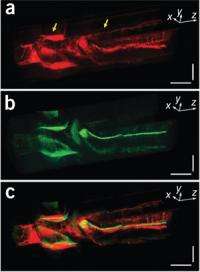
Simultaneous photoacoustic (a) and ultrasound (b) images of a rabbit esophagus show the clarity and detail gained by combining the two imaging techniques (c).
(Medical Xpress) -- Scientists from the University of Southern California in Los Angeles and Washington University in St. Louis have developed a new type of medical imaging that gives doctors a new look at live internal organs.
The imaging combines two existing forms of medical imaging photoacoustic and ultrasound and uses them to generate a combined image that high-contrast, high-resolution image that could help doctors spot tumors more quickly.
Photoacoustic endoscopy provides deeper penetration than optical endoscopy and more functional contrast than ultrasonic endoscopy, said Lihong Wang, PhD, principle investigator and corresponding author of a study on the new technology that appeared in Nature Medicine on July 15, and the Gene K. Beare Distinguished Professor in the department of biomedical engineering in Engineering & Applied Science at Washington University in St. Louis.
Wang collaborated with Qifa Zhou, Ruimin Chen and K. Kirk Shung of USC as well as Joon-Mo Yang, Christopher Favazza, Junjie Yao, Xin Cai, Konstantin Maslov from Washington University.
This is a first time that we have had small endoscopy with two imaging modalities, said Qifa Zhou, one of the principal investigators and co-authors of the study, and a professor at the NIH Resource Center for Medical Ultrasonic Transducer Technology at USC Biomedical Engineering.
Currently, doctors routinely employ ultrasound endoscopy to study internal organs. This technique places an ultrasound camera, similar to ones used to create images of fetuses, on a flexible scope that can be inserted internally.
Though these images are typically high-resolution, they are also low-contrast making a dim image, like a photograph shot in a poorly lit room.
To address the problem, Wang, Zhou and their teams added a photoacoustic imaging device to the ultrasound endoscope. The resulting camera zaps organ tissue with a light. When the light is absorbed by tissue, the tissue gets slightly hotter and expands. That expansion produces a sound pressure wave that the ultrasound device on the endoscope picks up.
This technology combines the best of both worlds, said Kirk Shung, director of the NIH Resource Center and a professor of biomedical engineering at USC.
The researchers have tested their new device inside the gastrointestinal tract, producing in vivo images detailed enough to show blood vessels as well as the density of the tissue around them.
This imaging has fine resolution and high contrast, said Joon-Mo Yang, PhD, a postdoctoral researcher in Wangs group. With a clearer picture of whats going on inside the gastrointestinal tract, doctors could potentially spot colon and prostate cancers earlier.
Provided by
Washington University in St. Louis
-
New imaging technique could speed cancer detection
Apr 04, 2012 |
not rated yet |
0
-
A more accurate and noninvasive look at cancerous tumors
Jul 10, 2012 |
not rated yet |
0
-
New imaging technology enlightened by biomedical engineering
Oct 19, 2010 |
not rated yet |
0
-
Novel technique changes lymph node biopsy, reduces radiaiton exposure
Jan 13, 2009 |
not rated yet |
0
-
Researchers develop technique to focus light inside biological tissue
Jun 26, 2012 |
not rated yet |
0
-
Motion perception revisited: High Phi effect challenges established motion perception assumptions
Apr 23, 2013 |
3 / 5 (2) |
2
-
Anything you can do I can do better: Neuromolecular foundations of the superiority illusion (Update)
Apr 02, 2013 |
4.5 / 5 (11) |
5
-
The visual system as economist: Neural resource allocation in visual adaptation
Mar 30, 2013 |
5 / 5 (2) |
9
-
Separate lives: Neuronal and organismal lifespans decoupled
Mar 27, 2013 |
4.9 / 5 (8) |
0
-
Sizing things up: The evolutionary neurobiology of scale invariance
Feb 28, 2013 |
4.8 / 5 (10) |
14
-
Pressure-volume curve: Elastic Recoil Pressure don't make sense
May 18, 2013
-
If you became brain-dead, would you want them to pull the plug?
May 17, 2013
-
MRI bill question
May 15, 2013
-
Ratio of Hydrogen of Oxygen in Dessicated Animal Protein
May 13, 2013
-
Alcohol and acetaminophen
May 13, 2013
-
Marie Curie's leukemia
May 13, 2013
- More from Physics Forums - Medical Sciences
More news stories
Computational tool translates complex data into simplified 2-dimensional images
In their quest to learn more about the variability of cells between and within tissues, biomedical scientists have devised tools capable of simultaneously measuring dozens of characteristics of individual ...
Medical research
11 hours ago |
5 / 5 (2) |
0
|
Now we know why old scizophrenia medicine works on antibiotics-resistant bacteria
In 2008 researchers from the University of Southern Denmark showed that the drug thioridazine, which has previously been used to treat schizophrenia, is also a powerful weapon against antibiotic-resistant bacteria such as ...
Medical research
May 17, 2013 |
4 / 5 (4) |
0
|
SUMO wrestling cells reveal new protective mechanism target for stroke
Scientists investigating the interaction of a group of proteins in the brain responsible for protecting nerve cells from damage have identified a new target that could increase cell survival.
Medical research
May 17, 2013 |
5 / 5 (1) |
0
How serotonin receptors can shape drug effects, from LSD to migraine medication
New findings by researchers carrying out experiments at the U.S. Department of Energy Office of Science's Advanced Photon Source (APS) help explain why some drugs that interact with two kinds of human serotonin ...
Medical research
May 17, 2013 |
4 / 5 (1) |
0
|
Preventing blood poisoning
Peptide molecules derived from the body's natural immune system can help boost the body's defence against life-threatening blood poisoning, joint University research has uncovered.
Medical research
May 17, 2013 |
4 / 5 (1) |
0
|
Researchers identify a potential new risk for sleep apnea: Asthma
Researchers at the University of Wisconsin have identified a potential new risk factor for obstructive sleep apnea: asthma. Using data from the National Institutes of Health (Heart, Lung, and Blood Institute)-funded Wisconsin ...
New theory on genesis of osteoarthritis comes with successful therapy in mice
Scientists at Johns Hopkins have turned their view of osteoarthritis (OA) inside out. Literally. Instead of seeing the painful degenerative disease as a problem primarily of the cartilage that cushions joints, ...
Study finds that sleep apnea and Alzheimer's are linked
A new study looking at sleep-disordered breathing (SDB) and markers for Alzheimer's disease (AD) risk in cerebrospinal fluid (CSF) and neuroimaging adds to the growing body of research linking the two.
'Gap' for HIV vaccine efforts after latest setback
The hunt for an HIV vaccine has gobbled up $8 billion in the past decade, and the failure of the most recent efficacy trial has delivered yet another setback to 26 years of efforts.
Ginger compounds may be effective in treating asthma symptoms
Gourmands and foodies everywhere have long recognized ginger as a great way to add a little peppery zing to both sweet and savory dishes; now, a study from researchers at Columbia University shows purified components of the ...
Ketamine shows significant therapeutic benefit in people with treatment-resistant depression
Patients with treatment-resistant major depression saw dramatic improvement in their illness after treatment with ketamine, an anesthetic, according to the largest ketamine clinical trial to-date led by researchers from the ...