Research yields two 'firsts' regarding protein crucial to human cardiac function
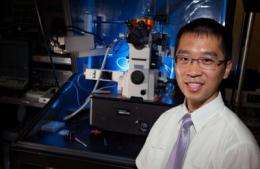
Florida State University physics doctoral student Campion Loong, working with Florida State professors, has achieved significant benchmarks in a study of the human cardiac protein alpha-tropomyosin. The study, "Persistence Length of Human Cardiac Alpha-Tropomyosin Measured by Single Molecule Direct Probe Microscopy," has been published in the journal PLoS ONE. Credit: Bill Lax/FSU Photography Services
Florida State University researchers led by physics doctoral student Campion Loong have achieved significant benchmarks in a study of the human cardiac protein alpha-tropomyosin, which is an essential, molecular-level component that controls the heart's contraction on every beat.
Using an imaging method called atomic force microscopy, Loong achieved two "firsts": the first direct imaging of individual alpha-tropomyosin molecules, which are very small—roughly 40 nanometers long—and the first demonstrated examples of a measure of the human cardiac protein's flexibility. From there, he established a baseline of how flexible a normal version of the protein is supposed to be in a healthy human heart.
"This basic research is important to broadening our understanding of how the human heart functions normally at the molecular level," Loong said. "The flexibility of alpha-tropomyosin dictates how effectively or properly the heart muscle will contract on each beat and has implications for keeping the heart free of cardiovascular disease.
"Before this study, we did not know how flexible this protein was," Loong said. "Using these results, now we can conduct subsequent studies to compare disease-related mutants of this protein to see how much they deviate from normal versions."
Loong served as the lead author of the paper "Persistence Length of Human Cardiac a-Tropomyosin Measured by Single Molecule Direct Probe Microscopy," which was published in the journal PLoS ONE. He conducted the research with physics Professor Huan-Xiang Zhou and biological science Professor P. Bryant Chase, both of Florida State.
When an electrical signal is generated in the heart to make it contract, calcium is released inside each heart muscle cell. The calcium then binds to a protein called troponin, and that triggers the "flexing movement" of alpha-tropomyosin, which allows another protein called myosin—the motor protein—to interact with the troponin/tropomyosin actin filaments. This series of events is what generates the heart's contraction that pumps blood. A subsequent removal of calcium inside each heart cell is what relaxes the heart, which allows the heart to fill with blood to be pumped on the next beat.
"Alpha-tropomyosin is a key element that makes the calcium signal either turn the heart on, making it contract, or turn it off, making it relax," Chase said. "There is an optimal range of flexibility of alpha-tropomyosin for the normal heart to function properly. The molecule can be too stiff or it can be too flexible, either of which could lead to cardiovascular disease. What we ultimately think is that evolution has tuned the mechanical properties of these proteins for optimal function in the heart."
Journal reference:
PLoS ONE
Provided by
Florida State University
-
Locating muscle proteins: Scientists bring the basis of muscle movement into sharper focus
Jul 19, 2012 |
not rated yet |
0
-
Secrets of water bug wings shed light on heart beats
Dec 07, 2010 |
not rated yet |
0
-
Atomic model of tropomyosin bound to actin
Feb 15, 2011 |
not rated yet |
0
-
Protein identified that helps heart muscle contract
Feb 16, 2010 |
not rated yet |
0
-
Muscle weakness: New mutation identified
Jun 14, 2007 |
not rated yet |
0
-
Motion perception revisited: High Phi effect challenges established motion perception assumptions
Apr 23, 2013 |
3 / 5 (2) |
2
-
Anything you can do I can do better: Neuromolecular foundations of the superiority illusion (Update)
Apr 02, 2013 |
4.5 / 5 (11) |
5
-
The visual system as economist: Neural resource allocation in visual adaptation
Mar 30, 2013 |
5 / 5 (2) |
9
-
Separate lives: Neuronal and organismal lifespans decoupled
Mar 27, 2013 |
4.9 / 5 (8) |
0
-
Sizing things up: The evolutionary neurobiology of scale invariance
Feb 28, 2013 |
4.8 / 5 (10) |
14
-
Lagrangian of object with air resistance
2 hours ago
-
Does electromagnetic waves are generated by dc current?
2 hours ago
-
Please check what's in the Ulaby book regarding reflection.
6 hours ago
-
Question in reflection and transmission at oblique incidence.
10 hours ago
-
Is this plasma (picture in thread)
11 hours ago
-
Basic physics understanding. Could someone explain?
13 hours ago
- More from Physics Forums - Classical Physics
More news stories
Registry confirms TAVI efficacy and safety in Asian patients
Transcatheter aortic valve implantation (TAVI) is effective and safe in Asian patients, according to early experience based on first results from a multicentre Asian registry reported at EuroPCR 2013.
Cardiology
17 hours ago |
not rated yet |
0
Diagnostic coronary angiography: Functional flow reserve changes decisions in 25 percent of cases
Routinely measuring fractional flow reserve (FFR) using pressure wire assessment during coronary angiography for diagnosis of chest pain leads to significant changes in the management of one in four patients, according to ...
Cardiology
20 hours ago |
not rated yet |
0
Feasibility trial reports deployment of new device for TAVI in aortic insufficiency
A new investigational device - the Helio System (TF-FA) - being developed for use with the Sapien XT Transcatheter Heart Valve was successfully deployed in all four patients in a small, first-in-human feasibility study of ...
Cardiology
20 hours ago |
not rated yet |
0
Cardiac study used as source for new guidelines on treating people undergoing coronary artery bypass surgery
Cardiac research from the University of Alberta had serious impact as a source for the American College of Cardiology and the American Heart Association's new guidelines on how to treat patients undergoing coronary artery ...
Cardiology
20 hours ago |
not rated yet |
0
Dual-source cardiac CT IDs CAD in hard-to-image patients
(HealthDay)—In patients who have previously been considered difficult to image, dual-source cardiac (DSC) computed tomography (CT) can identify clinically significant coronary artery disease, according ...
Cardiology
May 23, 2013 |
not rated yet |
0
Engineered cytomegalovirus protects monkeys from HIV equivalent
(Medical Xpress)—A new study by researchers in the US has shown that an ancient virus can be modified to help in the fight against the simian immunodeficiency virus SIV, which is the equivalent in monkeys ...
Researchers identify first drug targets in childhood genetic tumor disorder
Two mutations central to the development of infantile myofibromatosis (IM)—a disorder characterized by multiple tumors involving the skin, bone, and soft tissue—may provide new therapeutic targets, according to researchers ...
Hormone levels may provide key to understanding psychological disorders in women
Women at a particular stage in their monthly menstrual cycle may be more vulnerable to some of the psychological side-effects associated with stressful experiences, according to a study from UCL.
Going live: Immune cell activation in multiple sclerosis
Biological processes are generally based on events at the molecular and cellular level. To understand what happens in the course of infections, diseases or normal bodily functions, scientists would need to ...
Help at hand for people with schizophrenia
How can healthy people who hear voices help schizophrenics? Finding the answer for this is at the centre of research conducted at the University of Bergen.
Alzheimer's disease, the soft target of the euthanasia debate
(Medical Xpress)—The way Alzheimer's disease is portrayed by advocacy groups and the media is having undue influence on the euthanasia debate, according to a Deakin University nursing ethics professor.