Study explains decrease in insulin-producing beta cells in diabetes
September 13, 2012 in Diabetes
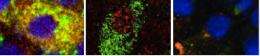
The life cycle of transcription factor FoxO1 closely mirrors the state of health of the pancreatic beta cell. In a healthy cell, FoxO1 (stained red) is inactive and co-localizes with insulin (green) in the cytoplasm, giving rise to yellow color (left panel). In early diabetes, stress caused by elevated blood glucose is counteracted by the movement of FoxO1 to the nucleus, which allows cells to continue to produce insulin (middle panel). But if stress persists, this mechanism fails, in which case FoxO1 is degraded and insulin production ceases, giving rise to dedifferentiated beta cells (right panel). Credit: Image Credit: Chutima Talchai, Ph.D./Columbia University Medical Center
Scientists generally think that reduced insulin production by the pancreas, a hallmark of type 2 diabetes, is due to the death of the organ's beta cells. However, a new study by Columbia University Medical Center (CUMC) researchers shows that beta cells do not die but instead revert to a more fundamental, undifferentiated cell type. The findings suggest that strategies to prevent beta cells from de-differentiating, or to coax them to re-differentiate, might improve glucose balance in patients with type 2 diabetes. The study, conducted in mice was published today in the online edition of the journal Cell.
"The prevailing theory is that the death of beta cells is responsible for the decline in insulin production in type 2 diabetes," said study leader Domenico Accili, MD, professor of Medicine and the Russell Berrie Foundation Professor at CUMC. "But when you look at a diabetic pancreas, you find very few, if any, dead beta cells. So, the organ dysfunction is out of proportion with the number of dead cells. Nobody has had a plausible explanation for this."
Dr. Accili and co-author Chutima Talchai, PhD, suspected that some answers might lie in the activity of FoxO1 protein. FoxO1—a transcription factor, or protein that controls when genes are switched on or off—serves as a kind of gauge of the body's nutritional status. When a cell is well nourished, FoxO1 is inactive and stays in the cell body, or cytoplasm. In the face of a physiologic stress, such as high blood sugar, FoxO1 travels to the nucleus and ultimately disappears. "The starting point of our study was to ask, why does FoxO1 go to the nucleus in the early phases of diabetes, and is the decrease in FoxO1 a cause of diabetes or a consequence?" said Dr. Accili.
To address these questions, Dr. Talchai created a strain of mice whose beta cells lack FoxO1. Initially, the mice appeared normal, but after a physiologic stress, such as pregnancy or aging, the mice developed low levels of insulin and high levels of glucagon (a pancreatic hormone that counters the effects of insulin)—responses also seen in human diabetes.
The researchers then used a novel form of cell-lineage tracing to find out what happened to the beta cells. "To our surprise, we found that the beta cells had not disappeared but had changed into a different cell type. They had sort of walked back from fully committed insulin-making cells to an uncommitted progenitor-like, multipotent development stage," said Dr. Accili. In addition, some of the beta cells became glucagon-producing cells, which would explain why people with diabetes have abnormally high glucagon levels. The same changes in beta cells were observed in other mouse models of diabetes.
"Our findings tell us that FoxO1 is necessary to maintain the identity of beta cells," said Dr. Accili. "During metabolic stress, beta cells gradually lose FoxO1 and begin to de-differentiate, probably as a self-protective mechanism."
The study has important implications for the treatment of type 2 diabetes. "Currently, we give patients medications that force beta cells to work even harder," said Dr. Accili. "But it's like flogging a dying horse. You can push beta cells only so far. Our findings would suggest that treatment should begin by giving beta cells a rest, by administering insulin. Then, we should give an agent that promotes the re-differentiation of beta cells. What that agent could be, we don't know; but we do have some inkling from our work that certain signaling pathways, such as the wnt or notch pathways, could be targeted for this purpose."
More information: The study is titled, "Pancreatic B-Cell Dedifferentiation As Mechanism Of Diabetic B-Cell Failure."
Journal reference:
Cell
Provided by
Columbia University Medical Center
-
A new approach to treating type I diabetes? Gut cells transformed into insulin factories
Mar 11, 2012 |
not rated yet |
0
-
Connexins: Providing protection to cells destroyed in Type 1 diabetes
Nov 07, 2011 |
not rated yet |
0
-
Scientists find a new way insulin-producing cells die
Feb 25, 2011 |
not rated yet |
0
-
Insulin signaling is distorted in pancreases of Type 2 diabetics
Dec 13, 2011 |
not rated yet |
0
-
Researchers discover mechanism that could convert certain cells into insulin-making cells
Apr 29, 2011 |
not rated yet |
0
-
Motion perception revisited: High Phi effect challenges established motion perception assumptions
Apr 23, 2013 |
3 / 5 (2) |
2
-
Anything you can do I can do better: Neuromolecular foundations of the superiority illusion (Update)
Apr 02, 2013 |
4.5 / 5 (11) |
5
-
The visual system as economist: Neural resource allocation in visual adaptation
Mar 30, 2013 |
5 / 5 (2) |
9
-
Separate lives: Neuronal and organismal lifespans decoupled
Mar 27, 2013 |
4.9 / 5 (8) |
0
-
Sizing things up: The evolutionary neurobiology of scale invariance
Feb 28, 2013 |
4.8 / 5 (10) |
14
-
How many joules expended for a push up?
2 hours ago
-
force to keep the folding doors
2 hours ago
-
Confusion regarding direction of kinetic friction on inclined plane.
3 hours ago
-
Mage hand
9 hours ago
-
Sphygmomonometers energy...storage?
11 hours ago
-
How does momentum, inertia and drag affect the motion of an object?
14 hours ago
- More from Physics Forums - Classical Physics
More news stories
Exercise prevents fructose-induced hypertriglyceridemia
(HealthDay)—Moderate aerobic exercise prevents fructose-induced hypertriglyceridemia in healthy males, according to a study published online May 14 in Diabetes.
Diabetes
22 hours ago |
5 / 5 (1) |
0
|
DNA variant affects diabetes risk and treatment response
A DNA variant near a digestive enzyme does not only affect risk of developing diabetes but also affects the response to treatment, an international consortium of researchers including the University of Dundee has found.
Diabetes
May 17, 2013 |
not rated yet |
0
|
The artificial pancreas that keeps tabs on sugar
(Medical Xpress)—Development of a sophisticated artificial pancreas holds potential to transform the lives of patients with Type 1 diabetes.
Diabetes
May 16, 2013 |
5 / 5 (1) |
0
|
Study findings significant for treating infections in Type 1 diabetes
A small University at Buffalo study has found for the first time that in Type 1 diabetics, insulin injections exert a strong anti-inflammatory effect at the cellular and molecular level, while even small amounts of glucose ...
Diabetes
May 16, 2013 |
not rated yet |
0
Hospital hypoglycemia rates up in black men with diabetes
(HealthDay)—Home diabetes regimens partially explain the increased risk of having a hypoglycemia event during hospitalization among older African-American men with diabetes, according to a study published ...
Diabetes
May 14, 2013 |
not rated yet |
0
US psychiatry gets makeover in new manual
The latest makeover to a massive psychiatric tome honored by some, reviled by others and even called the "Bible" of mental disorders is being released Saturday with a host of new changes.
New case of SARS-like virus in Saudi: ministry
A new case of the deadly coronavirus has been detected in Saudi Arabia where 15 people have already died after contracting it, the health ministry announced on Saturday on its Internet website.
New research identifies risks, interventions for children's GI health
An increasing number of U.S. children are experiencing gastrointestinal issues that require interventions to resolve, according to research presented at Digestive Disease Week (DDW).
New colonoscope provides ground-breaking view of colon
A ground-breaking advance in colonoscopy technology signals the future of colorectal care, according to research presented today at Digestive Disease Week(DDW). Additional research focuses on optimizing the minimal withdrawal ...
AIDS science at 30: 'Cure' now part of lexicon
Big names in medicine are set to give an upbeat assessment of the war on AIDS on Tuesday, 30 years after French researchers identified the virus that causes the disease.
For combat veterans suffering from post-traumatic stress disorder, 'fear circuitry' in the brain never rests
Chronic trauma can inflict lasting damage to brain regions associated with fear and anxiety. Previous imaging studies of people with post-traumatic stress disorder, or PTSD, have shown that these brain regions can over-or ...