Study explores how brain disruption may foster schizophrenia

September 26, 2012 in Neuroscience

Study explores how brain disruption may foster schizophrenia

Enlarge

Credit: Shutterstock

(Medical Xpress)—A team led by Yale researchers has used pharmacological neuroimaging and computational modeling to examine large-scale functional organization in the human brain. Their novel approach has yielded important insights about how disruption of a specific molecular signaling mechanism within neural systems may contribute to symptoms of schizophrenia. The results are reported online ahead of print in the Proceedings of the National Academy of Sciences.

Previous studies on this topic have been limited to processes in local circuits; however, cognition involves large-scale with multiple interacting regions. The current study suggests that coordination of these large-scale systems depends on the proper functioning of glutamate – a key .

"While neuroimaging alone has aided our understanding of higher cognitive function, it cannot reveal cellular-level mechanisms in humans. The addition of pharmacology and computational modeling help us start to see a more complete picture," said Alan Anticevic, PhD, associate research scientist in psychiatry at the Yale School of Medicine and lead author of the study. "This deeper understanding could lead to better treatment of such as schizophrenia."

The team found that a balance of excitatory and inhibitory function in the is vital for optimal large-scale network coordination and cognition, and that inhibitory neurons play a crucial role in producing the that may occur in individuals with schizophrenia.
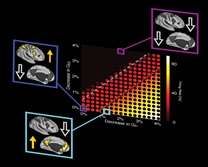
Study explores how brain disruption may foster schizophrenia

Glutamate and computational principles of anti-correlated neural systems. Pictured is a parameter space of a biophysically-realistic computational model of working memory, with hypothesized neural system effects of N-methyl-D-aspartate receptor antagonism.

Additionally, for the first time, the team elucidated the link between drug effects and behavior using a mathematical model that was built from the level of cells. Perturbing the balance of neuronal inhibition inside the model closely matched experimental observations.

Philip Corlett, PhD, assistant professor of psychiatry, and John Krystal, MD, Robert L. McNeil Jr. Professor of Translational Research and chair of psychiatry, share senior authorship. The team's state-of-the-art mathematical models were developed by John Murray, a PhD student in physics at Yale, and Xiao-Jing Wang, PhD, professor of neurobiology, of psychology, and of physics at Yale, both of whom are co-authors of the study.

"These results provide the exciting possibility of understanding psychiatric symptoms at the levels of individual cells, neural systems, and human behavior," said Corlett. Krystal added, "Such translational approaches ultimately offer the promise for rationally-devised treatments for psychiatric conditions."

More information: www.pnas.org/conte… 109.abstract

Journal reference: Proceedings of the National Academy of Sciences search and more info website

Provided by Yale University search and more info website

5 /5 (1 vote)  

Rank 5 /5 (1 vote)
Relevant PhysicsForums posts

More news stories

B vitamins could delay dementia

(Medical Xpress)—Despite spending billions of dollars on research and development, drug companies have been unable to come up with effective treatments for dementia and Alzheimer's Disease (AD). Now, A. ...

Neuroscience created 36 minutes ago | popularity 4.5 / 5 (2) | comments 0 | with audio podcast report

Waiting for a sign? Researchers find potential brain 'switch' for new behavior

You're standing near an airport luggage carousel and your bag emerges on the conveyor belt, prompting you to spring into action. How does your brain make the shift from passively waiting to taking action when ...

Neuroscience created 1 hour ago | popularity not rated yet | comments 0 | with audio podcast

If you can remember it, you can remember it wrong

(Medical Xpress)—Native peoples in regions where cameras are uncommon sometimes react with caution when their picture is taken. The fear that something must have been stolen from them to create the photo ...

Neuroscience created 2 hours ago | popularity 3.5 / 5 (2) | comments 0 | with audio podcast report

Study shows where scene context happens in our brain

In a remote fishing community in Venezuela, a lone fisherman sits on a cliff overlooking the southern Caribbean Sea. This man –– the lookout –– is responsible for directing his comrades on the water, ...

Neuroscience created 4 hours ago | popularity 4 / 5 (1) | comments 0 | with audio podcast

Clouds in the head

Many brain researchers cannot see the forest for the trees. When they use electrodes to record the activity patterns of individual neurons, the patterns often appear chaotic and difficult to interpret.

Neuroscience created 6 hours ago | popularity not rated yet | comments 0


Enrichment therapy effective among children with autism, study finds

Children with autism showed significant improvement after six months of simple sensory exercises at home using everyday items such as scents, spoons and sponges, according to UC Irvine neurobiologists.

Poliovirus vaccine trial shows early promise for recurrent glioblastoma

An attack on glioblastoma brain tumor cells that uses a modified poliovirus is showing encouraging results in an early study to establish the proper dose level, researchers at Duke Cancer Institute report.

'Doctor shopping' by obese patients negatively affects health

Overweight and obese patients are significantly more likely than their normal-weight counterparts to repeatedly switch primary care doctors, a practice that disrupts continuity of care and leads to more emergency room visits, ...

Aggressive behavior linked specifically to secondhand smoke exposure in childhood

Children who are exposed to secondhand smoke in early childhood are more likely to grow up to physically aggressive and antisocial, regardless of whether they were exposed during pregnancy or their parents have a history ...

Insight into the dazzling impact of insulin in cells

Australian scientists have charted the path of insulin action in cells in precise detail like never before. This provides a comprehensive blueprint for understanding what goes wrong in diabetes.

Finding a family for a pair of orphan receptors in the brain

Researchers at Emory University have identified a protein that stimulates a pair of "orphan receptors" found in the brain, solving a long-standing biological puzzle and possibly leading to future treatments for neurological ...