Uncovering the genome's regulatory code
September 10, 2012 in Genetics

Uncovering the genome's regulatory code

Enlarge

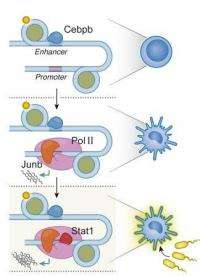
Regulatory factor hierarchy: The highest level (top) determines a cell’s basic identity; the second (middle) shapes its properties; the third (bottom) activates genes according to changing conditions

Since the sequencing of the human genome in 2001, all our genes – around 20,000 in total – have been identified. But much is still unknown – for instance where and when each is active. Next to each gene sits a short DNA segment, and the activity of this regulatory segment determines whether the gene will be turned on, where and how strongly. These short regulatory segments are as – if not more – important than the genes, themselves. Indeed, 90% of the mutations that cause disease occur in these regulatory areas. They are responsible for the proper development of tissues and organs, determining, for instance, that eye cells – and only eye cells – contain light receptors, while only pancreatic cells function to produce insulin. Clearly, a deeper understanding of this regulatory system – its mechanisms and possibilities for malfunction – may lead to advances in biomedical research, especially in developing targeted therapies for individual patients.

In spite of their importance, the "regulatory code" is not well understood. To address this problem, a research team led by Dr. Ido Amit of the Weizmann Institute Immunology Department, together with scientists from the Broad Institute in Massachusetts, including Manuel Garber, Nir Yosef and Aviv Regev, and Nir Friedman of the Hebrew University of Jerusalem, developed an advanced, automated system for mapping these sites, and then used this system to uncover important principles how these regulatory elements function. Among other things, their study, which appeared in Molecular Cell, revealed a for the regulatory code. By mapping a large number of regulatory factors, the team succeeded in revealing an overall plan for as well as the intimate details of the mechanisms involved in the immune response.

"We are seeing a race to map the regulatory code and uncover its ties to disease and human variation that is reminiscent of the race to sequence the ," says Amit. "But until now, participants have faced a serious hurdle: The process used for the past 30 years to map has been complicated, complex and labor-intensive, requiring huge scientific consortiums. With the new method, just a handful of researchers were able to conduct a study on a similar scale to the mega-team ones, and in a fraction of the time."

Their highly efficient, automated method enabled Amit and his team to measure a large number of regulatory proteins and their binding sites in parallel. They exposed immune cells to bacteria – setting the stage for gene activation – and then traced the actions of several dozen different regulatory proteins known to play a role in the immune response over four points in time. Not only were the researchers able to identify the binding locations of each and the genes they activate, but the levels of activation and the mechanisms employed.

One of their more significant findings was that the actions of these regulatory factors can be neatly classified into three levels in a sort of regulatory hierarchy. In the bottom tier are those factors that create the rough divisions into main cell types by directing cell differentiation. These factors are the "basic identity" guides that can, on their own, determine whether a cell will have the characteristics of a muscle cell, a nerve cell, etc. On the second tier are the regulatory factors that determine a cell's sub-identity, which they do by controlling the strength of a gene's expression. These factors are in charge of producing closely-related sub-types, for instance, muscle fibers that are either smooth or striated, or closely-related immune cells. Regulatory factors in the third tier are even more specialized: They only affect the expression of certain genes that are called into action in response to signals from outside the cell: bacterial invaders, hormones, hunger pangs, etc.

The hope is that understanding the ins and outs of the regulatory code will help researchers to understand and predict how diseases arise and progress due to malfunctions in regulatory mechanisms. In the future, understanding the regulatory program may lead to advances in rehabilitative medicine. Regulatory mechanisms could be used to redirect the differentiation of a patient's cells, which could then be reimplanted, thus avoiding the problems inherent in using donor cells.

Amit: "The new method for mapping the gene's regulatory plan may open new vistas for investigating all sorts of biological processes, including the system failures that occur in disease."

More information: www.sciencedirect.… 276512006570

Journal reference: Molecular Cell search and more info website

Provided by Weizmann Institute of Science search and more info website

5 /5 (1 vote)  

Filter


Move the slider to adjust rank threshold, so that you can hide some of the comments.


Display comments: newest first

JVK
Sep 10, 2012

Rank: 1 / 5 (1)
"They exposed immune cells to bacteria – setting the stage for gene activation – and then traced the actions of several dozen different regulatory proteins known to play a role in the immune response over four points in time." As I recall, the immune response is like the olfactory response in its ability to distinguish between self and non-self as is required for nutrient acquisition and pheromone-controlled reproduction in species from microbes to man. Why start with microbial activation of gene expression in immune cells when the actual starting point for cellular differentiation occurs with exposure to nutrient chemicals that induce changes in intracellular signaling and stochastic gene expression required for nutrient chemical dependent individual survival and pheromone controlled reproduction?

Rank 5 /5 (1 vote)
Relevant PhysicsForums posts

More news stories

Researchers identify new circadian clock component

Northwestern University scientists have shown a gene involved in neurodegenerative disease also plays a critical role in the proper function of the circadian clock.

Genetics created May 16, 2013 | popularity 3 / 5 (1) | comments 0 | with audio podcast

Returning genetic incidental findings without patient consent violates basic rights, experts say

Informed consent is the backbone of patient care. Genetic testing has long required patient consent and patients have had a "right not to know" the results. However, as 21st century medicine now begins to use the tools of ...

Genetics created May 16, 2013 | popularity 5 / 5 (1) | comments 3 | with audio podcast

Ethicists provide framework supporting new recommendations on reporting incidental findings in gene sequencing

In a paper published in Science Express, a group of experts led by bioethicists in the Center for Medical Ethics and Health Policy at Baylor College of Medicine provide a framework for the new American College of Medical Geneti ...

Genetics created May 16, 2013 | popularity not rated yet | comments 0

Experts urge caution over use of new genetic sequencing techniques

The use of genome-wide analysis (GWA), where the entirety of an individual's DNA is examined to look for the genomic mutations or variants which can cause health problems is a massively useful technology for diagnosing disease. ...

Genetics created May 16, 2013 | popularity not rated yet | comments 0

Collecting DNA for human rights: How to help while safeguarding privacy

DNA databases might help identify victims of crime and human trafficking, but how do we safeguard the personal privacy of innocent victims and family members? A new report online May 15 in the Cell Press journal Trends in ...

Genetics created May 15, 2013 | popularity not rated yet | comments 0


Researchers identify a potential new risk for sleep apnea: Asthma

Researchers at the University of Wisconsin have identified a potential new risk factor for obstructive sleep apnea: asthma. Using data from the National Institutes of Health (Heart, Lung, and Blood Institute)-funded Wisconsin ...

Computational tool translates complex data into simplified 2-dimensional images

In their quest to learn more about the variability of cells between and within tissues, biomedical scientists have devised tools capable of simultaneously measuring dozens of characteristics of individual ...

New theory on genesis of osteoarthritis comes with successful therapy in mice

Scientists at Johns Hopkins have turned their view of osteoarthritis (OA) inside out. Literally. Instead of seeing the painful degenerative disease as a problem primarily of the cartilage that cushions joints, ...

Study finds that sleep apnea and Alzheimer's are linked

A new study looking at sleep-disordered breathing (SDB) and markers for Alzheimer's disease (AD) risk in cerebrospinal fluid (CSF) and neuroimaging adds to the growing body of research linking the two.

'Gap' for HIV vaccine efforts after latest setback

The hunt for an HIV vaccine has gobbled up $8 billion in the past decade, and the failure of the most recent efficacy trial has delivered yet another setback to 26 years of efforts.

Ginger compounds may be effective in treating asthma symptoms

Gourmands and foodies everywhere have long recognized ginger as a great way to add a little peppery zing to both sweet and savory dishes; now, a study from researchers at Columbia University shows purified components of the ...