Wnt5a protein critical to gut lining repair
September 6, 2012 in Medical research

Protein critical to gut lining repair

Enlarge

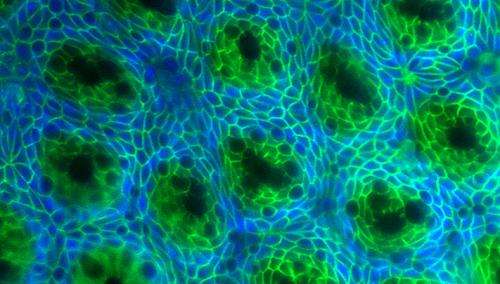
Scientists have identified a protein that is critical to repairing glands in the intestine’s inner lining. The glands appear as dark green spots above and are rebuilt every two to four weeks as the inner lining of the gut is continually renewed. Credit: Hiroyuki Miyoshi

Scientists at Washington University School of Medicine in St. Louis have identified a protein essential to repairing the intestine's inner lining.

That lining is among the body's busiest highways, trod not only by the food we ingest but also by trillions of that aid digestion. Because the plays key roles in absorbing nutrients and containing the , any damage must be fixed promptly.

The researchers report Sept. 6 in that a protein called Wnt5a is essential for reconstructing in the intestinal lining. The glands, called crypts of Lieberkühn, contain that continually pump out other cells that renew the gut lining, which is replaced every two to four weeks. The crypts look like dimples in the gut lining and are vulnerable to damage and loss from infection and inflammation.

"For example, can destroy huge stretches of the lining, including the crypts," says senior author Thaddeus Stappenbeck, MD, PhD, associate professor of pathology and . "If crypts can't be repaired as the lining is rebuilt, their absence would place substantial stresses on crypts in healthy portions of the gut. So it's important to better understand how the crypts are replaced."

In the new study, Stappenbeck and his colleagues showed that when crypts are lost to injury in mice, the nearest surviving crypts expand into the damaged area and create an array of channels. These wound channels, which contain rapidly dividing stem cells, eventually subdivide into new crypts.

Stappenbeck found that cells that line the outer wall of the gut migrate to sites of damage within the inner lining to provide Wnt5a, a signaling molecule that stops stem cells from dividing. This shutdown triggers the formation of dimples in the wound channels that become new crypts.

Because mice that lack the Wnt5a gene aren't viable, co-author Terry Yamaguchi, PhD, of the , bred mice in which scientists could selectively turn off the gene after the mice became adults. When the gut lining was injured and Wnt5a was disabled, the wound channels formed but failed to divide into crypts.

To further confirm the link between the gene and crypt repair, Hiroyuki Miyoshi, PhD, a postdoctoral fellow in Stappenbeck's laboratory, devised a robust method for growing gut stem cells in test tubes. When he applied Wnt5a to the stem cells, they stopped dividing, proving that the protein was the critical ingredient for initiating crypt formation.

The scientists also showed that Wnt5a activated a signaling pathway in the stem cells that is known to stop cell proliferation. Stappenbeck, who also is an associate professor of developmental biology, is now planning additional studies of Wnt5a, including investigations of whether the protein plays similar roles elsewhere in the body.

"We're also very curious about what causes the outer lining of the gut to send cells that make Wnt5a into the inner lining of the gut, because that's not something we've seen previously," he says. "Our best theory so far is that when this happens, the body may be reactivating a pathway it uses to construct the gut early in development."

More information: Miyoshi H, Ajima R, Luo C T-Y, Yamaguchi TP, Stappenbeck TS. Wnt5a potentiates TGF-beta signaling to promote colonic crypt regeneration after tissue injury. Science Express, Sept. 6, 2012.

Journal reference: Science Express search and more info website

Provided by Washington University School of Medicine search and more info website

4 /5 (3 votes)  

Rank 4 /5 (3 votes)
Relevant PhysicsForums posts

More news stories

Baby's life saved with groundbreaking 3-D printed device that restored his breathing

Every day, their baby stopped breathing, his collapsed bronchus blocking the crucial flow of air to his lungs. April and Bryan Gionfriddo watched helplessly, just praying that somehow the dire predictions ...

Medical research created 8 hours ago | popularity 5 / 5 (1) | comments 0

Research shows how immune system peacefully co-exists with 'good' bacteria

The human gut is loaded with commensal bacteria – "good" microbes that, among other functions, help the body digest food. The gastrointestinal tract contains literally trillions of such cells, and yet the ...

Medical research created 12 hours ago | popularity 5 / 5 (3) | comments 0 | with audio podcast

Slowing the aging process—only with antibiotics

Swiss scientists reveal the mechanism responsible for aging hidden deep within mitochondria—and dramatically slow it down in worms by administering antibiotics to the young.

Medical research created 12 hours ago | popularity 4.9 / 5 (7) | comments 0 | with audio podcast

How healthy are you for your age?

On May 22, JoVE will publish details of a technique to measure the health of human genetic material in relation to a patient's age. The method is demonstrated by the laboratory of Dr. Gil Atzmon at New York's Albert Einste ...

Medical research created 15 hours ago | popularity not rated yet | comments 0

A molecular explanation for age-related fertility decline in women

(Medical Xpress)—Scientists supported by the National Institutes of Health have a new theory as to why a woman's fertility declines after her mid-30s. They also suggest an approach that might help slow ...

Medical research created 17 hours ago | popularity not rated yet | comments 0 | with audio podcast


Rate of bicycle-related fatalities significantly lower in states with helmet laws

Existing research shows that bicyclists who wear helmets have an 88 percent lower risk of brain injury, but researchers at Boston Children's Hospital found that simply having bicycle helmet laws in place showed a 20 percent ...

Researchers complete largest genetic sequencing study of human disease

Researchers from Queen Mary, University of London have led the largest sequencing study of human disease to date, investigating the genetic basis of six autoimmune diseases.

Brain can be trained in compassion, study shows

Until now, little was scientifically known about the human potential to cultivate compassion—the emotional state of caring for people who are suffering in a way that motivates altruistic behavior.

Having both migraines, depression may mean smaller brain

(HealthDay)—Migraines and depression can each cause a great deal of suffering, but new research indicates the combination of the two may be linked to something else entirely—a smaller brain.

Novel approach for influenza vaccination shows promise in early animal testing

A new approach for immunizing against influenza elicited a more potent immune response and broader protection than the currently licensed seasonal influenza vaccines when tested in mice and ferrets. The vaccine ...

Calorie information in fast food restaurants used by 40 percent of 9-18 year olds when making food choices

A new study published online today (Thursday) in the Journal of Public Health has found that of young people who visited fast food or chain restaurants in the U.S. in 2010, girls and youth who were obese were more likely ...