Biochemists open path to molecular 'chaperone' therapy for metabolic disease
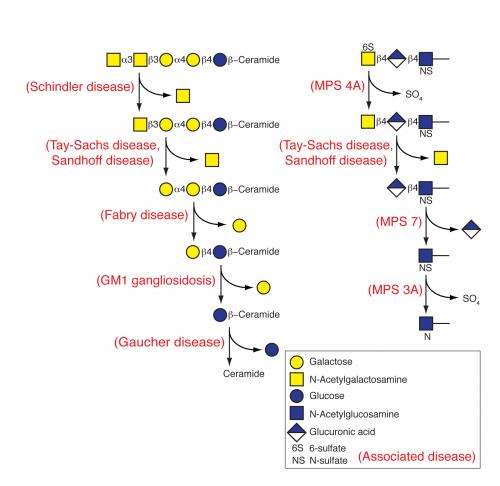
University of Massachusetts Amherst researchers, experts in revealing molecular structure by X-ray crystallography, have identified two new small "chaperone" molecules that may be useful in treating the inherited metabolic disorder known as Schindler/Kanzaki disease. This offers hope for developing the first ever drug treatment for this very rare disease.
Findings are reported in the current issue of Proceedings of the National Academy of Sciences. First author Nathaniel Clark conducted this work for his doctoral degree at UMass Amherst with his advisor, biochemist Scott Garman, plus others at UMass Amherst and at Oxford University, U.K. The work was supported by the NIH's National Institute of Diabetes and Digestive and Kidney Diseases (NIDDK) and the National Institute of General Medical Sciences (NIGMS).
Schindler/Kanzaki is one in a family of more than 50 very rare lysosomal storage diseases that together affect about 7,000 to 8,000 births per year, with no cure at present and few treatment options.
Babies born with it have a faulty copy of a single gene that codes for the alpha-N-acetylgalactosaminidase (alpha-NAGAL) enzyme, one of the cell's "recycling" machines that clean up used, toxic molecules, or substrate. When it works normally, alpha-NAGAL breaks down a sugar-containing substrate in the cell's recycling center, the lysosome. If alpha-NAGAL underperforms or fails, patients have neuromuscular problems such as seizures and muscle weakness. Garman says, "Some substrates are very toxic and children born with these diseases are really, really sick, many only living a short time."
The faulty gene causes its damage by misfolding proteins, yielding an unstable, poorly functioning alpha-NAGAL enzyme. One route to treat the disease is to stabilize alpha-NAGAL by using small molecules as so-called "pharmacological chaperones." The two molecules two Garman and colleagues identified and tested keep the alpha-NAGAL enzyme on track to proper folding.
In their paper, the UMass Amherst researchers show how these chaperones, sugar mimics (iminosugars) DGJ and DGJNAc, stabilize the defective alpha-NAGAL enzyme. Further, Clark, Garman and colleagues for the first time demonstrate by biochemical, crystallographic and cellular experiments exactly how the small molecule binds to the enzyme and provides that stability.
"People had hypothesized that this approach, using DGJNAc to treat Schindler disease, would work," Garman says. "Now we have shown for the first time that it does. These experiments show we can add DGJNAc to cells and increase the amount of the Schindler enzyme. As the culmination of Nat Clark's PhD thesis, it's a great achievement for him. We were the first to discover the enzyme's structure in 2009, and now we've discovered the small molecules that bind and stabilize that enzyme."
Their current paper describes how the biochemists extended their earlier crystallographic studies. They developed assays to measure how the small molecule chaperones bind to alpha-NAGAL and how they affect the enzymatic activity, the stability, and the cellular location of alpha-NAGAL.
The biochemists hope this work, which outlines how the chaperones could be used in treatment, may lead to their approval for compassionate use as an experimental drug. DGJ has already been found safe in humans and is now in Phase III clinical trials for Fabry disease, another lysosomal storage disorder. Thanks to this work it and DGJNAc might be useful in treating patients with Schindler disease.
In earlier studies and the current work, the UMass Amherst research team used their special expertise in X-ray crystallography to create three-dimensional images of all atoms in a protein to understand how it changes shape to carry out its metabolic mission. "We started working on these enzymes because very little was known about their structures," Garman says. "As basic researchers, we think we can make the most impact in just such cases, where few fundamentals are known. All this then provides ammunition to others to take what we find and move it forward. Principles we learn about Schindler disease can be applied to the whole family of lysosomal disorders."


