3-D technology boosts project to aid heart surgery
October 16, 2012 by Rosie Gochnour And Joe Kullman in Cardiology
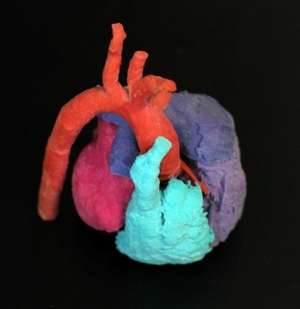
Heart models developed by ASU biomedical engineers show details of various kinds of anatomical defects. Credit: Jessica Slater/ASU
(Medical Xpress)—Efforts to improve preparation for heart surgery are the focus of a collaboration of Arizona State University biomedical engineering researchers and physicians at Phoenix Children's Hospital and St. Joseph's Hospital and Medical Center in Phoenix.
Surgeons at these medical facilities are using three-dimensional physical models of hearts developed by an ASU team led by David Frakes, an assistant professor in the School of Biological and Health Systems Engineering and the School of Electrical, Computer and Energy Engineering, two of ASU's Ira A. Fulton Schools of Engineering.
The heart models are constructed using information acquired from computed tomography (CT) scans and magnetic resonance imaging as a design blueprint.
The custom-made models reveal a wealth of information about a patient's heart condition, providing physicians with a tool to aid surgical planning with the aim of decreasing the likelihood of complications during surgery.
The project has recently been aided by the acquisition of a three-dimensional printer with the support of a $75,000 grant from Phoenix Children's Hospital Leadership Circle awarded to Stephen Pophal, director of the Children's Heart Center for Pediatric Cardiology.
The Leadership Circle is a group of more than 100 community leaders who help raise funding for research initiatives and new technologies for the hospital.
Use of the new printer significantly improves the manner in which a three-dimensional heart structure is communicated to surgeons, giving them a quick, accurate and intuitive understanding of a patient's anatomical condition.
"This knowledge means patients can spend a lot less time in surgery and under anesthesia, which could greatly reduce the risks of these invasive procedures," explains Frakes, who is also working to develop use of the models as educational tools.
Justin Ryan, a biomedical engineering doctoral student on Frakes' research team, describes the three-dimensional printing technique as similar to constructing a building out of bricks. "Many layers of bricks, laid from the ground up, create a building – a full three-dimensional object," he says. "The heart models are essentially printed one brick at a time in layers, until the model is whole."
The new printer at Phoenix Children's Hospital produces three-dimensional heart models by first printing extremely thin two-dimensional slices, which are then bound together by an adhesive and sprayed with ink to give the model various colors that denote specific anatomical features. An average heart model printout consists of around 600 bound layers, each only about one-tenth of a millimeter thick.
Provided by
Arizona State University
-
ASU bioengineers will expand work to solve cardiovascular health challenges
Jun 28, 2011 |
not rated yet |
0
-
3-D printing technology from CT images may be used effectively for neurosurgical planning
Apr 29, 2011 |
not rated yet |
0
-
First study of heart 'maps' for kids could help correct rapid rhythms
Jul 23, 2012 |
not rated yet |
0
-
Virtual surgery shows promise in personalized treatment of nasal obstruction
Apr 18, 2011 |
not rated yet |
0
-
Grant to fund 'pioneering' brain-computer interface technology
Oct 13, 2010 |
not rated yet |
0
-
Motion perception revisited: High Phi effect challenges established motion perception assumptions
Apr 23, 2013 |
3 / 5 (2) |
2
-
Anything you can do I can do better: Neuromolecular foundations of the superiority illusion (Update)
Apr 02, 2013 |
4.5 / 5 (11) |
5
-
The visual system as economist: Neural resource allocation in visual adaptation
Mar 30, 2013 |
5 / 5 (2) |
9
-
Separate lives: Neuronal and organismal lifespans decoupled
Mar 27, 2013 |
4.9 / 5 (8) |
0
-
Sizing things up: The evolutionary neurobiology of scale invariance
Feb 28, 2013 |
4.8 / 5 (10) |
14
-
what is the distance traveled
4 hours ago
-
Image of a Convex Lens Cut in Half Horizontally
7 hours ago
-
Ray tracing throught optical system of thick lenses
8 hours ago
-
Faraday's law on circular wire
8 hours ago
-
Specific Exergy vs Specific Flow Exergy
10 hours ago
-
The Durability of Bone: Long Falls
18 hours ago
- More from Physics Forums - Classical Physics
More news stories
Costs to treat stroke in America may double by 2030
Costs to treat stroke are projected to more than double and the number of people having strokes may increase 20 percent by 2030, according to the American Heart Association/American Stroke Association.
Cardiology
4 hours ago |
not rated yet |
0
New blood-thinner measures may cut medication errors
Blood thinners are the preferred treatment option to prevent heart attacks, blood clots and stroke, but they are not without risk, and not just because of their side effects. These high-risk drugs, known as anticoagulants, ...
Cardiology
7 hours ago |
not rated yet |
0
Registry questions superiority of bivalirudin over heparin
Results from a large observational study reported at EuroPCR 2013 today question whether bivalirudin is superior to heparin in the absence of GPIIb/IIIa blockade, showing similar 30-day mortality in patients with non-ST segment ...
Cardiology
7 hours ago |
not rated yet |
0
Study shows low rate of late lumen loss with bioresorbable DESolve device
The DESolve bioresorbable coronary scaffold system achieves good efficacy and safety with low rates of late lumen loss and major coronary adverse events at six months, show first results from the pivotal DESolve Nx trial ...
Cardiology
7 hours ago |
not rated yet |
0
Biodegradable stent proves non-inferior to drug-eluting stent
The Orsiro stent, which is a novel stent platform eluting sirolimus from a biodegradable polymer, demonstrated non-inferiority to the Xience Prime everolimus-eluting stent for the primary angiographic endpoint of in-stent ...
Cardiology
23 hours ago |
5 / 5 (1) |
0
Having both migraines, depression may mean smaller brain
(HealthDay)—Migraines and depression can each cause a great deal of suffering, but new research indicates the combination of the two may be linked to something else entirely—a smaller brain.
Novel approach for influenza vaccination shows promise in early animal testing
A new approach for immunizing against influenza elicited a more potent immune response and broader protection than the currently licensed seasonal influenza vaccines when tested in mice and ferrets. The vaccine ...
Brain can be trained in compassion, study shows
Until now, little was scientifically known about the human potential to cultivate compassion—the emotional state of caring for people who are suffering in a way that motivates altruistic behavior.
SARS-like virus claims new life in Saudi
A man who had contracted the coronavirus has died in Saudi Arabia, raising the death toll in the kingdom from the SARS-like virus to 17, the health ministry announced on its website on Wednesday.
Glaxo, US partnering to develop new antibiotics
GlaxoSmithKline PLC says it's starting an unusual collaboration with the U.S. government to develop several antibiotics for both bioterrorism threats and bacterial infections resistant to current medicines.
Good marriage can buffer effects of dad's depression on young children
What effect does a father's depression have on his young son or daughter? When fathers report a high level of emotional intimacy in their marriage, their children benefit, said a University of Illinois study.